


Framed or unframed, desk size to sofa size, printed by us in Arizona and Alabama since 2007. Explore now.
Shorpy is funded by you. Patreon contributors get an ad-free experience.
Learn more.




- Texas Flyer wanted
- Just a Year Too Soon
- WWII -- Replacing men with women at the railroad crossing.
- Yes, Icing
- You kids drive me nuts!
- NOT An Easy Job
- I wonder
- Just add window boxes
- Icing Platform?
- Indiana Harbor Belt abides
- Freezing haze
- Corrections (for those who care)
- C&NW at Nelson
- Fallen Flags
- A dangerous job made worse
- Water Stop
- Passenger trains have right of way over freights?
- Coal
- Never ceases to amaze me.
- Still chuggin' (in model form)
- Great shot
- Westerly Breeze
- For the men, a trapeze
- Tickled
- Sense of loneliness ...
- 2 cents
- Charm City
- What an Outrage
- Brighton Park
- Catenary Supports

Photos submitted by Shorpy members!
Print Emporium







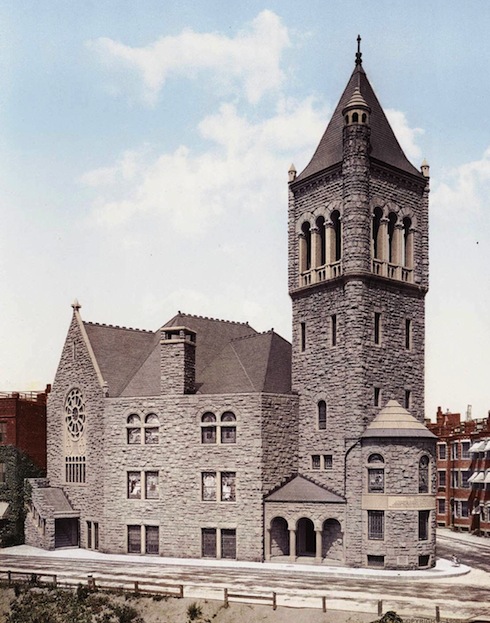
The Mother Church: 1907
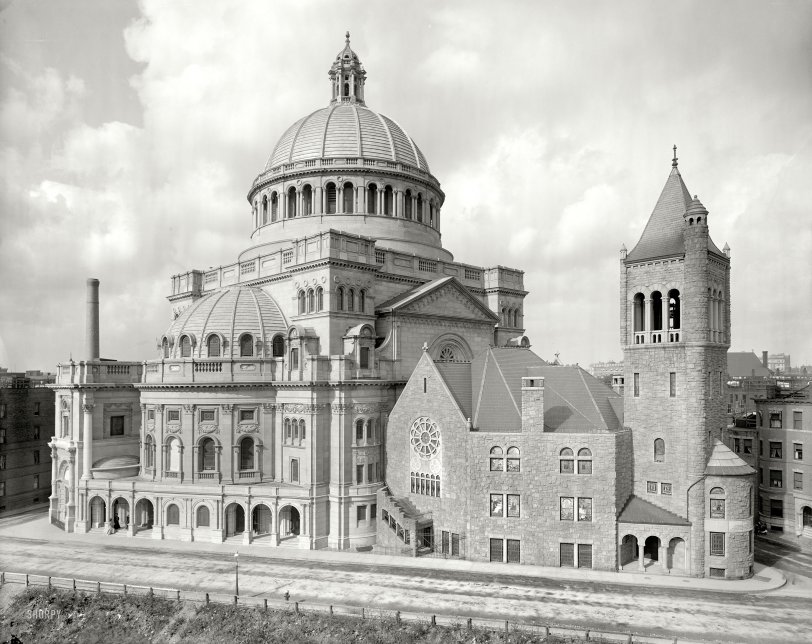
Boston, Massachusetts, circa 1907. "First Church of Christ, Scientist." 8x10 inch dry plate glass negative, Detroit Publishing Company. View full size.
Prior to expansion
This photo seems to show that the church was once surrounded by other structures. It now sits within a "complex", complete with a large reflecting pool. There is a highrise building set to go up on some of the property that will no doubt affect the aesthetics of the area.
I know someone who worked at the complex for many years, though I only got to visit once myself. I'm told at least part of the complex rests on wood pilings, as the Back Bay was once ... a bay! These pilings are susceptible to rot if not kept wet.
Also, the Christian Science Monitor was once produced here.
Another fact that makes me squeamish: the parking garage is underneath the large reflecting pool. I have a hard enough time parking under a multi-story building, and I am not sure if being under all that water is any less unsettling!

Memories
I used to live down the street from the Mother Church. One of my favorite places to hang-out in the summer was in the modern courtyard, by the fountains.
Architectural Styles
The newer part of the church, on the left, is designed in the Beaux-Arts Classical style - the most popular style of the turn of the century - but not very well. It has some stray elements of the Romanesque (a medieval style), such as the wheel window toward the right (partly hidden by the older church) and the corbel tables on the triangular pediment above it. The older church, on the right, is Richardsonian Romanesque (and rather better at that - after all, Boston was the birthplace of the Richardsonian Romanesque).
Mother Church
The building on the right is known as the Original Mother Church, built in 1894. The one on the left is the Mother Church Extension, built in 1906. More on this, including architectural styles, here:
http://www.sacred-destinations.com/usa/boston-christian-science-mother-c...
Amalgamation
Is this Byzantine-Gothic, or what?
An odd conflation of styles.
Pure Constantinople to the left. A mixture of Romanesque and Highland Romantic to the right. I had to investigate further, and according to Google Images they have since added a large pool bordered by a building which looks to be inspired by Le Corbusier's béton brut style. An interesting example of elements of architectural history in a small space.
The faux stairway commented on below seems to now serve as an essential element in the control of the runoff water which goes between the two buildings, at least judging by the the water pipe which drains onto the slope. Good thing too, large amounts of runoff water in the smell space between the two buildings could cause lots of problems, especially in freeze/thaw cycles.
You should see the inside
The inside is all stone and dark wood, built to fit the shape of the lot. Totally asymmetrical where most churches have symmetrical wings of pews, this one has numerous wings of pews each of a different size, shape and angle to the altar. Yet most beautiful.
A block or so behind the church is a sports bar that serves "out of this world" clam chowder, oops off subject.
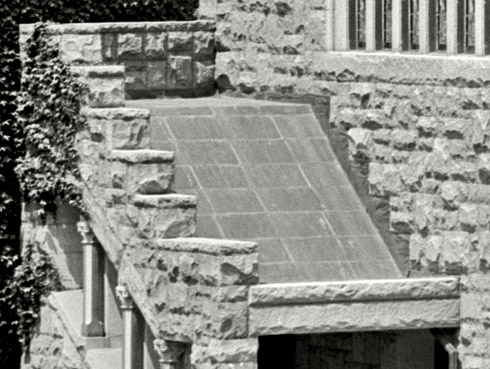
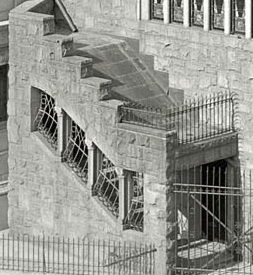
Faux Stairs
>> I can understand the lower set of stairs, but what's with what appears to be a set of stairs above that go nowhere, on the smaller Church.
I think if you look closely, you will see that it's the stones behind the top set you point to that make it look like a staircase. The pieces closest to that wall and the dark stones run straight down what is the roof for the lower staircase.
The Original
Here's a shot of the smaller church before they built the big mother next door.
Religious Evolution
Like church structures I get involved with (I'm a fire alarm guy), this building looks as if it evolved over time: it was not designed as it stands as a single structure. I'm guessing that the smaller face we see (rose window on left, bell tower on right)is the original house of worship. Can anyone tell me if I'm right?
Stairway
I can understand the lower set of stairs, but what's with what appears to be a set of stairs above that go nowhere, on the smaller Church. And, do you enter the larger Church through the smaller one? Interesting overall design for the larger Church, seems to read quite well from outside.
Thanks for clearing up my staircase question. Sort of an optical illusion, the horizontal lines of the roofing material and the stepped flashing at the wall.
Escher-esque!
 Shorpy.com is a vintage photography site featuring thousands of high-definition images. The site is named after Shorpy Higginbotham, a teenage coal miner who lived 100 years ago. Contact us | Privacy policy | Accessibility Statement | Site © 2024 Shorpy Inc.
On Shorpy:
Today’s Top 5