



Framed or unframed, desk size to sofa size, printed by us in Arizona and Alabama since 2007. Explore now.
Shorpy is funded by you. Patreon contributors get an ad-free experience.
Learn more.




- Lost in Toyland
- And without gloves
- If I were a blindfolded time traveler
- Smoke Consumer Also Cooks
- Oh that stove!
- Possibly still there?
- What?!?
- $100 Reward
- Freeze Frame
- Texas Flyer wanted
- Just a Year Too Soon
- WWII -- Replacing men with women at the railroad crossing.
- Yes, Icing
- You kids drive me nuts!
- NOT An Easy Job
- I wonder
- Just add window boxes
- Icing Platform?
- Indiana Harbor Belt abides
- Freezing haze
- Corrections (for those who care)
- C&NW at Nelson
- Fallen Flags
- A dangerous job made worse
- Water Stop
- Passenger trains have right of way over freights?
- Coal
- Never ceases to amaze me.
- Still chuggin' (in model form)
- Great shot

Photos submitted by Shorpy members!
Print Emporium





The Nixon: 1908
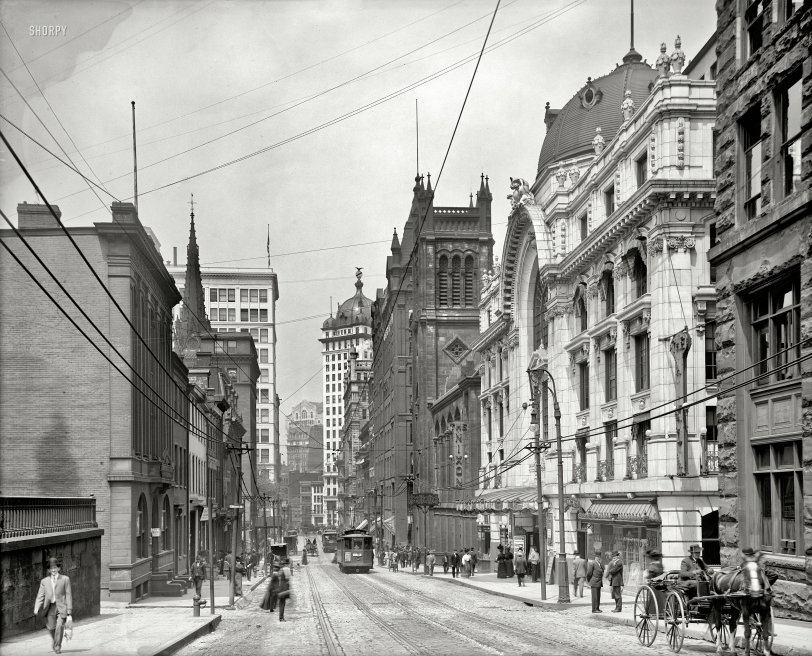
Pittsburgh, Pennsylvania, circa 1908. "Nixon Theatre, Sixth Avenue & Cherry Alley." 8x10 inch glass negative, Detroit Publishing Company. View full size.
Digital Display
Good observation, jdowling. I have no idea what it was used for, but a digital number display is exactly what it is. The seemingly random arrangement of the "pixels" is so that the digits are nicely formed. I can just barely remember the change (in the Fifties) of the scoreboard at the high-school football stadium from one like that to the newer "7-segment" concept.
The originals, like the one here, were an electric nightmare (calling them "electronic" was decades in the future) requiring incredible amounts of wiring, switches, and relays, and broke down very often. Perhaps that's why this one isn't lit.
[We've since learned it's a carriage call. - tterrace]

Digital Street Clock?
Under the Nixon sign and at the street curb, on the pole. It appears to be a three character dot matrix display.
This is the second such display I've seen in a Shorpy photo. I've Googled several phrases but can't find anything like it. Anybody?
Torn down in 1950
The Nixon stood till 1950 when it was torn down to make room for the (ugly) former Alcoa HQ.
Sam, Fred, Sam
The Nixon-Nirdlinger family owned and ran the Nixon Theatre. Sam Nixon passed away in 1918, and the business passed to his son Fred. Fred had a remarkable ability to keep wedding cake companies in business - marrying five different women, the fifth one twice. Fifth wife Charlotte Nixon-Nirdlinger shot and killed Fred on the French Riviera in 1931, and was eventually acquitted on the grounds of self-defense. In 1931, Sam's grandson Sam took over the theatre. It was demolished in 1950, for a new Alcoa building.
+108
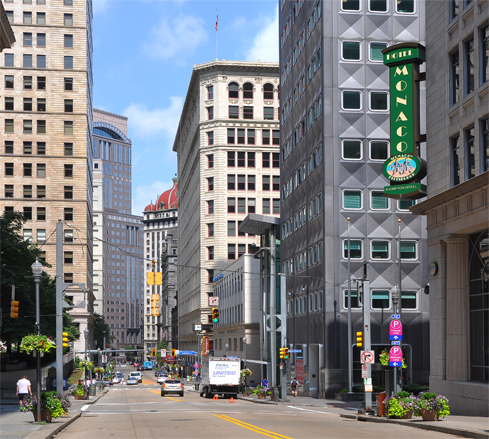
Below is the same view from July of 2016.
 Shorpy.com is a vintage photography site featuring thousands of high-definition images. The site is named after Shorpy Higginbotham, a teenage coal miner who lived 100 years ago. Contact us | Privacy policy | Accessibility Statement | Site © 2024 Shorpy Inc.
On Shorpy:
Today’s Top 5