



Framed or unframed, desk size to sofa size, printed by us in Arizona and Alabama since 2007. Explore now.
Shorpy is funded by you. Patreon contributors get an ad-free experience.
Learn more.



- Baldwin 62303
- Baldwin VO-1000
- Cold
- No expense spared
- Tough Guys
- Lost in Toyland
- And without gloves
- If I were a blindfolded time traveler
- Smoke Consumer Also Cooks
- Oh that stove!
- Possibly still there?
- What?!?
- $100 Reward
- Freeze Frame
- Texas Flyer wanted
- Just a Year Too Soon
- WWII -- Replacing men with women at the railroad crossing.
- Yes, Icing
- You kids drive me nuts!
- NOT An Easy Job
- I wonder
- Just add window boxes
- Icing Platform?
- Indiana Harbor Belt abides
- Freezing haze
- Corrections (for those who care)
- C&NW at Nelson
- Fallen Flags
- A dangerous job made worse
- Water Stop

Photos submitted by Shorpy members!
Print Emporium




Dark Passage: 1942
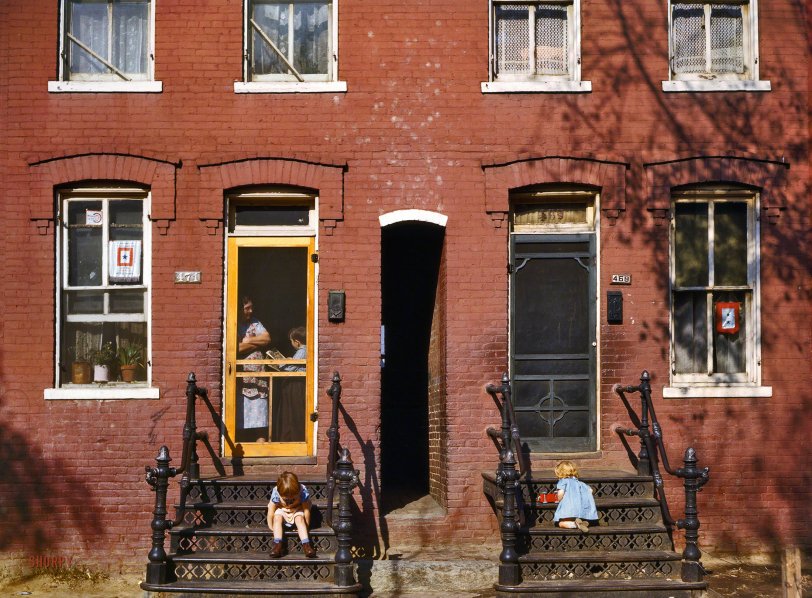
Washington, D.C., 1942. "Children on rowhouse steps, corner of N and Union Streets S.W." Note service stars in the windows and the curious narrow passage between houses. Kodachrome transparency by Louise Rosskam. View full size.
Google No More
Don't try to find Union St in DC! Union Street was replaced by apartment buildings...

Alleyways
I live in Philadelphia, and when I was a kid (60s and 70s), we always used the alleyways as a shortcut between streets. No need to walk all the way around the corner to get to the next street, just cut through the alley. I used to know all the alleys in my neighborhood, we played in them. Back then, we always kept the alleys clean.
Now all the alleyway entrances have steel gates and locks on them, to prevent burglars and other bad guys from accessing the back of the houses. And a many are filled with trash and rubbish.
Life really was different, Back in the Day.
Tall enough for a man on horseback
These tall narrow passageways can also been seen in the Soulard Historic District near downtown St. Louis. I was told in the early 1970s that the tall narrow passageways were built to permit a person to ride their horse out into the street from the stable behind the row house.
[Back when horses were 18 inches wide. - Dave]
War Bond Quota
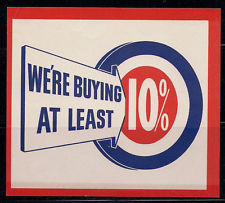
Patriotic family whose window sticker says they're setting aside 10 percent of income for the purchase of War Bonds and stamps.
Alley racing
Wow, did this bring back memories from about 65 years ago (Yes, I'm a geezer). My family used to visit my Granny and Grandpop in Wilmington, Delaware, where the street kids befriended me (I being the youngest). We used to run through those "alleyways," as the kids called them, then flying down other back alleys all day.
One day while out alone (either no one watched their kids then or my parents hoped I would get lost), I went into the "cellar" of an abandoned house and found a bag of iron WWI soldiers and a reel of film. After I dragged them home, my grandfather pulled out his projector to play the film. It was a home movie of sailors throwing their hats in the air at an Annapolis graduation from way back. Who knows what famous future Admiral was in there.
Film finished, my grandmother handed the reel and the bag of soldiers to me, saying; "OK, now take them back to where you found them, they don't belong to us."
"But Granny -- "
"But nothing, march!"
Ghost Alleys
Our neighborhood is an historic district just north of Washington, D.C. My house was built in 1926.
There's what once was an alleyway behind our house, and the houses with fences don't encroach upon it. I've never seen a vehicle try to drive down it, but that might be possible.
In our case, as with most of the other homes without a back fence, it's just treated as an extension of the back yard. We mow half and my neighbor in back mows the other half.
In D.C., many of the old alleyways still exist and some of the carriage houses have been converted into trendy living spaces or bars.
Convenient to shopping!
These row houses must have been right across the street from Shulman's Market, also at the corner of N & Union, as shown here: https://www.shorpy.com/node/117
Comics Action
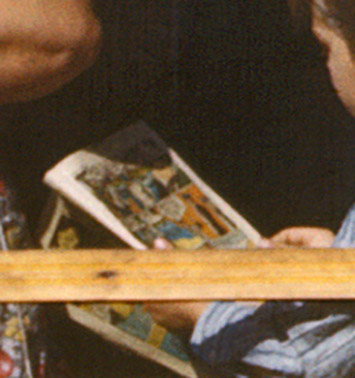
The kid in the doorway showing his gran a comic book, possibly reading a Superman No. 1!
Blast from the past
My dad grew up in a row house at 3019 N. Franklin Street in Philadelphia. As a kid I remember visiting Grandma and venturing out her back door into her small garden area, then along the common footpath and out the alleyway to the street. I remember from childhood that whenever I read a story that featured someone walking down an alleyway, I pictured the dark, narrow passage I wandered through as a child. I have not thought of these experiences in about 45 years. Your photo caused a tremor in the cobwebs of my mind. Thanks so much!
Stop!
How many times do I have to tell your kids? Don't throw that ball against the wall above the door.
White Dots
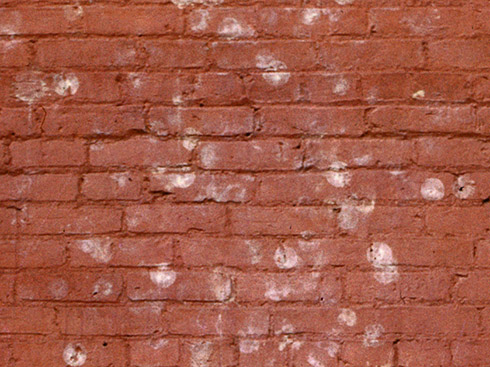
I suspect the white dots above the passageway may have been caused by throwing a rubber ball against the bricks. Having done that many times as a child, it is generally safest to do that where there are no windows! No Mom, it wasn't me!
Cast Iron stoop.
The "Passageway" between houses
Served many functions to include trash removal, garbage removal but the primary function was a fire alley.
Philadelphia row homes had an alley that ran behind houses and served two streets for the same purpose. Without access to the rear of the houses fireman could not effectively fight an ongoing fire.
Apparently the DC homes did not have a common alley therefore one was incorporated in construction to serve two adjoining houses.
Passageways
The rowhouses in SW Washington DC had alleys for the removal of trash and still do. These houses for the most part are still standing today in 2007. The passsages were just for access to the back garden from the front, nothing more.
Not odd & even.
Look again - the numbers are 469 and 471 .
Address numbers
Street addresses, and how they are done are set by local law + the post office. Each house on my street skips 10 or so numbers. I suspect they were allowing for future streets and subdivisions.
My own lot is 910 feet deep by 150 wide and could hold 12 lots of 110x75 aiming side-wise on my lot plus room for the street on the side.
Some of these stub end street-subdivisions were done.
I hate those "lattitude, longitude" areas which specify locations by the relation to some central spot. Many Northwest townships in In, OH, and IL are done this way.
Addresses on Row Houses
I am curious as to why the addresses are both "odd" and "even" on the same side of the street. Today the odds are on one side and the evens on the other.
Excellent comment!
Thank you for that truly informative and interesting comment! Everyone be sure to read "passageways" below.
Passageways
I was raised in a row house in Jamaca, Queens, Long Island in the early 40's, I'm 68 now. The houses were side by side as shown and back to back. If you were lucky each house had a little garden. If you were REALLY lucky, you had an alleyway running the length of the block between the gardens. Usually just wide enough for a one-horse cart or small truck to pick up garbage and coal ash (that's how most everybody heated, unless you were lucky enough to have gas). The garbage and coal ash always came out the basement door in the back of the house (note that there are none in the front of the houses -- we had our pride). So if you didn't have an alleyway, you had to get the garbage and coal ash to the front for pickup. And when they couldn't deliver coal directly to the basement by truck through a window, they had to bag it (100-pounders) and carry it back. I learned several new words from the carriers in several different languages. Got slapped with a wet dishrag (and that HURTS) every time I used one in the presence of my Mother.
The back door!
There were indeed back doors to these rowhouses. However, you couldn't get to the street from the back yard unless you went through the house so they would put in these passageways so that the back yards would have access to the streets without having to go through someones house. Most of the backyard gardens (as they used to call them) had a gate which opened onto a common path which led to the passageway. Not a lot of privacy in the back from your immediate neighbors.
CURIOUS PASSAGEWAY BETWEEN HOUSES
The back door hadn't been invented yet!
Curious Passageway between houses
That was the only access from the street side to the rear of the rowhouses because the rowhouse probably took up most of the block.
Free Service Stars
Here is an image of the form that ran in newspapers in 1942 for ordering free Service Stars. Blue stars indicate service within the boundaries of the United States. A silver star denotes service overseas and a gold star denotes a death while in service.
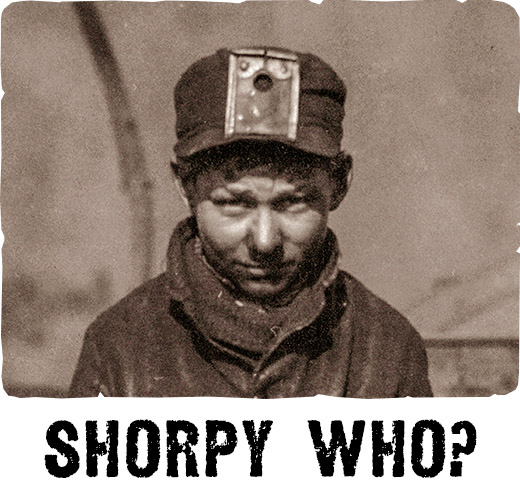
 Shorpy.com is a vintage photography site featuring thousands of high-definition images. The site is named after Shorpy Higginbotham, a teenage coal miner who lived 100 years ago. Contact us | Privacy policy | Accessibility Statement | Site © 2024 Shorpy Inc.
On Shorpy:
Today’s Top 5