


Framed or unframed, desk size to sofa size, printed by us in Arizona and Alabama since 2007. Explore now.
Shorpy is funded by you. Patreon contributors get an ad-free experience.
Learn more.



- Baldwin 62303
- Baldwin VO-1000
- Cold
- No expense spared
- Tough Guys
- Lost in Toyland
- And without gloves
- If I were a blindfolded time traveler
- Smoke Consumer Also Cooks
- Oh that stove!
- Possibly still there?
- What?!?
- $100 Reward
- Freeze Frame
- Texas Flyer wanted
- Just a Year Too Soon
- WWII -- Replacing men with women at the railroad crossing.
- Yes, Icing
- You kids drive me nuts!
- NOT An Easy Job
- I wonder
- Just add window boxes
- Icing Platform?
- Indiana Harbor Belt abides
- Freezing haze
- Corrections (for those who care)
- C&NW at Nelson
- Fallen Flags
- A dangerous job made worse
- Water Stop

Photos submitted by Shorpy members!
Print Emporium
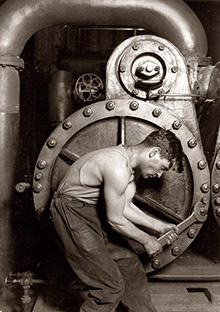



Powerhouse: 1921
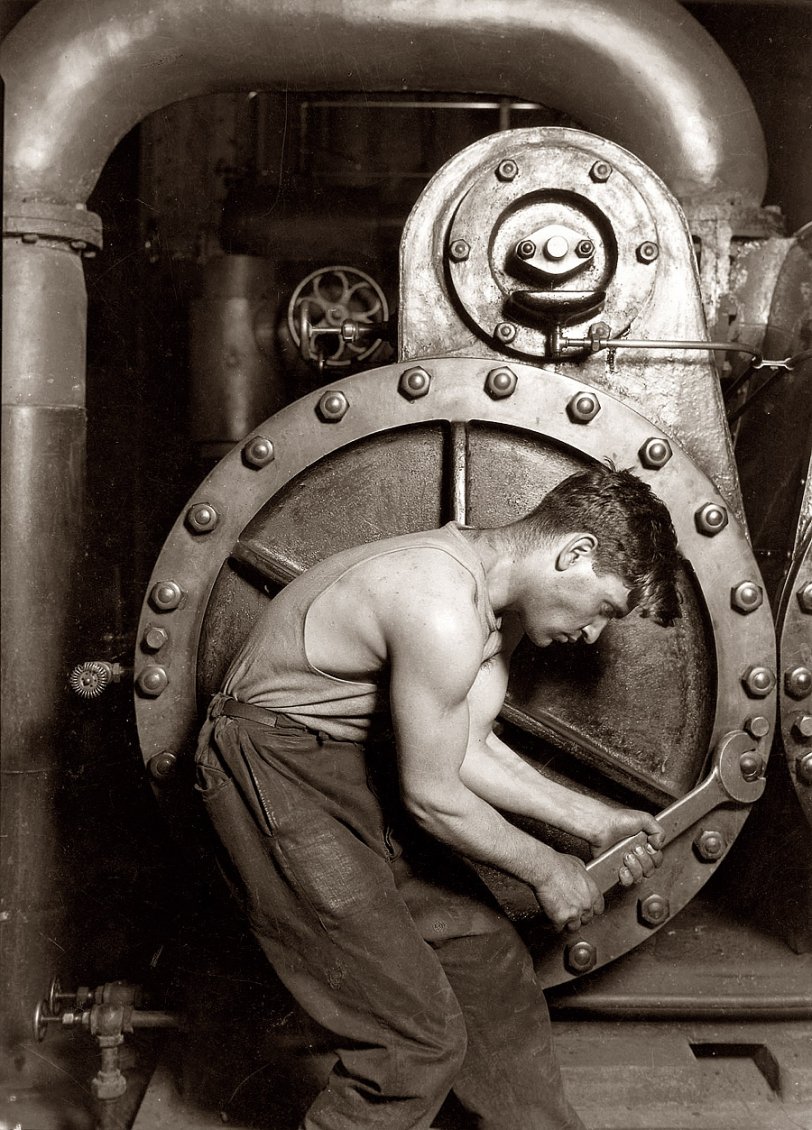
On this Labor Day 2021, Shorpy wishes everyone a meaningful and at least momentary break from toil.
"Powerhouse Mechanic and Steam Pump" (1921). One of Lewis Wickes Hine's celebrated "work portraits" made after his decade-long project documenting child labor. View full size.
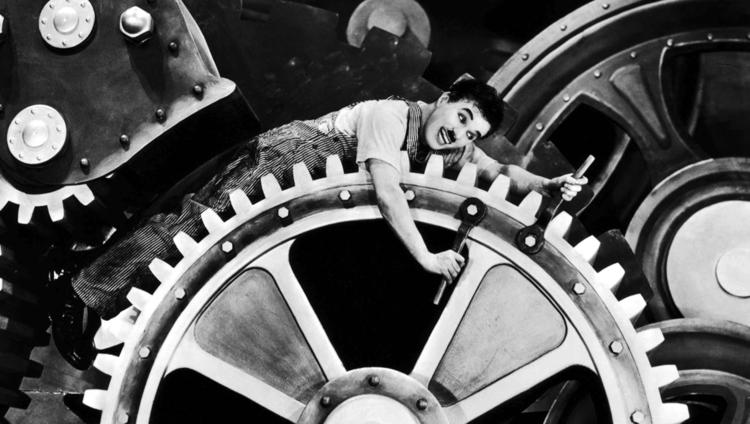
Chaplin's take fifteen years later
Hine's photo clearly influenced (though perhaps indirectly) Charlie Chaplin's iconic imagery in 'Modern Times'.

Momentary break
Well here I am working 12 hour shifts Sat-Sun-Mon, but taking a "momentary break from the toil" to post this comment. Thanks for the well-wishes Dave, and a Happy Labor Day to all!
Grandpa was the draftsman
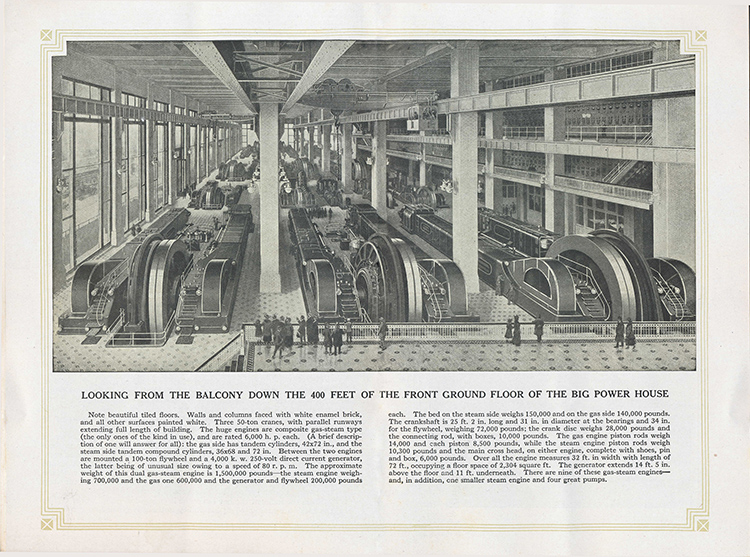
My grandfather was the draftsman to Edward Gray who designed the Highland Park "Gas-Steam" 6,000 hp engines. One was saved, the first item placed in the Henry Ford Museum. Massive and declared the largest engine in the world at that time. Artist's rendition of the nine 'gas-steam', one 'gas only 5,000hp' and also shows the very first 1500hp engine built at Riverside Engine in Oil City, Pennsylvania, where my grandfather first worked for Edward Gray starting in 1906. The two moved to Highland Park late 1909, as the Highland Park plant was being built.
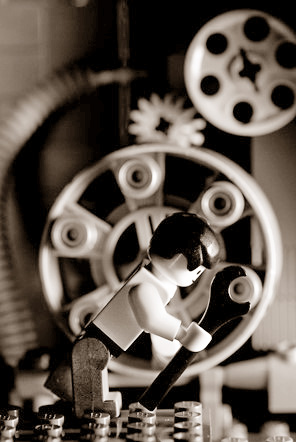
You know a photo is famous
When it's copied in another medium.
RE: Correct Wrench
That caught my eye, too: especially since there's no way it can turn clockwise without fouling the bolt head above it. But I suspect they needed a loose fit around the nut so the wrench could be held at an compositionally satisfying angle.
Correct wrench
It is the angle at which the wrench is being held that makes it seem too large. The ends of the wrench are on the nut, but the back part is closer too the camera, so looks larger. If it were flat, it would be clear that if fit.
Correct Wrench
Does it not seem a bit large for the nut?
Posing is also work
Hine let his working people look like they were posing, which is the work they were doing at that particular moment. It's one reason why his photos are art as well as documents.
Powerhouse
Some years ago (decades actually) I had the good fortune to work with Ray Scott on a number of different projects. Mostly he'd invent and I'd build. He was utterly brilliant and constantly creating things. Bright idea-sparks seemed to fly from him.
We were speaking about composition and the origins of how music is "made" - he told me that the basic ostinato theme for "Powerhouse" came from a peek inside the large open doors of one of ConEd's steam-electric plants in New York in the 30s.
He said: "I was just knocked out by the rhythm and sounds those three big engines were making. And they stayed in sync with each other for quite a long time. Immediately I heard the tune in my head, and I practically ran to my office to write it down!"
Hanging in a frame on the wall of my studio is a signed copy of the sheet music he gave me - one of my 'treasured things'.
Pleasant Labor Day to all here at Shorpy - especially Dave and tterrace whose Labors we enjoy.
He looks like
Amazing! but he looks like Buster Crabbe!
"Blended"
"As if the worker was blended with the machine." - Anonymous Tipster, Tue, 07/22/08
Indeed.
But is the relationship symbiotic, or parasitic -- and if the latter, which is the parasite and which the host?
Extra credit: Do you think your answer to that question might have been different if Keanu Reeves and/or the Wachowski Bros had never existed?
Rush
The rock group Rush used this picture in some of their art work on their Snakes & Arrows Audio DVD. There were some mods to the picture but the main part of it was this image.
Strong image
As if the worker was blended with the machine.
Cheers
Three cheers to Dave for his note about art and portraiture.
Steamfitter
This picture is brilliant, and I've often thought that this guy looks like a model. If he was less attractive would it hold appeal?
Express Yourself
Looks like something from the Madonna "Express Yourself" music video... Ooops. I just dated myself.. :-)
Steamfitter?
I did a project on this photograph in grade 12 photography. I was actually expecting it to appear on Shorpy.com eventually, seeing how it's such an iconic piece. It was called Steamfitter when we did the project, do you know if both titles are used interchangeably?
This was the picture that got me interested in Lewis Wickes Hine's photography. Thanks for posting it!
Nice Image.
I think Chaplin in "Modern Times" and Fritz Lang in "Metropolis" must have been inspired by this photo.
Listening to "Powerhouse"
While looking at a picture titled "Powerhouse" what could be more appropriate that listening to Raymond Scott's "Powerhouse."
Re: Icon
> That has got to be one of the iconic pictures of the 20th century.
...staged like so many of them.
[It's not "staged," it's posed. Which is how art photography works. No different from painting, sculpture or any other representational form. This is why it's called a portrait. - Dave]
Icon
That has got to be one of the iconic pictures of the 20th century.
 Shorpy.com is a vintage photography site featuring thousands of high-definition images. The site is named after Shorpy Higginbotham, a teenage coal miner who lived 100 years ago. Contact us | Privacy policy | Accessibility Statement | Site © 2024 Shorpy Inc.
On Shorpy:
Today’s Top 5