


Framed or unframed, desk size to sofa size, printed by us in Arizona and Alabama since 2007. Explore now.
Shorpy is funded by you. Patreon contributors get an ad-free experience.
Learn more.



- Baldwin 62303
- Baldwin VO-1000
- Cold
- No expense spared
- Tough Guys
- Lost in Toyland
- And without gloves
- If I were a blindfolded time traveler
- Smoke Consumer Also Cooks
- Oh that stove!
- Possibly still there?
- What?!?
- $100 Reward
- Freeze Frame
- Texas Flyer wanted
- Just a Year Too Soon
- WWII -- Replacing men with women at the railroad crossing.
- Yes, Icing
- You kids drive me nuts!
- NOT An Easy Job
- I wonder
- Just add window boxes
- Icing Platform?
- Indiana Harbor Belt abides
- Freezing haze
- Corrections (for those who care)
- C&NW at Nelson
- Fallen Flags
- A dangerous job made worse
- Water Stop
Photos submitted by Shorpy members!
Print Emporium
Gotham: 1915
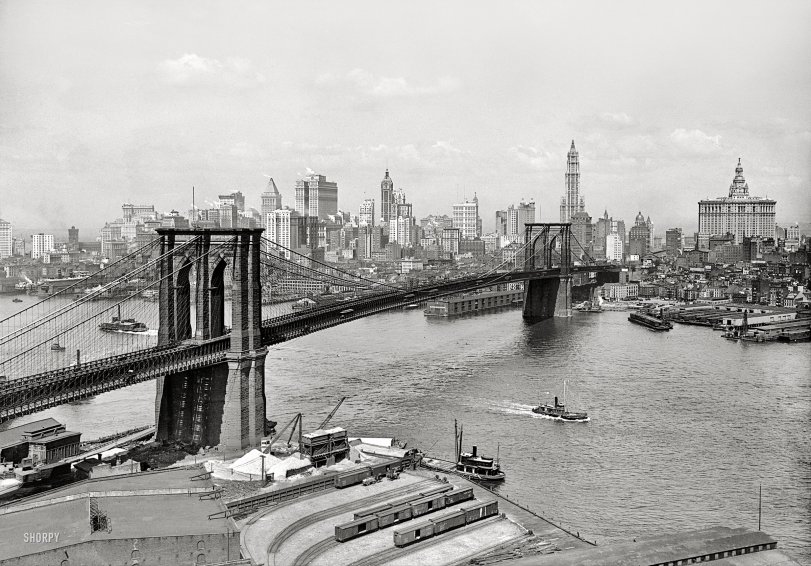
New York circa 1915. "Brooklyn Bridge, East River and skyline." The Woolworth Building stars in this Lower Manhattan view, with the Singer, Bankers Trust, Hudson Terminal, Municipal and Park Row buildings as understudies. 5x7 inch dry plate glass negative, Detroit Publishing Company. View full size.
More like 1922
195 Broadway (AT&T or whatever they called it-- the white bldg just right of midspan of the bridge) has been expanded north to Fulton St, so can't be much before 1922; the Cotton Exchange at 60 Beaver St isn't there, so not later than 1923. (The Cotton Exchange is the building with the columned top and blank east wall near the left edge of the 1960 aerial.)
Must have been taken from the tower of the building that's still there on the east side of Main St, at 40.7036N 73.99045W.

1923 - 1925
New York Stock Exchange Addition from 1922 is there.
Enlarged 195 Broadway from 1923 is there.
Transportation Building from 1927 is not there.
The only thing missing
is the bat signal in the sky.
Team tracks
The rail cars being loaded/unloaded are on what the railroad industry called a team track, in reference to the teams of horses required to handle the boxcar lading. The tracks served businesses that had no direct rail service to their doors, and were owned by a railroad in most cases. Team tracks are very scarce today. Pulling loads and empties scattered throughout a yard is a very time consuming and expensive proposition, and railroads have generally opted out of business of this nature.
Had the opportunity to work the old Milwaukee Road Railroad Reed Street team track yard in Milwaukee, Wisconsin many years ago. We handled mostly fresh produce from California, destined to brokers who sold the stuff to local supermarkets. One of the brokers might have an iced URTX reefer consigned to them show up, and would send a couple of fellows with a truck to unload it. They did it just like the guys in the picture: one bag or carton at a time.
So neat and clean
The little bit of rail road at bottom center looks so neat and clean it could almost be part of someones "N" scale layout.
The only activity in that area is the loading/unloading of the two cars on the most distant track.
How it looked in 1927
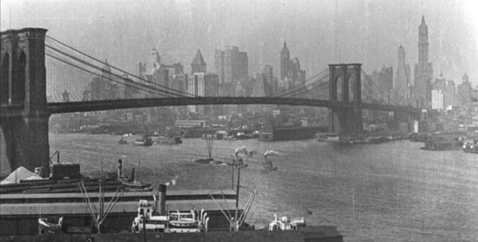
When Harold Lloyd filmed Speedy in 1927 from this vantage point he captured the Standard Oil Building (near Battery Park to the left), and the Transportation Building (to the left of the Woolworth Building), two buildings that do not appear in this image.
Lightning Rods?
I notice several structures have rod-like structures. It seems 1915 would be a bit early for anything other than Morse-based radio, so I'm wondering if those are lightning rods. Nice angle on the bridge and city. Anyone know the likely photographer vantage point?
[By 1915, New York's skyscrapers had dozens of Marconi masts, for both marine and terrestrial telegraphy as well as wireless telephone, and hundreds of flagpoles. - Dave]
Intermodal xportation
So many kinds of transportation here, in between eras. The bridge has more streetcars than horse buggies, and no autos that I can make out. So were these electrified streetcars with overhead power?
In the foreground is what is now Empire Fulton Ferry State Park. There are horse-drawn wagons loading or unloading the boxcars in the foreground. Is that sand in the barge?
On the river I see no sail-powered boats. So even though we're still very much in the age of animal power, wind power is pretty much a thing of the past.
Great photo for mixing smaller and larger scales.
 Shorpy.com is a vintage photography site featuring thousands of high-definition images. The site is named after Shorpy Higginbotham, a teenage coal miner who lived 100 years ago. Contact us | Privacy policy | Accessibility Statement | Site © 2024 Shorpy Inc.
On Shorpy:
Today’s Top 5