


Framed or unframed, desk size to sofa size, printed by us in Arizona and Alabama since 2007. Explore now.
Shorpy is funded by you. Patreon contributors get an ad-free experience.
Learn more.



- Baldwin 62303
- Baldwin VO-1000
- Cold
- No expense spared
- Tough Guys
- Lost in Toyland
- And without gloves
- If I were a blindfolded time traveler
- Smoke Consumer Also Cooks
- Oh that stove!
- Possibly still there?
- What?!?
- $100 Reward
- Freeze Frame
- Texas Flyer wanted
- Just a Year Too Soon
- WWII -- Replacing men with women at the railroad crossing.
- Yes, Icing
- You kids drive me nuts!
- NOT An Easy Job
- I wonder
- Just add window boxes
- Icing Platform?
- Indiana Harbor Belt abides
- Freezing haze
- Corrections (for those who care)
- C&NW at Nelson
- Fallen Flags
- A dangerous job made worse
- Water Stop
Photos submitted by Shorpy members!
Print Emporium
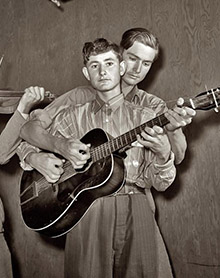

Cockaday and Banning: 1924
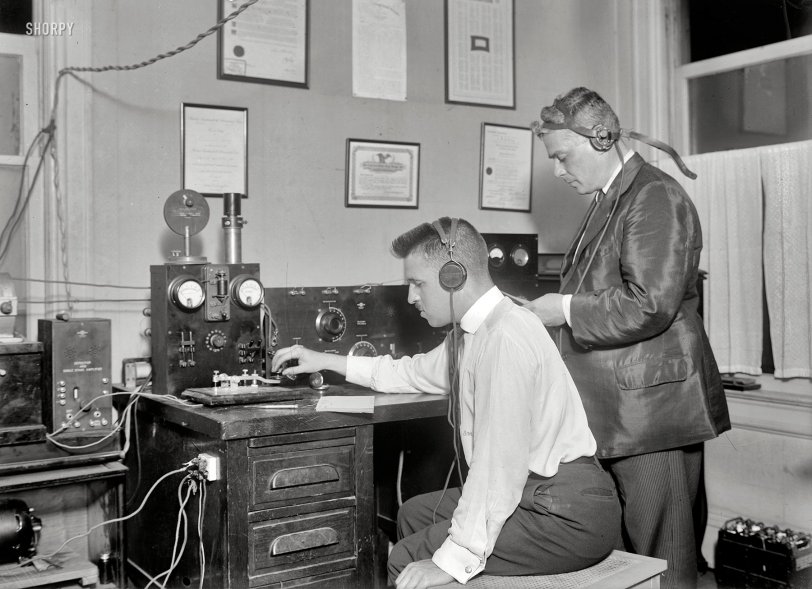
New York circa 1924. "L.M. Cockaday and Maj. Kendall Banning." 5x7 glass negative, George Grantham Bain Collection. View full size.
Chronological Cockaday
Father: Edward J. M. Cockaday, born February 1866 in England
Mother: Kate Simmonds, born August 1869 in England
Laurence Marsham Cockaday, born June 18, 1894, Greenville, New Jersey
1915: Vocalist, possibly with his father who was also a vocalist and a professor of music
1916: General Secretary, Cathedral Choir School (of St. John the Divine which still exists)
1917: Electrical Engineer for the New York Interborough Railroad
1918: Radio instructor for the U.S. Navy
1919: Patent for Radiotelegraphy, "invented certain new and high potential electrical oscillations from a direct current or other supply"
1920: Electrical Engineer
1921: Was involved in relaying the Dempsey-Carpentier heavyweight title fight via radio. Setup a relay at the Majestic Theater which was heard by 265 people. More info here.
1922: Techical Editor for "Popular Radio." (he was also one of the founders). Authored Radio-Telephone ($1.50) for Everyone which was also published in England.
1923: Authored three publications: Wireless Telephony For All; How to Build the Haynes DX Receiver; and How to Build the Haynes 2-Tube Amplifier.
1924: With Kendall Banning authoried How To Build Your Radio Receiver.
1925: Working at Popular Radios's laboratory. Designed a circuit for radios to operate with alternating current. Served on the Operating Regulations Committee at the 4th National Radio Conference.
1926: Silver Cockady Four Tube Receiver is being sold
1927: On the advisory board for WGL based at the Hotel Majestic (the station lasted less than two years).
1931: In March became the Editor for "Radio News"; Author of 23 Lessons in Radio
1932: Author of Radio Experimenters' Handbook
1933: Author of Short-Wave Handbook with Walter H. Holze
1934: Author of If Not Television Why Not Facsimile published by "Radio News
1937: Was teaching at New York University, and authored 34 Lessons In Radio and Television.
1940: On July 12th he enlisted in the U.S. Navy. He retired at the grade of Captain in January 1957.
1957: His wife Marguerite Mary Cockaday, a social worker, passes away after a long illness in Annapolis, Maryland.
1986: Cockaday dies on November 18th in Manhattan, New York. Both he and his wife are buried in Annapolis at St. Marys Cemetery.
He was also the Technical Editor of the New York Herald Tribune, but I could not find the exact dates, but certainly before 1931.
Details of one of the transformers he helped design can be seen here.
The first photo below is the frontispiece of his book Radio-Telephony For Everyone, and it shows the same room as in the Shorpy photo. The second, also showing the same room, is from the November 1921 edition of Popular Science Monthly, Page 22.
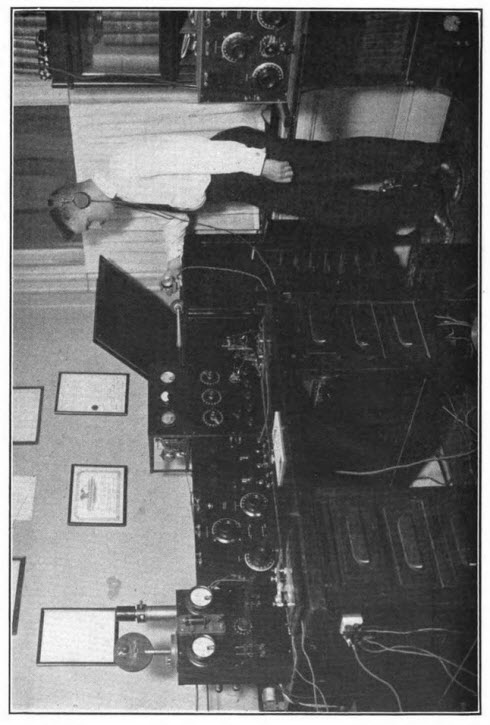
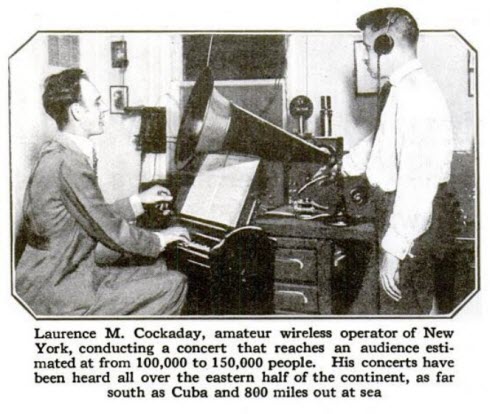

Radio components identified
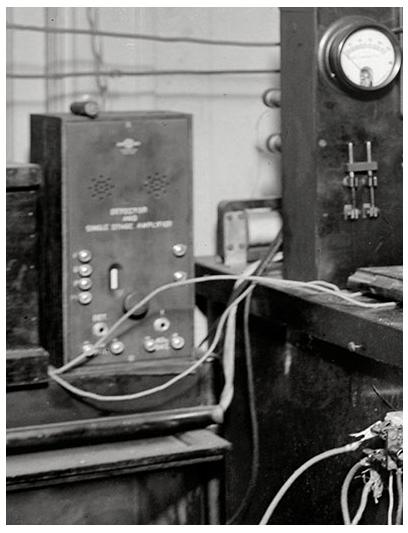
The Detector/1-Stage Audio Amplifier was a Superadio Corporation D/A as seen on the logo on the set. The Superadio Corporation was the successor to the L. M. Cockaday Co. starting January of 1921 as seen in a January 1921 Pacific Radio News advertisement. The radio on the desk was also a Superadio Corp. product as can be seen by the same logo. On top of the device with two meters sits a Wireless Specialty Apparatus Clark Tone-Tester which is a miniature crystal radio to monitor the tone of the transmitted signal.
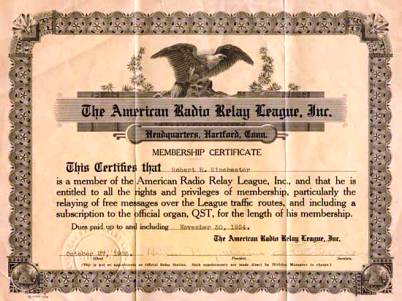
ARRL Member
In the middle of the wall is a Membership Certificate in the American Radio Relay League, the pioneer Ham Radio organization, headquartered in Connecticut.
Re Flat Top
Mister Cockaday was much more than just a telegraph key pilot. That component to the left of the desk (shown below) was one of the radio products of L.M. Cockaday and Company, 2674 Bailey Avenue, New York City. It was described in a Cockaday ad in the January 1921 issue of Wireless Age as "...the BEST detector and single stage amplifier in the WORLD" and cost $45, about $523 today.
Major Banning
With that shiny jacket and matching trousers, he must have been quite the rake at the big post-war 1919 national wireless radio convention. But, alas, by 1924 what once was stylish apparently was demoted to throw-something-on-for-work. A veteran of World War One (signal corps), Banning was a member of the Sons of the American Revolution (the Banning lineage in the U.S. goes back at least to the late 17th Century). Also he was an author, possibly most famous for "Censored Mother Goose Rhymes", per this, found online:
Censored Mother Goose Rhymes by Kendall Banning (1929)
Flipped through an interactive version of this very funny book today at the Ransom Center’s wonderful “Banned, Burned, Seized, and Censored” exhibit. (It’s out of print, so you can read the whole thing online.)
Originally published in 1926 and dedicated to “The Censors who have taught us how to ready naughty meanings into harmless words,” Banning reprinted it in support of the efforts to revise parts of tariff legislation that allowed customs agents to ban “obscene” books from the US—the book was distributed to congressmen in the middle of the debate.1
Banning (1879-1944) wasn’t some underground prankster: he was a war veteran, a poet (a New York Times review in 1913 said of his work, “no other poet in America at the moment has such a gift of pure melody”), an author of over a dozen books (he wrote books on Annapolis and West Point), and an editor of Cosmopolitan, Popular Radio, and Hearst Magazine.
Fun fact: Gertrude Stein owned a copy.
Major Banning is buried at Arlington National Cemetery, and here's his grave:
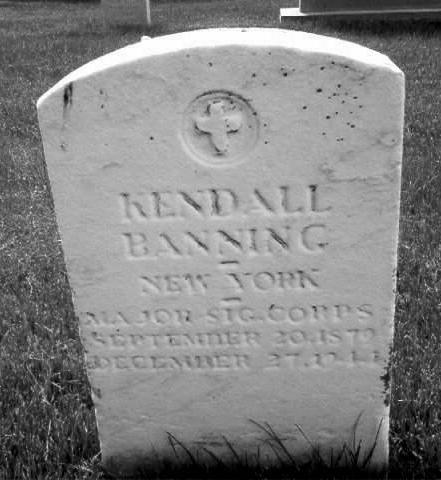
Kendall Banning
was the editor of Popular Radio magazine at this time.
Flat Top
The guy in the light shirt could almost fit in perfectly in appearance with young men in the early 60's.
 Shorpy.com is a vintage photography site featuring thousands of high-definition images. The site is named after Shorpy Higginbotham, a teenage coal miner who lived 100 years ago. Contact us | Privacy policy | Accessibility Statement | Site © 2024 Shorpy Inc.
On Shorpy:
Today’s Top 5