


Framed or unframed, desk size to sofa size, printed by us in Arizona and Alabama since 2007. Explore now.
Shorpy is funded by you. Patreon contributors get an ad-free experience.
Learn more.



- Baldwin 62303
- Baldwin VO-1000
- Cold
- No expense spared
- Tough Guys
- Lost in Toyland
- And without gloves
- If I were a blindfolded time traveler
- Smoke Consumer Also Cooks
- Oh that stove!
- Possibly still there?
- What?!?
- $100 Reward
- Freeze Frame
- Texas Flyer wanted
- Just a Year Too Soon
- WWII -- Replacing men with women at the railroad crossing.
- Yes, Icing
- You kids drive me nuts!
- NOT An Easy Job
- I wonder
- Just add window boxes
- Icing Platform?
- Indiana Harbor Belt abides
- Freezing haze
- Corrections (for those who care)
- C&NW at Nelson
- Fallen Flags
- A dangerous job made worse
- Water Stop

Photos submitted by Shorpy members!
Print Emporium



The Ladies Who Lunch: 1943
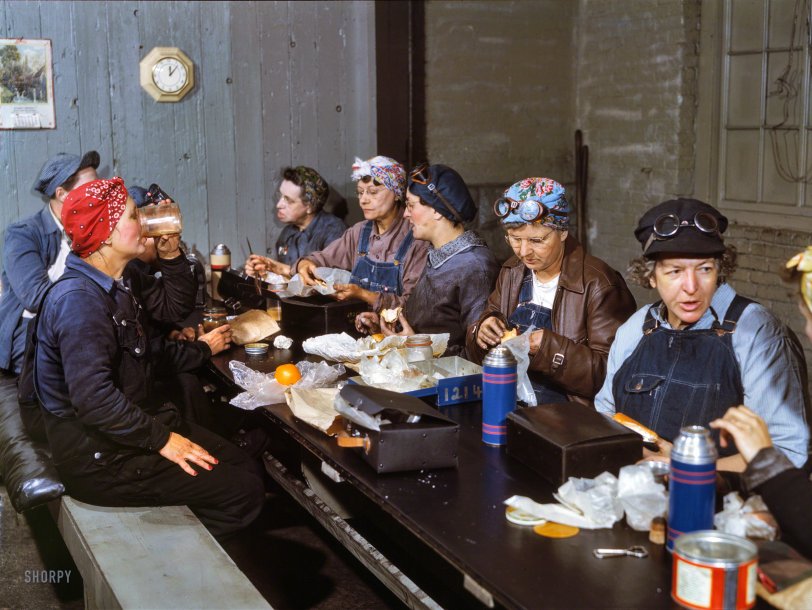
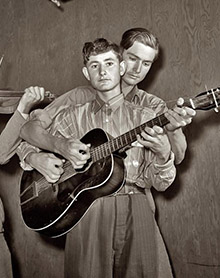
April 1943. "Women workers employed as wipers in the roundhouse having lunch in their rest room, Chicago & North Western Railroad, Clinton, Iowa." Marcella Hart is at left, Mrs. Elibia Siematter at right. Kodachrome transparency by Jack Delano for the Office of War Information. View full size.
Waxed Paper
You fold it up, take it home in your lunch box, and use it for the next several meals.

Paging Norman Rockwell
This looks like something he would have painted during the war.
Wiper in action
Also from 1943 in Clinton, Iowa: https://www.shorpy.com/node/21255. Perhaps this woman wiping the window is one of our lunch ladies?
Great photo
Thanks Dave for posting that again. Long been one of my favs, as others have said it oozes character and the type of arduous work many people toiled at during the War. Those Thermos bottles were standard accompaniments every day for millions of US workers. Probably these had hot (warm by noon) coffee or tea, sometimes soup. They'd just barely stay warm til noon. These wipers got quite dirty every day, so surprising their clothes weren't very dirty yet. But hands and fingernails were.
Interesting lunchpails
I have never seen this type of lunchpail before. It looks like some WW II item that was created for consumer usage to save metal for the war industry.
America Fights a War
This picture powerfully shows the way everyday Americans fought a War to Win it. Ten years earlier these ladies most certainly did not work down at the shop. Every family was somehow touched by the War effort. A sharp contrast to today's wars intimately touch maybe one in ten families. The rest have yellow ribbons and "Support the Troops" bumper stickers as their sacrifice.
Wonderful character study
This is another wonderful shot of railroaders. There is lots of character and determination in those faces - wives, mothers, grandmothers. They look relaxed but "all business" at the same time. Patriotism in 1943 wasn't just a popular phrase back then - you lived it!
Locomotive Wiper
"a Wiper's job was to pack the internal moving parts of a steam locomotive with wads of greasy gunk."
Not exactly. An engine wiper's primary job was to "wipe down" the locomotive. Coal-burning locomotives were obviously dirty, and the soot settled on the boiler jacketing and cab roof. A wiper cotton waste (basically stringy offal from textile production) dipped in a light oil to remove the soot. S/he also swept cinders off the "running boards" (the walkways alongside the boiler) and the tender deck, and cleaned the running gear motion.
LUNCH PAILS
Note that the majority of the lunch pails are wartime non-metallic. Also note the mason jars to carry a beverage and the wax paper used to wrap food.
This is real "Rosie the
This is real "Rosie the Riveter" stuff! Marcella - what a gal!
Wiper's Job
According to a Google search: a Wiper's job was to pack the internal moving parts of a steam locomotive with wads of greasy gunk. Sounds like that would make for a long day in the roundhouse.
Thermos Bottles
Interesting that two of them have matching Thermos bottles . . . blue with red stripes. Wonder what they had in them, something cold or hot?
Painted nails!
I love the lady with the red bandana has her nails painted!
 Shorpy.com is a vintage photography site featuring thousands of high-definition images. The site is named after Shorpy Higginbotham, a teenage coal miner who lived 100 years ago. Contact us | Privacy policy | Accessibility Statement | Site © 2024 Shorpy Inc.
On Shorpy:
Today’s Top 5