



Framed or unframed, desk size to sofa size, printed by us in Arizona and Alabama since 2007. Explore now.
Shorpy is funded by you. Patreon contributors get an ad-free experience.
Learn more.



- Tough Guys
- Lost in Toyland
- And without gloves
- If I were a blindfolded time traveler
- Smoke Consumer Also Cooks
- Oh that stove!
- Possibly still there?
- What?!?
- $100 Reward
- Freeze Frame
- Texas Flyer wanted
- Just a Year Too Soon
- WWII -- Replacing men with women at the railroad crossing.
- Yes, Icing
- You kids drive me nuts!
- NOT An Easy Job
- I wonder
- Just add window boxes
- Icing Platform?
- Indiana Harbor Belt abides
- Freezing haze
- Corrections (for those who care)
- C&NW at Nelson
- Fallen Flags
- A dangerous job made worse
- Water Stop
- Passenger trains have right of way over freights?
- Coal
- Never ceases to amaze me.
- Still chuggin' (in model form)
Photos submitted by Shorpy members!
Print Emporium



Breaker Boys: 1911
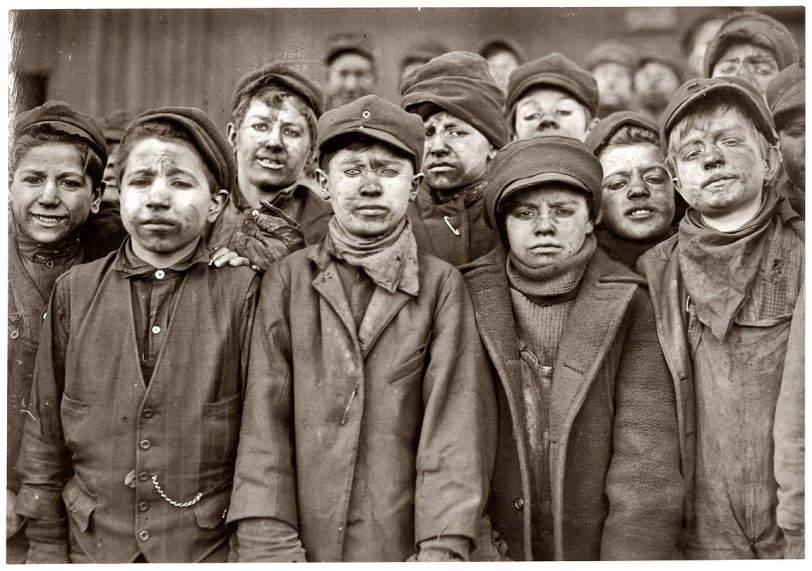
January 1911. Breaker boys in #9 Breaker, Pennsylvania Coal Company mine at Hughestown Borough near Pittston. Smallest boy is Angelo Ross, 142 Panama Street, Hughestown Borough. View full size. Photograph by Lewis Wickes Hine.
Breaker house
Growing up in West Virginia, I often heard my relatives talk about working in the coal mines and heard the stories about what it was like back when my great-grandfather and my grandfather worked the mines. Safety was not of real concern to the Company owners. Ventilation was poor and as a result my grandfather suffered his whole life from black-lung disease. My father has spent all his adult working life in and around the mines. I avoided that life myself by going to college and then joining the military.
This doesn't mean I don't respect the coal miners, I just wasn't cut out for underground work.
If I recall my mining knowledge correctly, I think the breaker house was where the larger chunks of coal were broken down into smaller, more manageable sizes. This was accomplished using a series of augers and large rollers. I've heard stories of breaker boys falling into the machinery and being mangled. The companies didn't care. Common business mentality was that workers were just cogs in the machine to be replaced when they were of no further use to the Companies.

Am I a bad parent?
...I show these pictures to my 9 year old when he complains about cleaning his room or doing household chores.
Been staring at this picture for 10 minutes
Oh man, the kid in the front with the blue eyes is freaking me out! Not to mention the kid behind him to the right who looks like he's about to either burst out in tears or kill someone.
... These kid, these kids. This is messed up. How could this have been going on just a hundred years ago...?
Shorpy
I love this web site. The photos are fantastic.Keep up the good work.
I live in the bituminous coal country of western Pennsylvania. According to my now retired mining expert, in the days when mules were used in the mines, the mules were often more valued and protected than the miners. If a mule was injured or killed, a replacement had to be bought. If a miner was injured or killed, he could be replaced for free by another miner willing to take his place. Thank God for John L. Lewis and his UMWA. I shudder to think what the mining profession would be like today if it weren't for Mr. Lewis, those miners and their families of long ago who suffered so much so that today's coalminer could go underground in safety and get paid decent wages for what surely must be the most dangerous job in the world.
A coal miner's daughter
Revloc, Pa.
 Shorpy.com is a vintage photography site featuring thousands of high-definition images. The site is named after Shorpy Higginbotham, a teenage coal miner who lived 100 years ago. Contact us | Privacy policy | Accessibility Statement | Site © 2024 Shorpy Inc.
On Shorpy:
Today’s Top 5