



Framed or unframed, desk size to sofa size, printed by us in Arizona and Alabama since 2007. Explore now.
Shorpy is funded by you. Patreon contributors get an ad-free experience.
Learn more.



- Baldwin 62303
- Baldwin VO-1000
- Cold
- No expense spared
- Tough Guys
- Lost in Toyland
- And without gloves
- If I were a blindfolded time traveler
- Smoke Consumer Also Cooks
- Oh that stove!
- Possibly still there?
- What?!?
- $100 Reward
- Freeze Frame
- Texas Flyer wanted
- Just a Year Too Soon
- WWII -- Replacing men with women at the railroad crossing.
- Yes, Icing
- You kids drive me nuts!
- NOT An Easy Job
- I wonder
- Just add window boxes
- Icing Platform?
- Indiana Harbor Belt abides
- Freezing haze
- Corrections (for those who care)
- C&NW at Nelson
- Fallen Flags
- A dangerous job made worse
- Water Stop

Photos submitted by Shorpy members!
Print Emporium










Balloon Wranglers: 1942
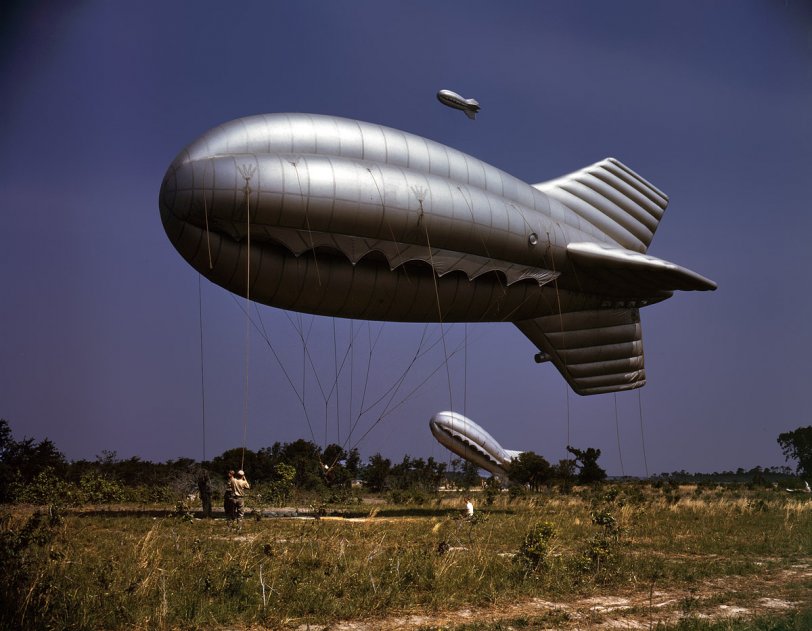
May 1942. Another shot of Marines training with barrage balloons at Parris Island, S.C. View full size. 4x5 Kodachrome transparency by Alfred Palmer.
Barrage Balloons
Aw come on Dave you know that there are people in your readership who are just as capable as Google in giving an answer.
Barrage balloons were used primarily to protect fixed installations or cities. The idea was to force aircraft - specifically dive bombers - to drop their bombs from higher altitudes thereby reducing accuracy and or to force a low flying plane to change course repeatedly rather than have a straight bombing run. The cables with which a barrage balloon was tethered would be dangerous to planes - they could rip a wing off for example. The British deployed more than 400 barrage balloons over London in 1940 (during the Blitz) and by 1944 there were over 3000 barrage balloons in England. The Balloon Barrage destroyed over 200 V-1 flying bombs in 1944.

 Shorpy.com is a vintage photography site featuring thousands of high-definition images. The site is named after Shorpy Higginbotham, a teenage coal miner who lived 100 years ago. Contact us | Privacy policy | Accessibility Statement | Site © 2024 Shorpy Inc.

On Shorpy:
Today’s Top 5