



Framed or unframed, desk size to sofa size, printed by us in Arizona and Alabama since 2007. Explore now.
Shorpy is funded by you. Patreon contributors get an ad-free experience.
Learn more.




- Freeze Frame
- Texas Flyer wanted
- Just a Year Too Soon
- WWII -- Replacing men with women at the railroad crossing.
- Yes, Icing
- You kids drive me nuts!
- NOT An Easy Job
- I wonder
- Just add window boxes
- Icing Platform?
- Indiana Harbor Belt abides
- Freezing haze
- Corrections (for those who care)
- C&NW at Nelson
- Fallen Flags
- A dangerous job made worse
- Water Stop
- Passenger trains have right of way over freights?
- Coal
- Never ceases to amaze me.
- Still chuggin' (in model form)
- Great shot
- Westerly Breeze
- For the men, a trapeze
- Tickled
- Sense of loneliness ...
- 2 cents
- Charm City
- What an Outrage
- Brighton Park

Photos submitted by Shorpy members!
Print Emporium
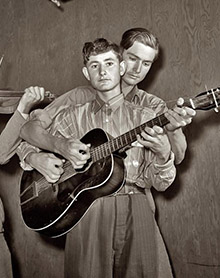







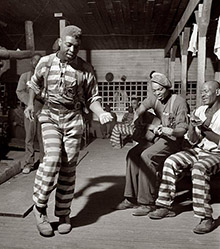






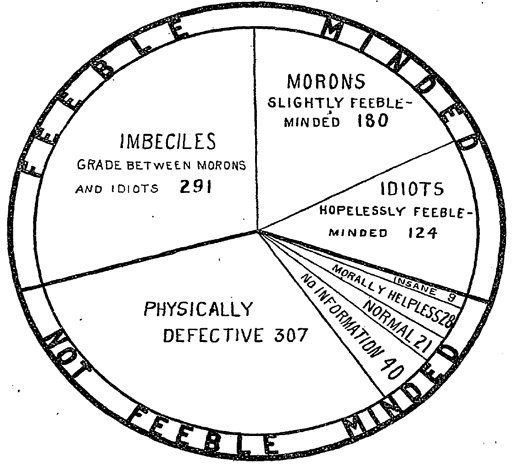
Imbeciles, Morons, Idiots: 1913
Sub-moron
Back in 1966, when I was 9, I took an externally-administered IQ test with the rest of my Grade 4 class in Winnipeg. I gave it no heed, since a stranger and not our regular teacher was giving us this test, so I answered no questions and simply doodled in the margins. Nothing came of it. Years later, some friends of mine were working in the school over the summer and they snooped in the files and came upon our Grade 4 IQ test scores. Imagine their slobbering pleasure when they found I had scored a 70. On various scales, I could have been classified as a borderline defective, dull, feeble-minded, or well below average, but my official classification at the time was sub-moron. A simple moron would not do. As it turns out, I cannot be executed for a capital crime in the US, so I suppose there are some minor advantages. I now have a nephew with learning and behavioral difficulties who has been labelled many things at school and in the doctor's office, so he takes especial delight in his uncle who is a sub-moron. Even the mention of the word submarine will set him off on a gleeful round of abuse directed at Uncle Sub-Mo.

Idiots, Imbeciles etc.
I am not sure what "morally helpless" means, but I think I'm in that group.
Does it make sense to have
Does it make sense to have the caravan move at the speed of the slowest camel? Having mentally disadvantaged children in the same classes as the normal ones can only make the unfortunate ones feel incompetent and unhappy. Where I live (Rhode Island) we have schools for such children, who often accomplish more than would be expected from them in regular schools. They are in no way made to feel inferior and are educated with encouragement and praise.
Wow
It's an organizational chart of company directors!
Failure
While I agree with the point that isolating would be arbitrary (both hard to define and somewhat morally queasy), I think that less is demanded from school-age children now then ever which is the point of the previous poster. I don't see how that's good in any way. I know a lot of teachers (brother-in-law is one) and it's almost mandated that they can't fail anyone. Do kids fail? Sure, but it's hard to do even when warranted.
Why do we do this? So that feelings aren't hurt and the child/person doesn't suffer emotional 'trauma/stigma'. Part of this is the system that says emotional well being is better than anything else (the you're ok, I'm ok philosophy) and the other part is the fear of consequences by upset parents. The problem with all this is that when they get into the real world that doesn't give a rip about how you 'feel' and fire your butt for underperforming, it's twice as bad. Everyone starts to get a sense of entitlement instead of becoming stronger through the struggle.
Outdated? Yes really...
The reason we don't "weed out" the "dullest" students is because it's unfair to ostracize children with mental or educational issues. Isolating them away from the "good" children creates a situation where low intelligence equals outcast. As there is a wide spectrum of intelligence -- you said so yourself -- any line drawn to determine who needs to be isolated and who can stay in a classroom will necessarily be arbitrary.
Anyway, the idea that "kids these days" are getting dumber is just alarmist rhetoric. It doesn't take much work to find articles and studies online which show IQ hasn't changed in any significant way except in regards to how it's tested (I believe we're on Weschler IV now; the standard test used to determine childhood IQ gets "normed" every 15 or so years.)
[Actually, IQ seems to have been trending up over the past few decades: "James Flynn, a philosopher and I.Q. researcher in New Zealand, has established that in the Western world as a whole, I.Q. increased markedly from 1947 to 2002. In the United States alone, it went up by 18 points." (New York Times, December 9, 2007). Wikipedia link on the Flynn Effect. - Dave]
Org. Chart
I thought this was the official White House organizational chart.
Goober Pea
I'm more curious about what
I'm more curious about what "Morally Helpless" means.
Normal
Considering that a lot of people drank a lot back then and that no one knew about fetal alcohol syndrome, it wouldn't surprise me that that quite a few rather dim children were born in those times.
But I'm concerned about the 21 who are "not feeble minded" and "normal." How did they get stuck in that "Clearing house". And how do they get out?
Clinical terms
Yes, those were clinical terms once, but they became perjorative, and a euphemism like "mentally retarded" had to be coined.
Then that became perjorative and "mentally challenged" was made...
Implausibly high numbers
The NYT article's header is telling: "NEARLY 15,000,000 SCHOOL CHILDREN ARE DEFECTIVES"
15 million kids -- in a nation whose population at the time was just under 100 million -- is an unrealistically high number. Assuming a 50% population of children, that puts the number of "defectives" at 30 percent.
This might be what Gould was referring to in his The Mismeasure of Man, when he suggested that IQ testing is not a valid means of assessing intelligence and is, more often, simply a political or social-manipulation tool.
Outdated? Not reallly...
Wow, great old NYT article! Sure, we chuckle at the terms (idiot, imbecile, and moron) used in the article and accompanying graphic, but in those days, these were true clinical terms that were not used in the pejorative.
What is really telling is that people in 1913 were not afraid to recognize that an average classroom of children constituted an entire continuum of intelligence and ability. We've got the same thing now... that doesn't change. The difference is that then, they largely ignored the slower kids for the sake of the smarter ones. Today, the exact opposite is true! We dumb down the standards for the smarter kids to "leave none of the stupid ones behind".
One quote from the article says: "A tiny cinder in the eye will entirely incapcitate a man, so one [deficient] child may disorganize and retard the work of a whole classroom."
Ugh, why can't we see this today??? Our government schools spend more of their effort teaching to the dullest in the classroom and the nation suffers by never challenging its best and brightest sufficiently.
 Shorpy.com is a vintage photography site featuring thousands of high-definition images. The site is named after Shorpy Higginbotham, a teenage coal miner who lived 100 years ago. Contact us | Privacy policy | Accessibility Statement | Site © 2024 Shorpy Inc.

On Shorpy:
Today’s Top 5