


Framed or unframed, desk size to sofa size, printed by us in Arizona and Alabama since 2007. Explore now.
Shorpy is funded by you. Patreon contributors get an ad-free experience.
Learn more.



- Baldwin 62303
- Baldwin VO-1000
- Cold
- No expense spared
- Tough Guys
- Lost in Toyland
- And without gloves
- If I were a blindfolded time traveler
- Smoke Consumer Also Cooks
- Oh that stove!
- Possibly still there?
- What?!?
- $100 Reward
- Freeze Frame
- Texas Flyer wanted
- Just a Year Too Soon
- WWII -- Replacing men with women at the railroad crossing.
- Yes, Icing
- You kids drive me nuts!
- NOT An Easy Job
- I wonder
- Just add window boxes
- Icing Platform?
- Indiana Harbor Belt abides
- Freezing haze
- Corrections (for those who care)
- C&NW at Nelson
- Fallen Flags
- A dangerous job made worse
- Water Stop

Photos submitted by Shorpy members!
Print Emporium



Papered Over: 1937
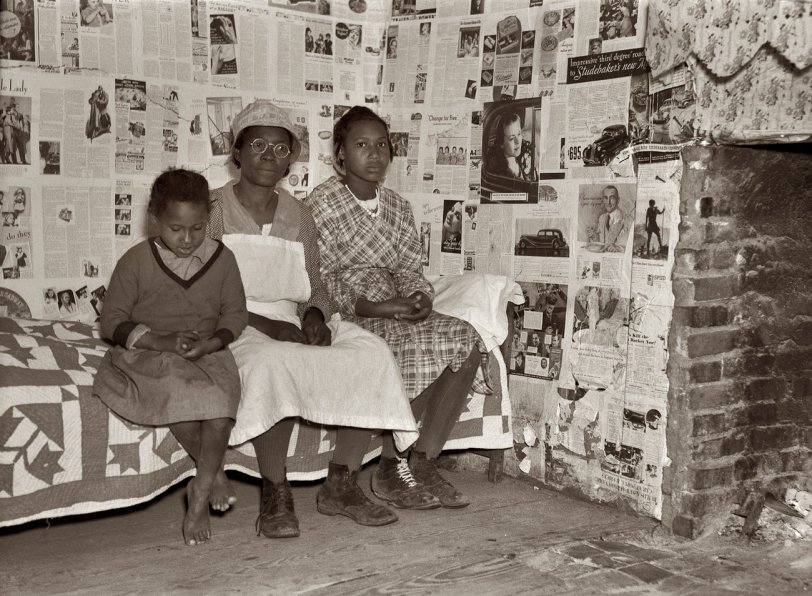
February 1937. "Negroes at Gee's Bend, Alabama. Descendants of slaves of the Pettway plantation. They are still living very primitively on the plantation." Here we see one of the celebrated Gee's Bend quilts. Medium format nitrate negative by Arthur Rothstein for the Farm Security Administration. View full size.
I should be grateful
How did they endure this, their faith must have been strong. However a fine job of wallpapering and the newseum. A testament to the human spirit.

Newspaper Wallpaper
Newspaper on the walls was very common back then. Most houses for lower income people were just boards nailed up to the studs with no insulation at all. If you were lucky you got boards on the inside of the studs too. These were rough sawed and the gaps were large. The newspapers made the house much warmer in the winter.
Newspaper
It helps insulate against drafts coming through the boards.
Quilt and...
That's a very nice quilt, I wonder if the family still has it.
What's the use of putting up newspaper on the walls? Why not just leave it bare?
News
Is that the Dionne quintuplets on the wall?
It looks that they replaced their newspaper wallpaper fairly often, it looks so clean and fresh.
Gee's Bend Quilts
Here is one of the famous Gee's Bend quilts. The skilled quilters of Gee's Bend have achieved international recognition with ongoing exhibits of their needlework. Their quilt designs were featured on U.S. postage stamps in 2006.
 Shorpy.com is a vintage photography site featuring thousands of high-definition images. The site is named after Shorpy Higginbotham, a teenage coal miner who lived 100 years ago. Contact us | Privacy policy | Accessibility Statement | Site © 2024 Shorpy Inc.

On Shorpy:
Today’s Top 5