



Framed or unframed, desk size to sofa size, printed by us in Arizona and Alabama since 2007. Explore now.
Shorpy is funded by you. Patreon contributors get an ad-free experience.
Learn more.



- Baldwin 62303
- Baldwin VO-1000
- Cold
- No expense spared
- Tough Guys
- Lost in Toyland
- And without gloves
- If I were a blindfolded time traveler
- Smoke Consumer Also Cooks
- Oh that stove!
- Possibly still there?
- What?!?
- $100 Reward
- Freeze Frame
- Texas Flyer wanted
- Just a Year Too Soon
- WWII -- Replacing men with women at the railroad crossing.
- Yes, Icing
- You kids drive me nuts!
- NOT An Easy Job
- I wonder
- Just add window boxes
- Icing Platform?
- Indiana Harbor Belt abides
- Freezing haze
- Corrections (for those who care)
- C&NW at Nelson
- Fallen Flags
- A dangerous job made worse
- Water Stop
Photos submitted by Shorpy members!
Print Emporium

Burglary, 2nd Degree
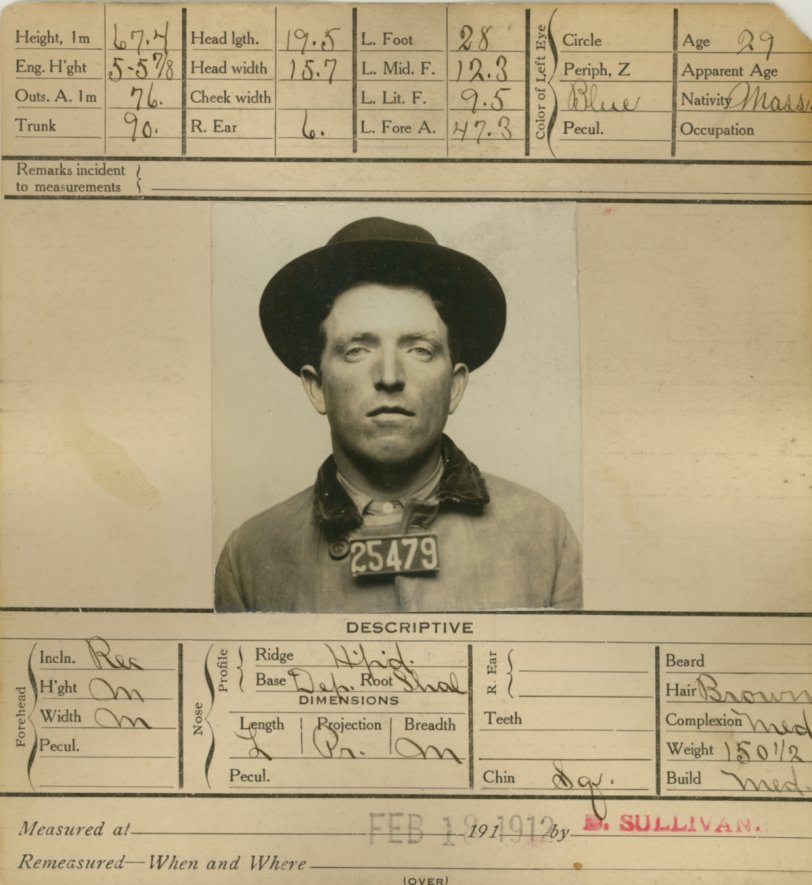
In 1912, second degree burglary got you 3 years.
Handedness
For some reason I'm stuck on the idea that the recorder appears to have been a lefty...

Fingerprints
Actually I have the card itself (and 5 others like it) and there aren't any fingerprints on the back on any of them, so I am guessing they were kept separate, as you suggested. The Henry system sounds very interesting-I had never heard of it until now. I'll have to do some research!
Fingerprints
This wasn't the time before fingerprints - the New York Police began taking fingerprints in 1906 and Scotland Yard had been taking them since 1901. By 1912 one would suspect it was a fairly common process. I suppose it's possible that this guy's prints were on the other side of the card, although it may be more likely that they were kept separate and sorted using one of the various classification systems, like the Henry system. Once you found the correct prints you could then pull the identification card with the full details.
Useful Eugenics?
Yes, and, at the time, the minutiae were considered important in determining characteristics of criminals, so the then-popular eugenics movement could improve on the species (when Nazi Germans did this, it quickly extinguished any popularity of eugenics in the US).
For further info, see Biological Theories of Crime: A Historical Overview by Nicole Hahn Rafter, from the 2000 exhibit Searching the Criminal Body: Art/Science/Prejudice at the University at Albany University Art Museum.
You may also find the Eugenics Archive fairly fascinating.
Card Catalog?
Imagine the filing system...
A is A.
Measuring Up
It's odd to see the metric system listed as the primary unit set. In the days before fingerprints, you'd need all these varied measurements to make sure you had your suspect. I wonder if he got to keep his hat.
Descriptive minutiae
Note the highly detailed and precise notation of seemingly secondary bodily specs. My presumption is that these would of great importance when a suspect's description needed to be transmitted to distant points, this being the days before wirephotos... I mean before faxes... I mean before the Internet.
 Shorpy.com is a vintage photography site featuring thousands of high-definition images. The site is named after Shorpy Higginbotham, a teenage coal miner who lived 100 years ago. Contact us | Privacy policy | Accessibility Statement | Site © 2024 Shorpy Inc.
On Shorpy:
Today’s Top 5