


Framed or unframed, desk size to sofa size, printed by us in Arizona and Alabama since 2007. Explore now.
Shorpy is funded by you. Patreon contributors get an ad-free experience.
Learn more.




- Indiana Harbor Belt abides
- Freezing haze
- Corrections (for those who care)
- C&NW at Nelson
- Fallen Flags
- A dangerous job made worse
- Water Stop
- Passenger trains have right of way over freights?
- Coal
- Never ceases to amaze me.
- Still chuggin' (in model form)
- Great shot
- Westerly Breeze
- For the men, a trapeze
- Tickled
- Sense of loneliness ...
- 2 cents
- Charm City
- What an Outrage
- Brighton Park
- Catenary Supports
- Just a Little Before I was Born
- Afternoon normal
- The Flat Iron Cafe survives
- Aging in Place
- Raise your hand
- Good and Bad
- Oh, the 70's
- Nooooooi
- The aluminum tubing

Photos submitted by Shorpy members!
Print Emporium













Cannonballs: 1862
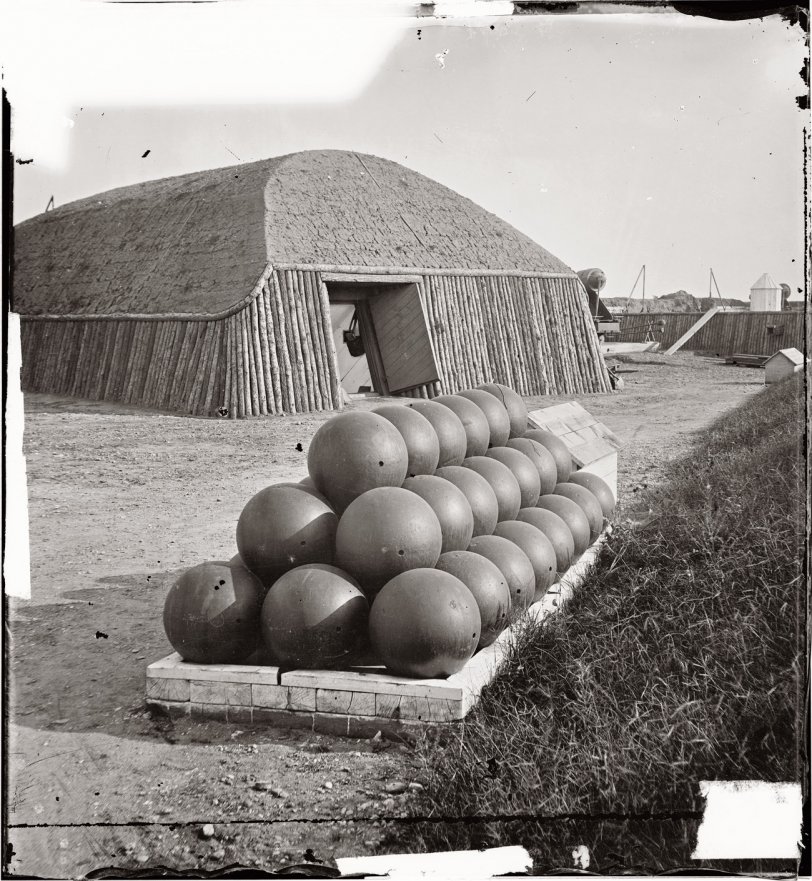
Magazine and cannonballs at Battery Rodgers, Alexandria, defending Washington during the Civil War, circa 1863. View full size. Half of stereograph pair.
Stereo again?
I sold quite a lot of 'Steri-opticon', 3-D photo cards, and was always of the belief that almost all of them were shot with special cameras designed specifically for the production of 'off-set' photos designed to mimic 3-D. The boxes housed two lenses, linked by cable. Shooting a scene produced two slightly divergent views of the same exposure. The original viewers are actually more valuable now than the old photo cards.

Shell size
These are not shot or cannon balls but shells as they are hollow and contain powder and or small shot. The holes are for the shell clamp for lifting to the cannon muzzle and are half inch in diameter. That would make these 8 inch. Notice all the lifting holes are at the same position as they were lifted on this rack.
Half of stereograph pair? 9x9 inches?
I've been trying for a while to find any information on the resolution of collodion glass plates. Unfortunately with little or no result.
Now I've got even more confused: Is the Civil War picture above really a half of a stereoscopic camera? If so, it's original size "should be" 3x3 inches, as far as I know.
If the original size of the picture is 9x9 inches, as you write, how can it be a half of a stereo camera?
[The stereograph is two 9x9 plates taken with the same camera, which is moved a few inches for the second exposure. (Incidentally, 3x3 would be one-quarter the size of a 9x9 plate.) - Dave]
Re: what caliber??
Those are mortar shells, primarily anti personnel use, not for breaching fortifications. Very high trajectory angle, short range. The fusing holes you see in the picture are somewhere between 5/8"-3/4" diameter to give some perspective of "caliber."
Big Bore
What caliber are those ?? They look HUGE !
Civil War photos
I'm not sure what you mean by computer-enhanced. It's been digitally processed (scanned, inverted, adjusted for contrast, resampled to fit the average video screen), obviously, or else you wouldn't be looking at it on your computer. It's sharp because it's big media, a glass-plate negative 9 inches by 9 inches ... you can get an incredible amount of detail in 81 square inches. The history of photography has generally been from high information density ("sharp") to less over the years as the size of cameras (and consequently recording media) has decreased. Just about the sharpest photograph you'll ever see is an old daguerreotype if it's in good condition. If you make the conservative estimate that the emulsion on a glass collodion plate can register 1000 dpi of detail, this 9x9 is the equivalent of an image taken by a digital camera with an 80mb sensor.
neat picture
I can't believe how crystal clear this picture is from 1862-63, has any restoration been done to it, or was it computer enhanced from the original?
 Shorpy.com is a vintage photography site featuring thousands of high-definition images. The site is named after Shorpy Higginbotham, a teenage coal miner who lived 100 years ago. Contact us | Privacy policy | Accessibility Statement | Site © 2024 Shorpy Inc.

On Shorpy:
Today’s Top 5