



Framed or unframed, desk size to sofa size, printed by us in Arizona and Alabama since 2007. Explore now.
Shorpy is funded by you. Patreon contributors get an ad-free experience.
Learn more.



- Baldwin 62303
- Baldwin VO-1000
- Cold
- No expense spared
- Tough Guys
- Lost in Toyland
- And without gloves
- If I were a blindfolded time traveler
- Smoke Consumer Also Cooks
- Oh that stove!
- Possibly still there?
- What?!?
- $100 Reward
- Freeze Frame
- Texas Flyer wanted
- Just a Year Too Soon
- WWII -- Replacing men with women at the railroad crossing.
- Yes, Icing
- You kids drive me nuts!
- NOT An Easy Job
- I wonder
- Just add window boxes
- Icing Platform?
- Indiana Harbor Belt abides
- Freezing haze
- Corrections (for those who care)
- C&NW at Nelson
- Fallen Flags
- A dangerous job made worse
- Water Stop

Photos submitted by Shorpy members!
Print Emporium



The Measure of a Man: 1917
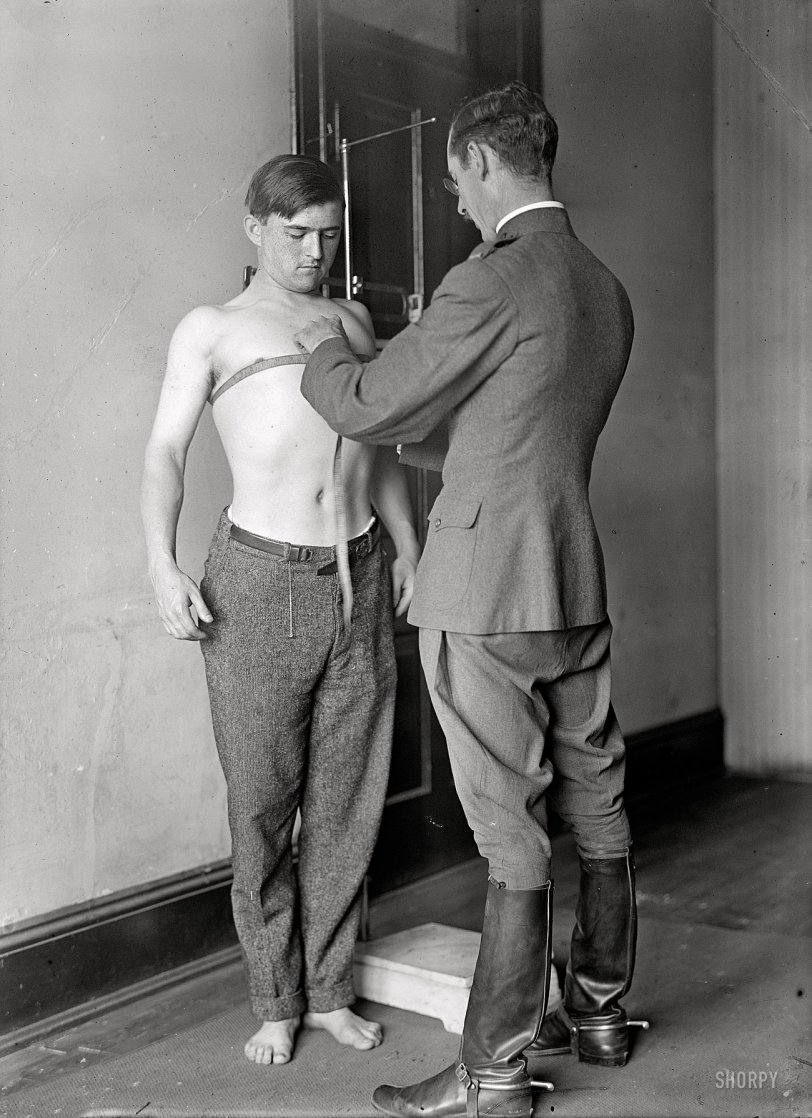
1917. "U.S. Army. Physical examination." Our second look at this young man's initiation into the Army. Harris & Ewing glass negative. View full size.
Neigh
The recruit isn't necessarily joining the cavalry, and the officer isn't necessarily a cavalryman. Lots of soldiers rode horses in those days, including any officer above the rank of captain in any branch.

Boots
Let me explain the boots and why you may have seen them still in use recently. I am a former (still in USAR) United States Army officer. I am a tanker. I also served in 3-8 Cavalry, Second Brigade, Third Armored Division. The boots are not really regulation. However, by a strict interpretation of the manual, AR 670-1, Wear and. Appearance of Army Uniforms and Insignia, you can make them regulation. At least, you could make them regulation in the 1980s. These days, I have no idea. All the manual used to say about boots was "black toed and able to be shined." So, tankers and cavalrymen got some pretty exotic boots, often spending hundreds of dollars. I wore "tanker boots." I have included a link to what they look like:

Still in Service
A few months ago, I saw an army sergeant with a Cavalry shoulder patch, rows of battle ribbons and wearing boots and spurs. I'm guessing the boots and spurs are part of the US Cavalry Class A uniform.
Riding Spurs
Note that the examining officer is wearing riding spurs. I guess we can assume that the young man is being inducted into the cavalry!
That outfit ...
If there is a riding crop anywhere in the examining room, put on your clothes and head for the hills, boy!
 Shorpy.com is a vintage photography site featuring thousands of high-definition images. The site is named after Shorpy Higginbotham, a teenage coal miner who lived 100 years ago. Contact us | Privacy policy | Accessibility Statement | Site © 2024 Shorpy Inc.
On Shorpy:
Today’s Top 5