


Framed or unframed, desk size to sofa size, printed by us in Arizona and Alabama since 2007. Explore now.
Shorpy is funded by you. Patreon contributors get an ad-free experience.
Learn more.



- Freeze Frame
- Texas Flyer wanted
- Just a Year Too Soon
- WWII -- Replacing men with women at the railroad crossing.
- Yes, Icing
- You kids drive me nuts!
- NOT An Easy Job
- I wonder
- Just add window boxes
- Icing Platform?
- Indiana Harbor Belt abides
- Freezing haze
- Corrections (for those who care)
- C&NW at Nelson
- Fallen Flags
- A dangerous job made worse
- Water Stop
- Passenger trains have right of way over freights?
- Coal
- Never ceases to amaze me.
- Still chuggin' (in model form)
- Great shot
- Westerly Breeze
- For the men, a trapeze
- Tickled
- Sense of loneliness ...
- 2 cents
- Charm City
- What an Outrage
- Brighton Park

Photos submitted by Shorpy members!
Print Emporium




Planter: 1865
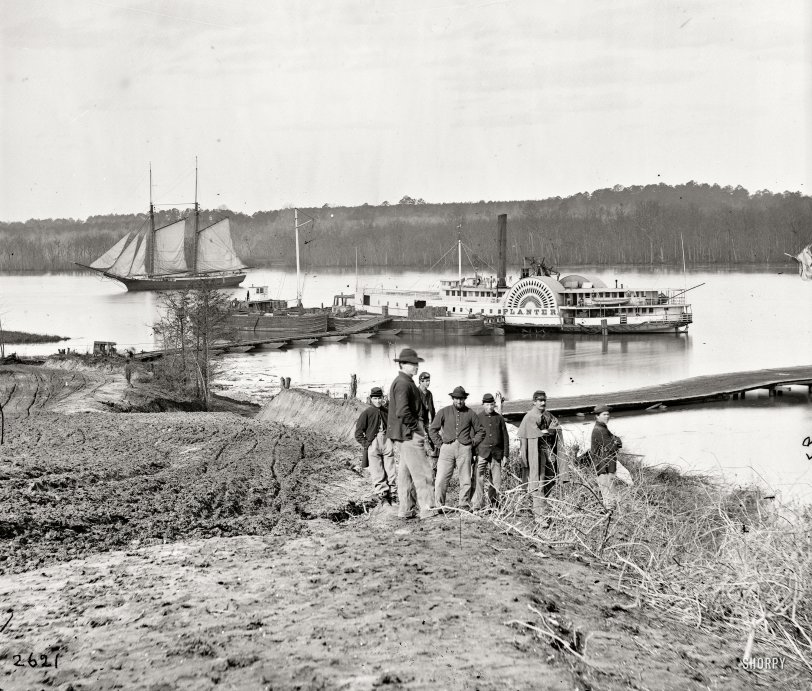
Circa 1865. "City Point, Virginia (vicinity). Medical supply boat Planter at General Hospital wharf on the Appomattox." Wet plate glass negative. View full size.
Steamboat Planter
Sternquarter view of Medical Supply Steamboat Planter at General Hospital Wharf on the Appomattox River, City Point, Virginia, circa 1865, from Library of Congress. Here's a link to the story of how the Planter under the control of the Confederates was taken over by slave crewmembers and who escaped and turned her over to the Federal forces in Charleston Harbor, NC: https://civilwarbookofdays.org/tag/css-planter/

Interesting pic ... could
could those be coffins piled on the supply boat?
They seem to have the wrong dimensions for coffins. - Ken
Fishing
I agree. This is a wonderful photo -- full of detail. I particularly like the wagon and horse in the far left center and the man sitting behind the little white house (captain's quarters?) on the boat. He appears to be looking out at the schooner. My question is - why isn't he fishing? The river looks like it would be teeming with fish.
Background
Nice little history of the sidewheeler "Planter" here.
Wow
What a detail-rich photograph! Note the wash hung to dry just aft of the Planter's wheelhouse. And there appears to be something (dredging equipment?) moored to starboard beyond the Planter.
Schooner etc
Lots of neat details in this picture. Planter is tied up to a piling with a stern and spring line, but the "dock" seems to be composed entirely of moored boats, suggesting its temporary nature. Alongside look like canal barges due to their straight sides and very bluff bows, apparently designed to a beam limit. In this period, barges could also be towed by a steam tug, but these may have been towed by mules.
The schooner, because of the short hoist and long gaffs of its lower sails and the very long bowsprit with so many headsails, looks like an "import" from Maine, or elsewhere in New England. The Chesapeake Bay "pungy schooners" of this period had taller sails, fewer headsails, and more of a graceful sheer but with less steeve to the bowsprit, while this ship has the sturdy lines common in more exposed waters.
I wonder if there is any way to find out the name of this schooner? Probably not without the exact date.
Civil War Era Boats
This is the best photo I've seen here in weeks. There's nothing better than boating images from this period. Love it!
Kedging
Kedging -- using the anchor and the windlass to move a ship back and forth -- was also an option in shallow water.
I lust
The paddlewheel is nice but I'm going on that schooner. Bon voyage! Can you imagine trying to maneuver a vessel of that size in a narrow channel with no engine and, therefore, no means for backing up? Guess that's when the rowboats come out to push/pull.
 Shorpy.com is a vintage photography site featuring thousands of high-definition images. The site is named after Shorpy Higginbotham, a teenage coal miner who lived 100 years ago. Contact us | Privacy policy | Accessibility Statement | Site © 2024 Shorpy Inc.

On Shorpy:
Today’s Top 5