


Framed or unframed, desk size to sofa size, printed by us in Arizona and Alabama since 2007. Explore now.
Shorpy is funded by you. Patreon contributors get an ad-free experience.
Learn more.



- Freeze Frame
- Texas Flyer wanted
- Just a Year Too Soon
- WWII -- Replacing men with women at the railroad crossing.
- Yes, Icing
- You kids drive me nuts!
- NOT An Easy Job
- I wonder
- Just add window boxes
- Icing Platform?
- Indiana Harbor Belt abides
- Freezing haze
- Corrections (for those who care)
- C&NW at Nelson
- Fallen Flags
- A dangerous job made worse
- Water Stop
- Passenger trains have right of way over freights?
- Coal
- Never ceases to amaze me.
- Still chuggin' (in model form)
- Great shot
- Westerly Breeze
- For the men, a trapeze
- Tickled
- Sense of loneliness ...
- 2 cents
- Charm City
- What an Outrage
- Brighton Park
Photos submitted by Shorpy members!
Print Emporium





The Sterilizer: 1922
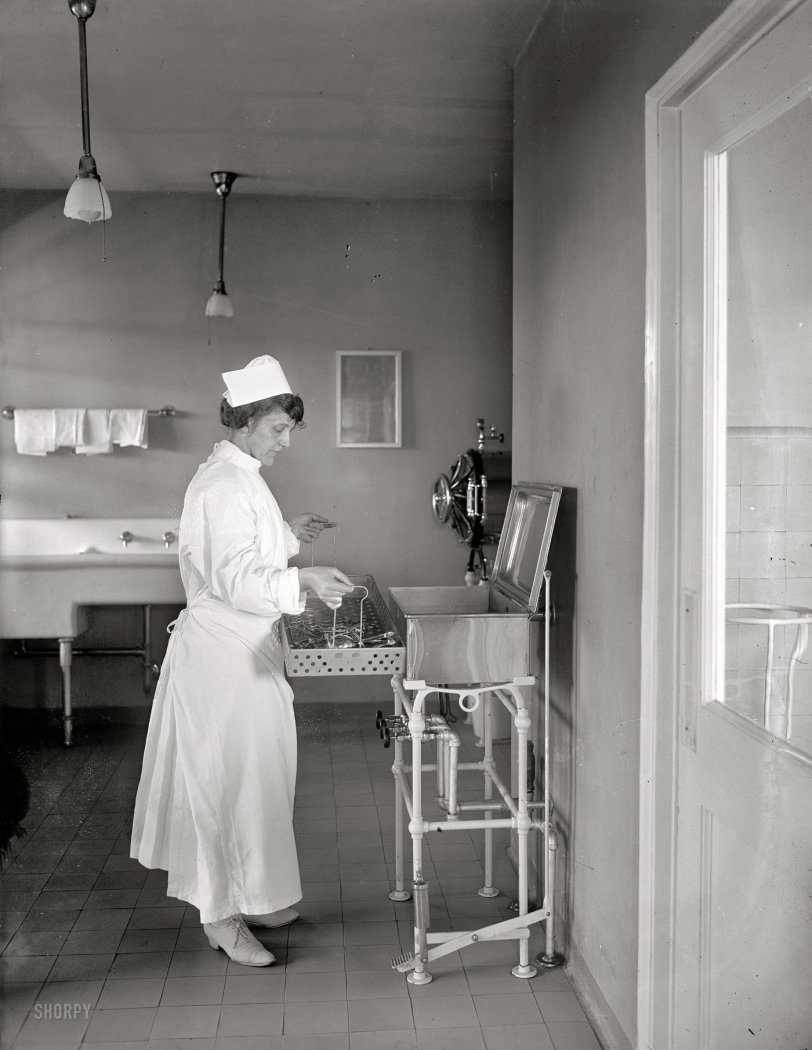
Why is this scary?
Until very recently, this was the process for sterilizing all surgical instruments. A high-pressure hot water bath clensed them of blood and other debris; they were put into an autoclave.
Nowadays, in the hospitals were I have worked, most of the instruments are disposible, since the cost in labor, equipment and energy to sterilize them is more than what they are worth.
I would bet that in a lot of other countries, and maybe even older hospitals in the US, the process and equipment looks pretty much like this.
Joseph Feather, RN

A Sterile Experience
My grandmother was a nurse, and told me that around WWI she used to take a horse-drawn cutter into farm country in the winter to deliver babies. (What I mean is to assist at the delivery - it wasn't the FedEx Stork Division). Fast forward to 1960, just before she retired, when she used to give me tours of the hospital facilities. The room used for recycling and sterilizing was identical to the photo. Hypos and their needles were sterilized, as well as surgical instruments, then sent around again (the needles were resharpened on a whetstone). Apparently almost everything is discarded today.
I don't know what Dave means by the left foreground - there's nothing there. The autoclave is in the background at the right.
[Look closer. On the left, wearing white shoes. - Dave]
Yikes
this one scares me just a little....
The actual sterilizer...
... is the steam autoclave in the background around the corner. The nurse is preparing to dip the instruments in a wash tank prior to the actual sterilization process.
[Actually the "actual sterilizer" is in the foreground, on the left. - Dave]
 Shorpy.com is a vintage photography site featuring thousands of high-definition images. The site is named after Shorpy Higginbotham, a teenage coal miner who lived 100 years ago. Contact us | Privacy policy | Accessibility Statement | Site © 2024 Shorpy Inc.

On Shorpy:
Today’s Top 5