Most of the photos on this site were extracted from reference images (high-resolution tiffs, 20 to 200 megabytes in size) from the Library of Congress research archive. (To query the database click here.) Many were digitized by LOC contractors using a Sinar studio back. They are adjusted by your webmaster for contrast and color in Photoshop before being downsized and turned into the jpegs you see here.

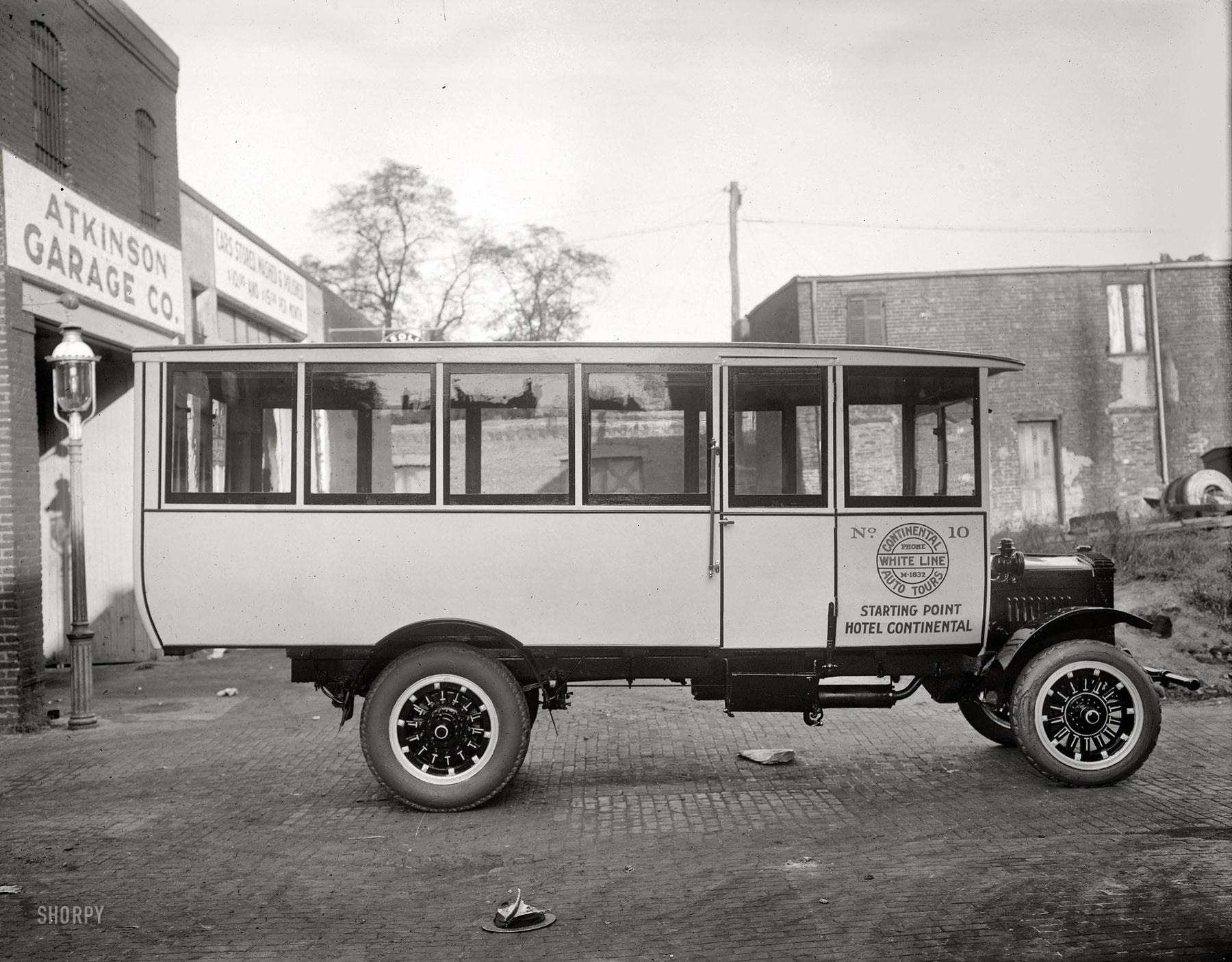
Washington, D.C., circa 1924. "Continental White Line bus." Who can pinpoint the location here? National Photo Co. Collection glass negative. View full size.
How lucky am I? My software business is located directly across the alley from this building. Blagden Alley rocks; we love being there amongst the history, trying to build something new.
By day: dutiful civic transport. By night: wanton destroyer of ladies' millinery.
I'm not usually very interested in vehicles of that age but that's got to be one of the most beautiful bus bodies I've ever seen. The designer was obviously someone who saw coachbuilding as an art rather than a job; just look at the sweep of the roof line - there's not a straight section in it.
This is the sort of thing that makes Shorpy the best website ever.
I don't think I'd have a lot of faith in that right front tire. It looks like a bad "re-capping" job is about to delaminate - blowout!
Another view of the old garage in Blagden Alley. Note the ghost lettering on the beam across the garage door. Google Maps goofed on the street name's spelling!
Between the photo and the Google pic. Can even see where the drain cover in the foreground was -- the dark circle on the left in the Street View.
[Wouldn't it be funny if that hat was still there. - Dave]
Is that a smashed hat in the foreground? Very nice omnibus.

According to an ad in the Washington Post (May 7, 1922), Atkinson Garage was in "Blagdon's Court" between 9th and 10th, M and N Streets NW.
[That didn't take long! Now called Blagden Alley. - Dave]

It doesn't appear that there was a great deal of ventilation for this omnibus. In a time before antiperspirants and in wool clothing, no ventilation would be a bad thing. I can just imagine some of the tours were rather ripe.
It could smell like the Lancaster County Farmer's Market on a rainy Friday in July after the Amish have been picking corn all week. The kind of smell that's nearly visible.
[The four-section windshield is hinged and opens for ventilation. Deodorants, which go back to the 19th century, were well established by the 1920s. - Dave]
I think it's right in front of the Atkinson Garage Company.