Syndicate content
Syndicate content
Syndicate content
   
Add to Google   Add to My Yahoo!


Member Photos


Photos submitted by Shorpy members.


About the Photos

Most of the photos on this site were extracted from reference images (high-resolution tiffs, 20 to 200 megabytes in size) from the Library of Congress research archive. (To query the database click here.) Most were digitized by LOC contractors using a Sinar studio back. They are adjusted by your webmaster for contrast and color in Photoshop before being downsized and turned into the jpegs you see here.


JUMP TO PAGE   100  >  200  >  300  >  400  >  500  >  600
VINTAGRAPH • POSTERS • AMAZING • DISCOVER PUERTO RICO

Mexican Central Railway: 1891

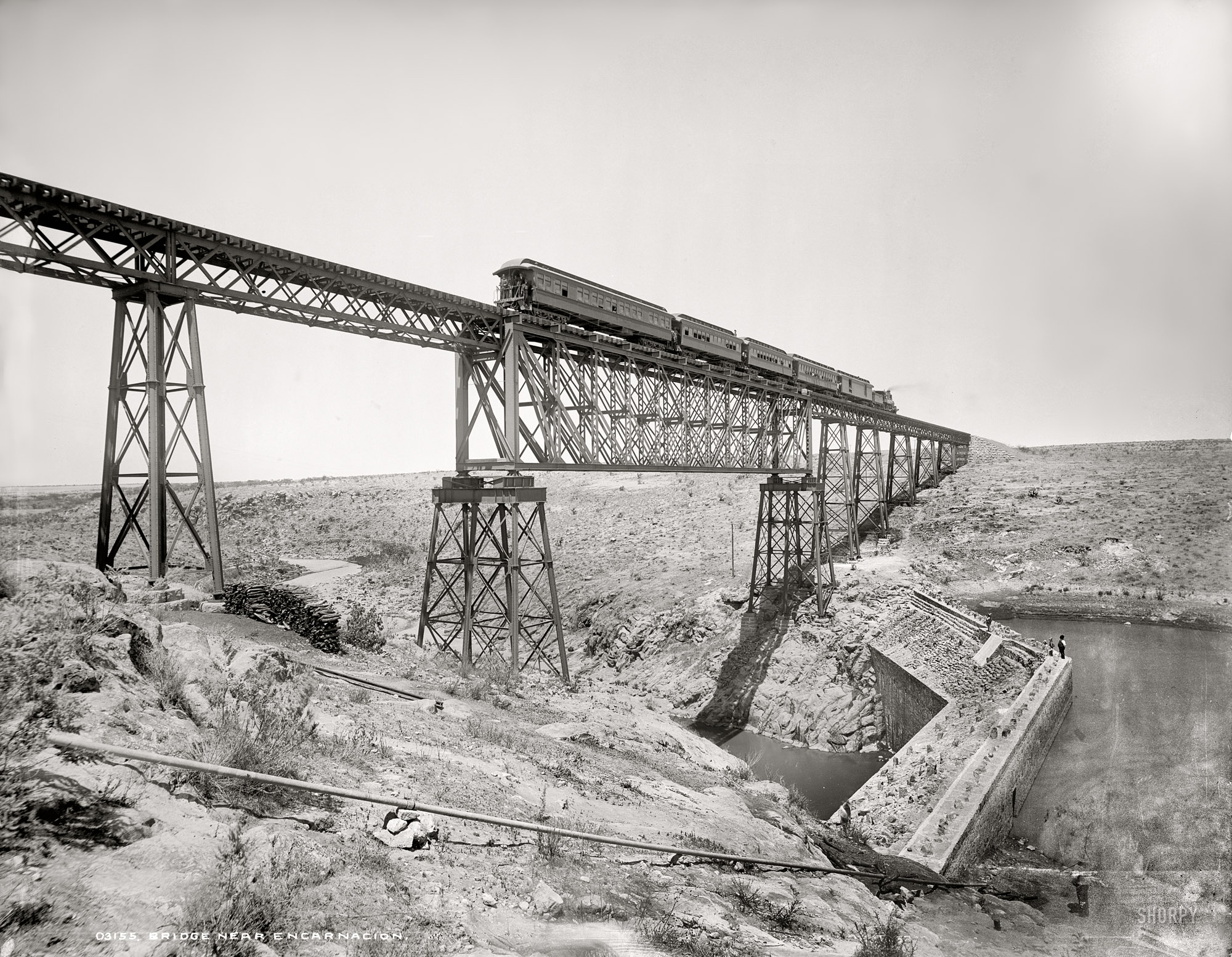
Mexican Central Railway: 1891

Jalisco, Mexico, circa 1891. "Bridge near Encarnacion. Ferrocarril Central Mexicano." Glass negative by William Henry Jackson. View full size.

On Shorpy:
Today's Top 5

Location

I am currently working on a conceptual architecture project that is focused on reprogramming abandoned stations of the old passenger railway system in Mexico. Does anyone know if this bridge is still in existence or where I can find its exact location? The name of the river which it spans would also be helpful.


Same Place

No doubt they are the same place. It was common for early RR bridges to be anchored by earth later in their history as loads got heavier and train speeds faster. The bridge is still inside the berm. Train cars would travel over the trestle, dumping their loads of sand or gravel repeatedly until the span was filled.

How many amazing vistas were spoiled by the cheapest and least creative engineering solution?


Re: Railroad bridge and a dam too

The small city in Nebraska where I grew up had this sort of setup, with a high railroad trestle crossing the gorge below the dam. We used to walk halfway across the bridge and drop through the tracks onto the concrete support. There were iron bars running down the side, forming a ladder to the ground 50 or 60 feet below. We'd climb down and fool around in the river, oblivious to the risk of getting there. The dam was part of a hydroelectric plant that supplied power to our city. It was about 2 feet wide at the top, with a 3-story drop below the water. Sometimes we'd walk across the dam with water running over our feet to get to an island in the middle of the stream above the dam, carrying 2-foot corn knives and other tools to build a fort in the "jungle". It's a wonder we survived to adulthood!


Trainvid

Seems to be the same place.


How we got these W. H. Jackson photos

William Henry Jackson was somewhat better as a photographer than a businessman. After being his own entrepreneur, he signed onto the Detroit Publishing Company in 1897 as its president, and in the bargain the company got this and 10,000 other Jackson photos. After Detroit Publishing went under, Edsel Ford bought 40,000 negatives for Greenfield Village in Michigan. In 1949, Jackson's negatives were donated to the Colorado Historical Society, which kept the Western U.S. photos and gave the rest to the Library of Congress -- and ultimately to Shorpy and us. Thanks very much indeed!


Wow!

Wow, awesome! Finally I see a picture of my country here in Shorpy! Kudos for that!


Locomotive Levitation

Amazing what could be done with sweat and steam power. The laws of physics haven't changed.


Railroad bridge and a dam too

Anyone know of other examples of this kind of combo?


Wow

What an amazing engineering feat.


Leave a Comment

CAPTCHA
This question is to prevent automated spam submissions. If you were logged in as a registered user, you wouldn't have to bother with this silliness.
 
THE 100-YEAR-OLD PHOTO BLOG
Syndicate content  Shorpy.com | History in HD is a vintage photography blog featuring thousands of high-definition images from the 1850s to 1950s. The site is named after Shorpy Higginbotham, a teenage coal miner who lived 100 years ago. Contact us | Privacy policy | Site contents © 2010 shorpy.com