



Framed or unframed, desk size to sofa size, printed by us in Arizona and Alabama since 2007. Explore now.
Shorpy is funded by you. Patreon contributors get an ad-free experience.
Learn more.




- Lost in Toyland
- And without gloves
- If I were a blindfolded time traveler
- Smoke Consumer Also Cooks
- Oh that stove!
- Possibly still there?
- What?!?
- $100 Reward
- Freeze Frame
- Texas Flyer wanted
- Just a Year Too Soon
- WWII -- Replacing men with women at the railroad crossing.
- Yes, Icing
- You kids drive me nuts!
- NOT An Easy Job
- I wonder
- Just add window boxes
- Icing Platform?
- Indiana Harbor Belt abides
- Freezing haze
- Corrections (for those who care)
- C&NW at Nelson
- Fallen Flags
- A dangerous job made worse
- Water Stop
- Passenger trains have right of way over freights?
- Coal
- Never ceases to amaze me.
- Still chuggin' (in model form)
- Great shot

Photos submitted by Shorpy members!
Print Emporium







Holey Smokestack: 1865
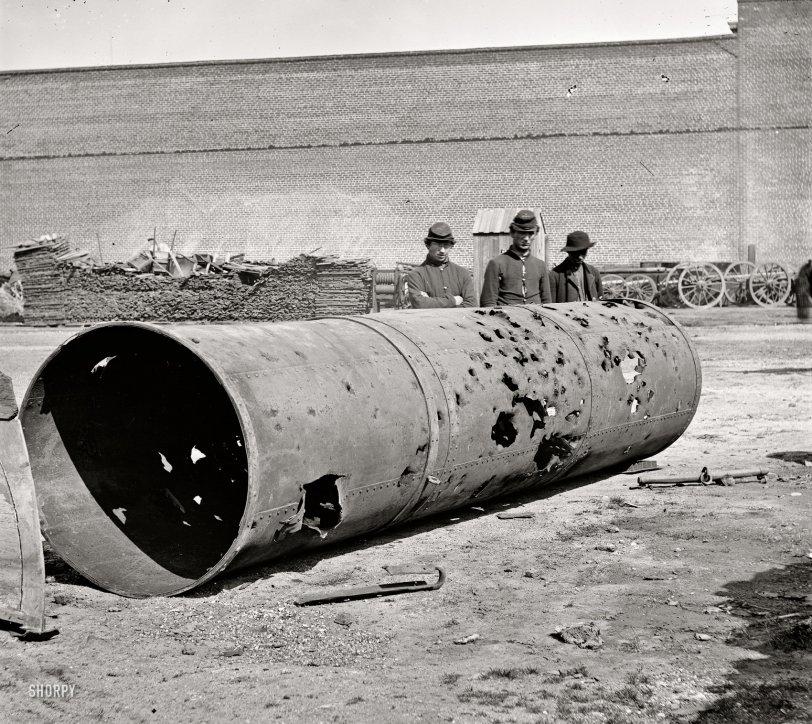
Richmond, April 1865. "Battered smokestack from C.S.S. ironclad ram Virginia No. 2. Holes made by Federal batteries." Wet plate glass negative. View full size.
Wonderwall
They don't lay bricks like that any more.

"Correction" Corrected
>> This is the stack from the famous duel of the ironclads known as the Monitor and the Merrimac.
Um, no. This was the stack of the CSS Virginia II (as the caption clearly states), an ironclad ram launched in June 1863 and commissioned May 1864. She was the lead ship of the James River Squadron and was severely damaged at the battle of Trent's Reach. Repairs were nearly completed when Richmond was evacuated and the ship destroyed by the retreating Confederates.
Correction to the history books
When I was in grade school the history books wouldn't even dignify the CSS Virginia by its name. They insisted on calling it the Merrimac. Which was the hull upon which the Ironclad Virginia was built.
This is the stack from the famous duel of the ironclads known as the Monitor and the Merrimac.
Sharp dresser
Look how ratty the middle guy's sack coat is!
Energizer bunny gone amok
I'm guessing that the Federal batteries were guns, or that a battery was a name for a gathering of soldiers with guns, or something like that, because if those holes were made by anything that people in 2009 would call a battery, look out!
It does indeed look battered.
And I can sort of see why the French call a drum a batterie.
You batter it to get a sound.
But then, how ever did the lead-acid or paste energy cell get called a battery?
["Battery" connotes multiplicity. Electrical storage devices started out as groupings or arrays of cells. A battery of cells, a battery of guns. - Dave]
 Shorpy.com is a vintage photography site featuring thousands of high-definition images. The site is named after Shorpy Higginbotham, a teenage coal miner who lived 100 years ago. Contact us | Privacy policy | Accessibility Statement | Site © 2024 Shorpy Inc.

On Shorpy:
Today’s Top 5