Most of the photos on this site were extracted from reference images (high-resolution tiffs, 20 to 200 megabytes in size) from the Library of Congress research archive. (To query the database click here.) Many were digitized by LOC contractors using a Sinar studio back. They are adjusted by your webmaster for contrast and color in Photoshop before being downsized and turned into the jpegs you see here.

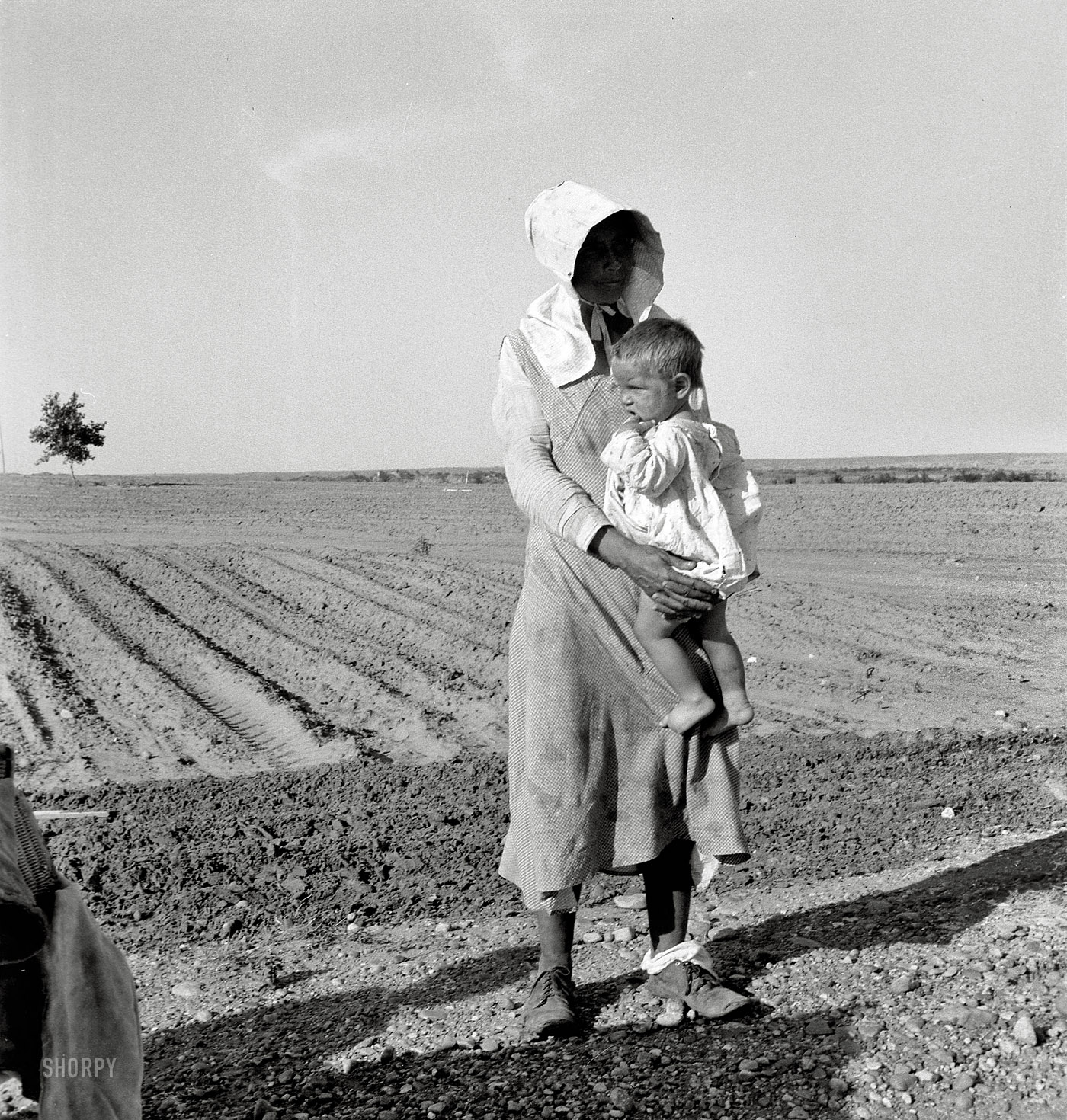
May 1937. "Mother and child of Arkansas flood refugee family near Memphis, Texas. These people, with all their earthly belongings, are bound for the lower Rio Grande Valley, where they hope to pick cotton." Medium-format nitrate negative by Dorothea Lange for the Resettlement Administration. View full size.
I grew up in Tennessee, where there were fields adjoining our fairly new subdivision. I wondered at the solitary trees left standing in those fields as well, and was told it was to give the farmers and animals a break from the hot sun as they plowed the fields.
who the wiseguy is who planted that solitary tree!
I am now in my seventies and was a child of that lonely, desperate time. My family had pictures of family members that looked almost as gaunt as the lady in the picture. My father worked for a dollar a day and felt blessed to have a cow loaned to him by a neighbor if he would feed the animal. Before my parents died they told us many stories of that timek and by doing this it has kept me grateful for our many blessings.
The generation that had to pick cotton is getting old and leaving us. My "Texas bride" was taken out of high school in Kaufman to pick cotton along with her sisters. To this day she resents not the picking of cotton but the fact her father drove home past the high school, where her friends could see them and know how they had spent the day.
I suppose we can't really say what their lives were like later. But in my personal experience, more than a few of these Depression kids grew into fortune (or at least comfortable middle-class stability) beyond their wildest dreams. It was the fate of a generation.
I'm afraid it didn't go as well for the adults. Many were simply destroyed, body and soul, eaten up by a decade of toil & poverty. Recall the old folks of fifty years ago who died at 54.
The way this woman's sun bonnet obscures her face in shadow gives her the eerie appearance of being the Grim Reaper.
Hope it was not a sign of things to come for this family.
I find it rather haunting that we can't really see the woman's face under that hood. Puts me in mind of that cemetery statue published on Shorpy not so long ago.
This is the most powerful image I have ever seen seen on Shorpy.Where do you start.I hope some other Shorpsters with superior commentary skills than I can do this picture justice.
That poor woman is so down that even her socks won't stay up.
That is an incredible image for all the obvious reasons.
The caption says that the "people" are bound for the lower Rio Grande Valley to pick cotton. Looking at the fields in the photo, which are southeast of Lubbock, it appears to be many months before cotton could be picked even in the further south region of the Rio Grande. So, one supposes that they will be out of work for a long, long time in the heat and summer of southern Texas.
The sadness of the mother's outfit including the sun bonnet is heart wrenching.The style of her clothes, homemade, haven't changed for a hundred years.. She and her family's lives probably wouldn't improve until the 1940s war economy provided jobs. I hope the baby grew up in better circumstances and that fate treated them all better.