


Framed or unframed, desk size to sofa size, printed by us in Arizona and Alabama since 2007. Explore now.
Shorpy is funded by you. Patreon contributors get an ad-free experience.
Learn more.



- Freeze Frame
- Texas Flyer wanted
- Just a Year Too Soon
- WWII -- Replacing men with women at the railroad crossing.
- Yes, Icing
- You kids drive me nuts!
- NOT An Easy Job
- I wonder
- Just add window boxes
- Icing Platform?
- Indiana Harbor Belt abides
- Freezing haze
- Corrections (for those who care)
- C&NW at Nelson
- Fallen Flags
- A dangerous job made worse
- Water Stop
- Passenger trains have right of way over freights?
- Coal
- Never ceases to amaze me.
- Still chuggin' (in model form)
- Great shot
- Westerly Breeze
- For the men, a trapeze
- Tickled
- Sense of loneliness ...
- 2 cents
- Charm City
- What an Outrage
- Brighton Park
Photos submitted by Shorpy members!
Print Emporium
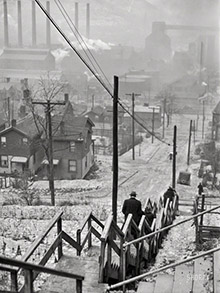
Deep Freeze: 1918
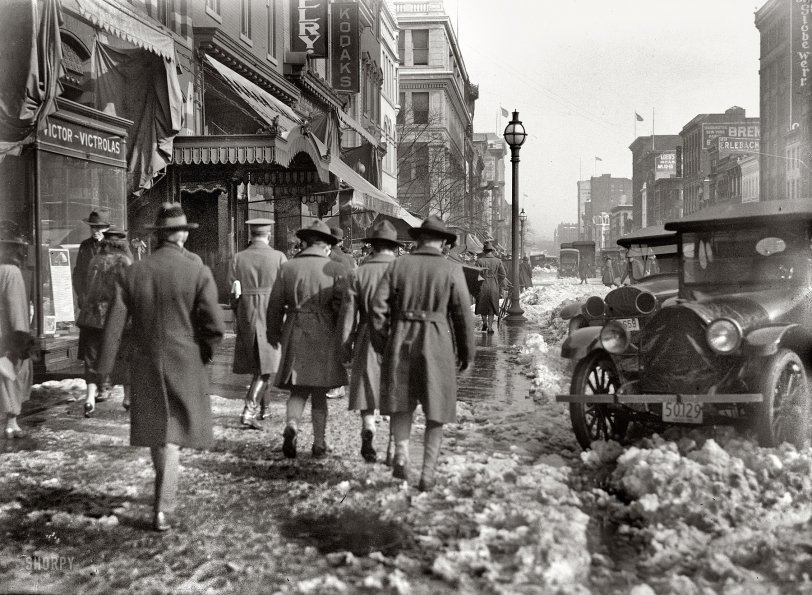
Washington, D.C., circa 1918. "Street scene with snow." More specifically the scene on F Street NW just outside the Harris & Ewing studio, which was over the Victrola store. Harris & Ewing Collection glass negative. View full size.
Giddy up!
On another Shorpy photo from the same period we see a District of Columbia National Guard medical officer wearing spurs while riding herd on medical exams. Spurs were part of an officer's uniform, harking back to the day when most officers were mounted. Traditions die hard. I've seen a photo of Dwight Eisenhower wearing boots and spurs early in WWII.

Spurs
Fort Meyer, just across the river from Washington D.C. was an Army cavalry post. Another tip that the officer (he had boots not leggings like the three enlisted men behind him) was a cavalry "trooper' is that the rear flap in his overcoat is unbuttoned. I was in the First Cavalry Division during and after WW II. We were required to keep the flap buttoned as we were "dismounted" cavalry. It could only be unbuttoned if you were mounted cavalry - tradition.
Bill
Pack up -- We're off to California
At the time of this photo, my parents were ten and six years old, growing up in Michigan and Wisconsin. Later, while in the Army, my dad was sent to Santa Barbara, CA, on the Pacific coast less than 100 miles north of LA.
In February, they needed only a light jacket to fend off winter. My dad penned a letter to mom stating emphatically, "When I'm discharged from the Army, we're moving to California." We arrived when I was about 7 months old (1945).
Scenes such as this keep me here.
Headlight covers
They protected the headlight from flying road debris. Shatterproof glass was some time in the future, as was the use of headlights in the daytime.
Cold Headlights?
OK, I know they covered the radiators in cold weather to keep the engine warm but does anyone know why the second car back has the headlights covered?
If I looked ...
Through my eyelashes, I'd swear I see the Verizon Center!
 Shorpy.com is a vintage photography site featuring thousands of high-definition images. The site is named after Shorpy Higginbotham, a teenage coal miner who lived 100 years ago. Contact us | Privacy policy | Accessibility Statement | Site © 2024 Shorpy Inc.
On Shorpy:
Today’s Top 5