


Framed or unframed, desk size to sofa size, printed by us in Arizona and Alabama since 2007. Explore now.
Shorpy is funded by you. Patreon contributors get an ad-free experience.
Learn more.



- Indiana Harbor Belt abides
- Freezing haze
- Corrections (for those who care)
- C&NW at Nelson
- Fallen Flags
- A dangerous job made worse
- Water Stop
- Passenger trains have right of way over freights?
- Coal
- Never ceases to amaze me.
- Still chuggin' (in model form)
- Great shot
- Westerly Breeze
- For the men, a trapeze
- Tickled
- Sense of loneliness ...
- 2 cents
- Charm City
- What an Outrage
- Brighton Park
- Catenary Supports
- Just a Little Before I was Born
- Afternoon normal
- The Flat Iron Cafe survives
- Aging in Place
- Raise your hand
- Good and Bad
- Oh, the 70's
- Nooooooi
- The aluminum tubing

Photos submitted by Shorpy members!
Print Emporium

NCR Girls: 1902
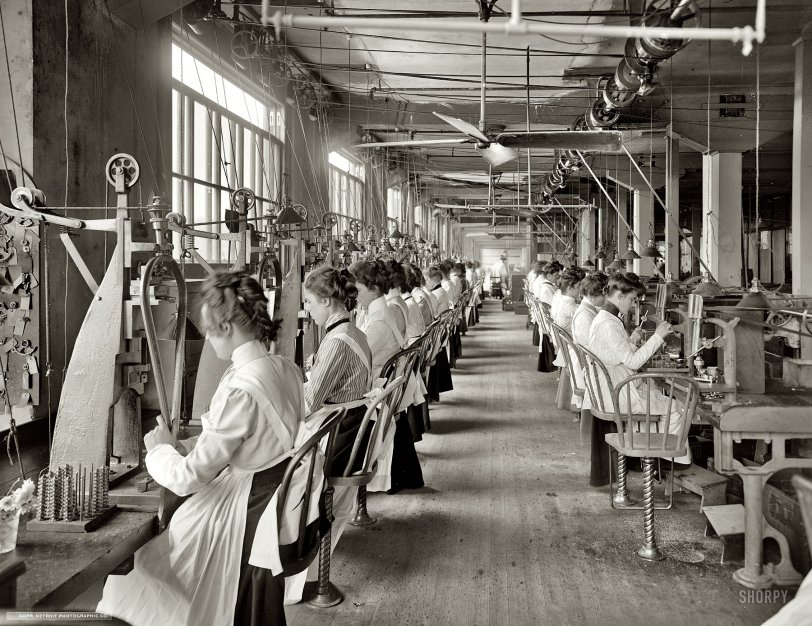
Dayton, Ohio, circa 1902. "Lock and drill department, National Cash Register." Dry plate glass negative, Detroit Publishing Company. View full size.
Gibson Girls
All these young ladies seem to have virtually the same hairstyles. Presumably, their hair is done up in pins to avoid tangling with machinery. I wonder if they truly let their hair down when they went home at night?

The machinery
The row on the right is small drill presses. Nothing unusual there.
The ones on the left look like pantograph engravers. The workpiece appears to be a decimal counting wheel or something similar. It's stuck on a horizontal shaft just below the top of the yoke in the center - you can see that it matches the ones stacked up on the pins to the left of the worker.
The machine has a vertical spindle that spins at high RPMs, judging from the pulley diameter ratios leading up to it.
The bottom of the machine may have some sort of pattern that the worker traces over and the machine follows. Numbers 0 through 9, perhaps.
Workplace amenities
Good point, Anonymous -- and as we see in the next photograph, the dining facilities are more than civilized. (Separate dining rooms for ladies and gentlemen. White tablecloths.)
Dressed to Kill
In comparison to these well-dressed ladies, today's workforce is a bunch of ragamuffins.
Nice Work
Mostly comfy looking height-adjustable chairs, footrests and stools, fans overhead, aprons to keep your clothes clean, height-adjustable task lighting, and even flowers on the workstation left front. Compared to other places we've seen, this was probably a good job to have in 1902.
 Shorpy.com is a vintage photography site featuring thousands of high-definition images. The site is named after Shorpy Higginbotham, a teenage coal miner who lived 100 years ago. Contact us | Privacy policy | Accessibility Statement | Site © 2024 Shorpy Inc.
On Shorpy:
Today’s Top 5