



Framed or unframed, desk size to sofa size, printed by us in Arizona and Alabama since 2007. Explore now.
Shorpy is funded by you. Patreon contributors get an ad-free experience.
Learn more.



- Baldwin 62303
- Baldwin VO-1000
- Cold
- No expense spared
- Tough Guys
- Lost in Toyland
- And without gloves
- If I were a blindfolded time traveler
- Smoke Consumer Also Cooks
- Oh that stove!
- Possibly still there?
- What?!?
- $100 Reward
- Freeze Frame
- Texas Flyer wanted
- Just a Year Too Soon
- WWII -- Replacing men with women at the railroad crossing.
- Yes, Icing
- You kids drive me nuts!
- NOT An Easy Job
- I wonder
- Just add window boxes
- Icing Platform?
- Indiana Harbor Belt abides
- Freezing haze
- Corrections (for those who care)
- C&NW at Nelson
- Fallen Flags
- A dangerous job made worse
- Water Stop

Photos submitted by Shorpy members!
Print Emporium




Child of migratory workers
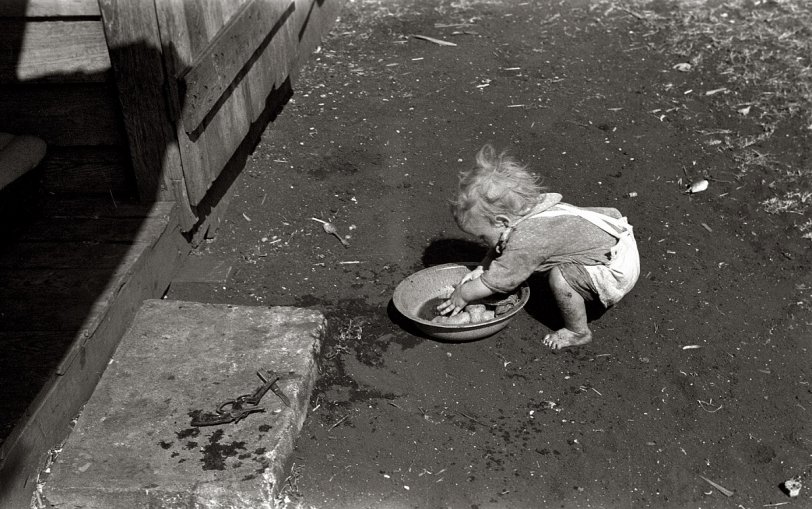
February 1939. "Child of migratory packinghouse workers. Belle Glade, Florida." View full size. 35mm nitrate negative by Marion Post Wolcott for the FSA.
Filthy child
I have a picture of me and a little boyfriend when I was 3 years old, both of us smiling and covered with mud and dirt. We had so much mud on our faces you could hardly make us out. We weren't migratory children however. Just normal kids having fun in the dirt and mud. I even remember eating dirt as a child. Something about a mineral deficiency.

Belle Glade Babe
This child looks like she's been well cared for. She's been bathed recently and her clothes are rather clean. "Filthy" says in real need of cleaning and the word also has an undertone, as "nasty." Yes, it is unfortunate that child is at someone's work-place for her child-care but in this picture I say she's OK. I remember getting dirty and loving to play in mud. 55 yrs after those early memories I'm still able to get around and get dirty without any ill effects.
my father could have been that child
Dad was born in 1937 to migrant worker parents. He started picking about 5 yrs of age. Belle Glade Florida was one of their yearly picking destinations. When not living in migrant shacks at a farm they lived in the car traveling from state to state and farm to farm living at a subsistence level that we might call homelessness today.
Homeless rootless, "food insecure", uneducated and exploited, often living on flour and water biscuits and stolen cottonseed cake intended for cattle, they couldn't afford to eat the crops they picked. Husband, wife, and 4 kids being "dragged around from pillar to post" as a great-aunt put it. After the Depression there were a lot of folks living like this and they felt lucky to have that while at the same time painfully aware of their exploitation.
The child seems blissfully unaware of the social implications of his/her plight and looks like she/he is enjoying themselves and has at least 4 'toys' to play with. Only a couple of years before he/she will be next to their parents in the field stooping and picking and not going to school- ironically contributing to the family's financial and social advancement.
Sad!
Sad Picture. . .I have a daughter about this age and for some reason, it hurt me see this. . .don't know why. Makes you wonder if she is still alive today?
Bang Bang
Good observation. Whether it's "real" or not, it's missing the barrel.
The gun.
It looks like half of a toy gun. Metal toys were cast in 2 half pieces and pinned together. I have no idea when they stopped doing that and started going to stamped metal. Then on to the plastic we know and love.
A little of both, maybe?
It looks like it might be a real gun that broke in half. The knife is definitely real.
Such Toys....
Note the toy gun and knife (a toy? or Real?) on the step to the left. IS that a spoon laying atop the toy gun?
 Shorpy.com is a vintage photography site featuring thousands of high-definition images. The site is named after Shorpy Higginbotham, a teenage coal miner who lived 100 years ago. Contact us | Privacy policy | Accessibility Statement | Site © 2024 Shorpy Inc.

On Shorpy:
Today’s Top 5