Most of the photos on this site were extracted from reference images (high-resolution tiffs, 20 to 200 megabytes in size) from the Library of Congress research archive. (To query the database click here.) Many were digitized by LOC contractors using a Sinar studio back. They are adjusted by your webmaster for contrast and color in Photoshop before being downsized and turned into the jpegs you see here.

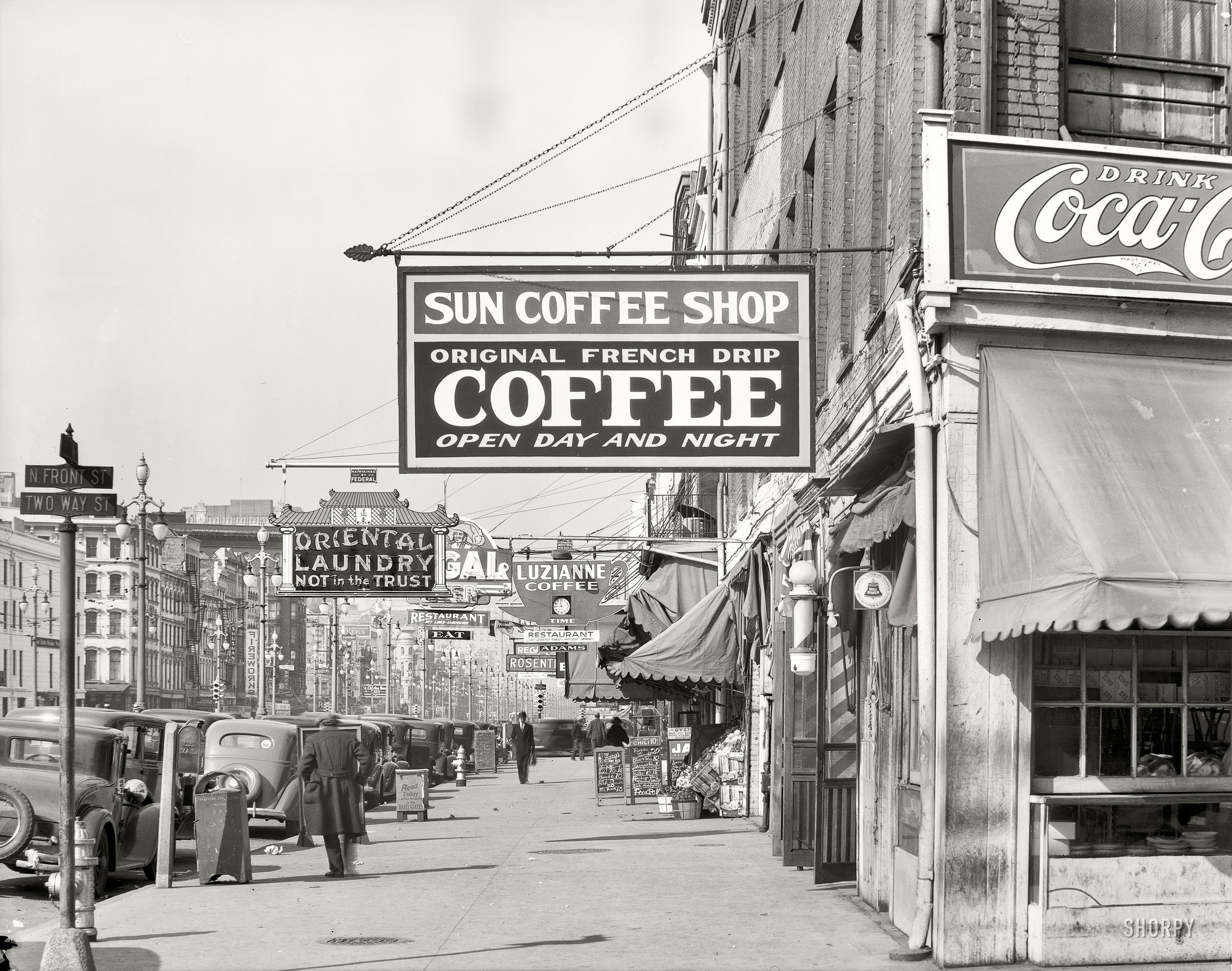
December 1935. "New Orleans, downtown street." North Front at Canal. Nitrate negative by Walker Evans for the Farm Security Administration. View full size.
Coffee made in a two-part pot. The bottom has a spout and handle and it is capped with a small pot with a lid.... You put the coffee in the top pot and and boiling water is poured over the grounds. They then drop down into the bottom pot. It is/was the favoured coffee in Louisiana.
Pots were hard to get for a long time but the popularity is again on the upswing and there are pots again being made.
Here is a poem about making the coffee...
Not to mention the more picturesque neon Regal Beer sign.
Not to be confused with French Press. The French Drip coffee maker consists of a pot from which you serve and the top part which contains the coffee grounds. Pour the hot water into the top portion and allow the water to drop through the grounds infusing the flavour into the water. continue to add water until the desired amount of coffee is made. Similar to the way that most coffee makers today operate, but when you realize that in the day most coffee was either percolated or served out of those big urns you can see why they advertised the more labour intensive (but better tasting) process.
What, I wonder, is "French Drip Coffee"?
I find it interesting that the tradition of being able to get a beer anywhere in New Orleans stretches back as far as anyone can remember, which is very much uncommon in the rest of the South. Does anyone else see the partially hidden Jax Beer sign?
I also like that the Barq's Root Beer logo hasn't changed in 75 years, in those days Barq's was a Southern Mississippi and South Louisiana beverage with the Biloxi, New Orleans, and Baton Rogue bottlers each having slightly different syrup formulas. Sadly, I'm too young to have experienced the old Third Coast.
Interesting in that some of the poles carrying the advertising signs have smaller signs advertising the fact that they maintain the signs!
Barq's Root Beer on the chalk sidewalk sign, didn't know Barq's was that old.
The city of my birth and it probably didn't look much different in 1948 when I made my appearance. Canal Street and North Front don't meet up today; Saks Fifth Avenue is on this corner and Harrah's Casino is across the street.
At 921 Canal St was the wonderful New Orleans department store Maison Blanche where we would go for photos with Santa and his sidekick Mr Bingle. Today it's the Ritz Carlton. I have to find one of our Santa photos.
Arthur Brisbane was one of the most important newspapermen of the early 20th century and worked for Hearst, but would die a year after this photo was taken. The Daily States would disappear by 1962 in a newspaper merger.
Wish that pedestrian wasn't blocking our view of the menu board.
Also, wonder when New Orleans got the tri-color traffic signals.
And how often today do you see a huge "FIREWORKS" sign?
[Well, if you live down South ... - Dave]

Chinese Laundries were ubiquitous in most cities. There was one in our neighbourhood when I was a kid but it closed in the very late 60s.
The building is still there but I doubt that the people who live in the remodelled and upscale building know its history.
I can still remember the tubs sitting outside the building at the back that was the actual wash-house, also turned into a pied-a-terre.
The photo was taken before its latest refurb.

The lengths they've gone to, extending so many signs closer to the street and car traffic, it seems. I imagine the first business to extend their sign outwards by about 10-15 feet caused the many others to do the same. Looks like the Oriental Laundry is ahead right now.
I actually drink Luzianne coffee, but I didn't know the brand was that old.
New Orleans looks to be one well-caffeinated town!
One of the Fords in the foreground has "BOHN" on the spare tire cover. Bohn Ford (now Don Bohn Ford) is still there, located on the West Bank in Harvey. In the '70s they were Dick Bohn Ford (no snide remarks, please).
Also, it looks to me like the sign for the cross street is Canal. Today that's where the Harrah's casino is located.
Another wonderful Shorpy picture packed with detail! I'm curious about the laundry sign in the centre of the the picture; they are advertising that they are "Not in the trust." Can anyone shed light on what this phrase refers to?
[It means the business is not part of a price-fixing cartel. - Dave]