



Framed or unframed, desk size to sofa size, printed by us in Arizona and Alabama since 2007. Explore now.
Shorpy is funded by you. Patreon contributors get an ad-free experience.
Learn more.



- Baldwin 62303
- Baldwin VO-1000
- Cold
- No expense spared
- Tough Guys
- Lost in Toyland
- And without gloves
- If I were a blindfolded time traveler
- Smoke Consumer Also Cooks
- Oh that stove!
- Possibly still there?
- What?!?
- $100 Reward
- Freeze Frame
- Texas Flyer wanted
- Just a Year Too Soon
- WWII -- Replacing men with women at the railroad crossing.
- Yes, Icing
- You kids drive me nuts!
- NOT An Easy Job
- I wonder
- Just add window boxes
- Icing Platform?
- Indiana Harbor Belt abides
- Freezing haze
- Corrections (for those who care)
- C&NW at Nelson
- Fallen Flags
- A dangerous job made worse
- Water Stop
Photos submitted by Shorpy members!
Print Emporium


Meanwhile, Back at the Stove Factory
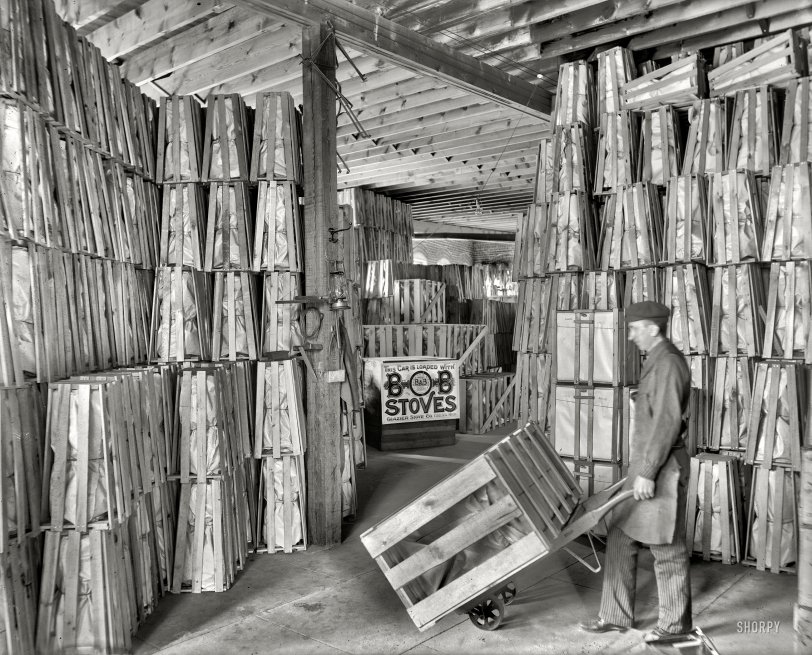
Chelsea, Michigan, circa 1901. "Glazier Stove Company, shipping room." Our sixth look behind the scenes at Glazier Stove, whose brand was B&B ("Brightest and Best"). 8x10 inch glass negative, Detroit Publishing Company. View full size.
Buzz Kill?
Kerosene could be much more forgiving than electricity in those days! Most rural service was knob and post, with many exposed, uninsulated runs, so as to facilitate attaching power clamps in random locations. Many a workman and farmer learned the hard way not to carry a shovel on your shoulder!

Creative wiring
Judging from the ingenious way in which that light bulb has been added to the circuit, the kerosene lantern may be the more benign option.
Stoves in Stir
I just remembered something about a gas range manufacturer. The Caloric Stove Company of Topton Pa, shipped their products with a Union Label sticker that read "No prison labor used".
Bob Books!
Now I know where the Bob Books got their logo! If you're not familiar with Bob Books (a series of kids' learn to read books) check out amazon. It is AMAZING!
Wouldn't wanna fight the fella
who could stack the stoves so high
Tinderbox
That's just the first word that comes to mind. Let's hope the electricity stays on and they don't have to light that kerosene lantern. Really no fire codes back in those days.
All he needs
Is a morning coat, a top hat and a cane. Nice pants.
Nothing says lovin'
... like shovin' an oven!
Creative shelving
Two interesting ways of putting up a shelf can be seen on the pillar. One is hanging by wires, the other is propped up with a stay. The latter is perhaps more practical, but I like the elegance of the wired shelf.
 Shorpy.com is a vintage photography site featuring thousands of high-definition images. The site is named after Shorpy Higginbotham, a teenage coal miner who lived 100 years ago. Contact us | Privacy policy | Accessibility Statement | Site © 2024 Shorpy Inc.

On Shorpy:
Today’s Top 5