


Framed or unframed, desk size to sofa size, printed by us in Arizona and Alabama since 2007. Explore now.
Shorpy is funded by you. Patreon contributors get an ad-free experience.
Learn more.



- Complicated then, forgotten now
- Bryan-Stevenson
- Skinny is as skinny does
- How do you rest in peace
- Riding the footboards
- Alas, hidden from view
- Baldwin Diesels
- Exclusive pump
- Bananas, Oysters and Smokey Joe
- Details, Details
- What's that building to the left of the tower?
- Coal Barges
- Bromo-Seltzer
- Inner harbor
- The Basin
- What a headache!
- Giant stepladder?
- Yeah, it was cold
- Love those coats
- Link & Pin Days Remnant
- Baldwin 62303
- Baldwin VO-1000
- Cold
- No expense spared
- Tough Guys
- What's your hurry, where's your hat?
- Sheriff's Signature
- Relocated in the Eighties
- Lost in Toyland
- And without gloves
Photos submitted by Shorpy members!
Print Emporium
Dorothea Lange: 1936
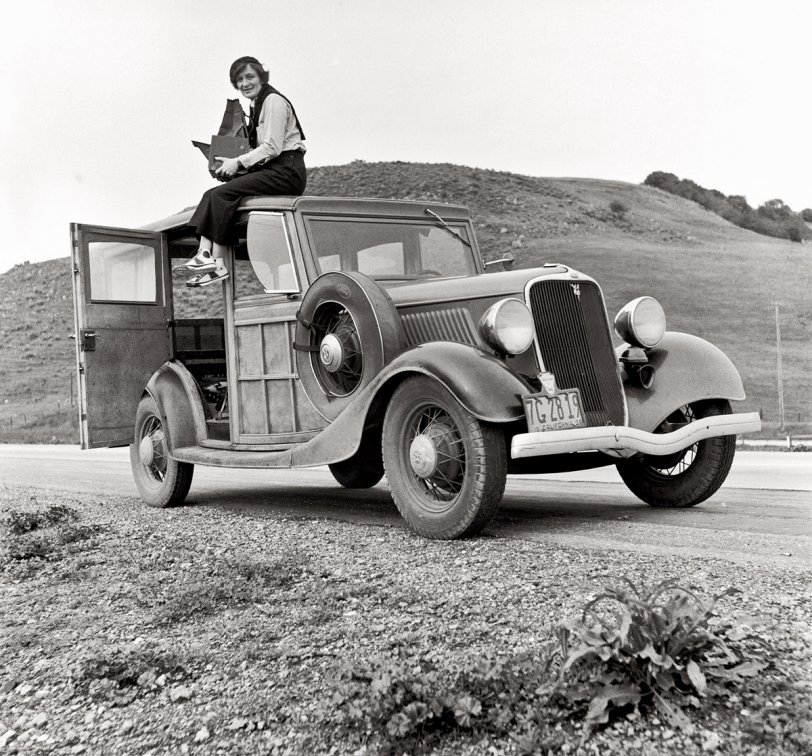
Dorothea Lange, Resettlement Administration photographer, in California atop car with her giant camera. February 1936. View full size.
The Camera, The Sneakers, The Car ... Oh My
You are all focused on really Fantastic aspects of this image, But, for me, with No doubt, the Star, the pioneer here is Dorothea. I have not seen her before this photo, but I'm instantly intrigued by her, and nothing else in this photo. I would have loved to have spent a day with her on location. Anywhere. I'm betting she was cool AF to hang out with and certainly left us a lot of Amazing images to enjoy.

Dorothea's camera
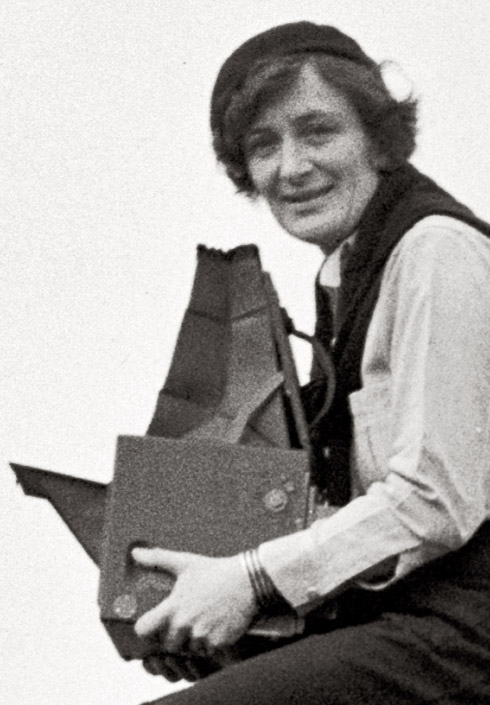
Her camera is 100% guaranteed 4x5 Graflex RB Series D. They were never made in the 5x7 size.
Dorothea 's shoes
The shoes of Dorothea looks like Converse.
[They're Goodrich Posture Foundation sneakers ("P.F. Flyers"). - Dave]
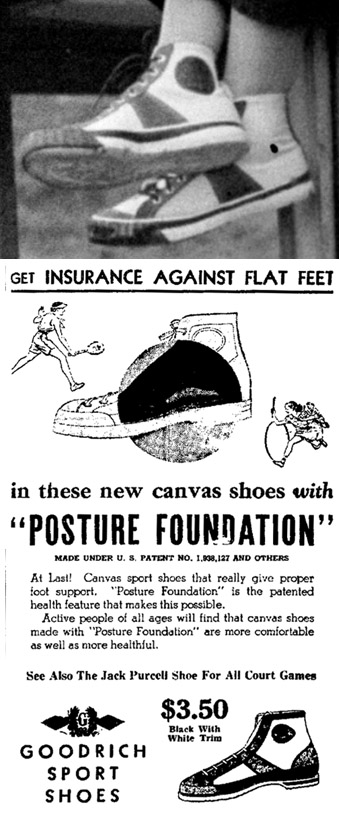
Photo by Rondale Partridge
The photo is by Rondale Partridge, son of Imogen Cunningham.
Dorothea is holding a Graflex 4x5 single lens reflex camera, which took sheet film. The flap in the front covers the lens, popping open to reveal the view. There is a big mirror at a 45 degree angle which transfers the image up onto the ground glass, essentially sitting on top of the camera box. The top pops up and the viewing hood folds up. The photographer looks down at the glass through the little rectangular opening at the very top, viewing the image that is flipped upside-down and backward, like all view cameras or similar SLR cameras such as a Hasselblad -- it works the same way. The camera could be hand-held, and the big negative made for great quality. You can see her left thumb on the shutter release. When the photographer trips the lever, the lens stops down, the mirror goes up against the ground glass, the light heads straight back through the camera flipping upside down and backward as the image always does through a lens, and at the end of all that mechanical clunking around, the fabric shutter at the very back of the camera, right in front of the film, slides up and allows the light to expose the film. The photographer then changes the film to the next sheet and resets the camera for the next image. They are beautiful cameras and some photographers find restored cameras just like this one and still use them. I would love to have one, but they are quite rare and expensive. Edward Weston also used this camera to photograph people and his models when doing nudes.
So...
If this is Lange and her camera, who's taking the picture... and with what?
[Somebody else. With a camera. Next! - Dave]
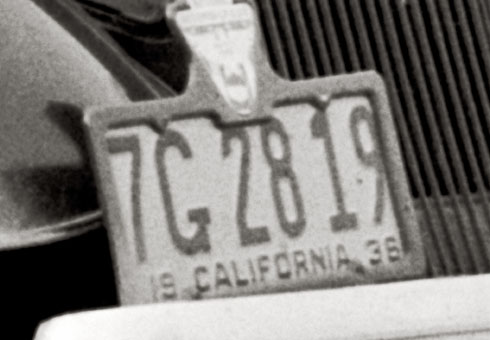
Don't think it is 1936
See the plate: California 1938
[The plate says 1936. - Dave]
Dorothea Lange's Camera
It is a Graflex Super D 4X5 SLR
DL's camera
It sure looks to me like a Series D, not a Super D, which weren't produced until 1948 (in the 4x5 size). It looks like a 4x5 to me, I have one and the proportions look right. DL wasn't a very big woman so I think a 4x5 would look just like that in her hands. I love my Graflex(es). If you get one you tend to get more. Great photo. I would also love to know what those sneakers are!
Now that's a Camera!!!!
Hi There,
Looks more like a 4x5 Series D, than a 4x5 Super D. The super has the chrome-plated struts on the hood / top lid.
Also by the looks of it, she has a Bag Mag mounted on the back (horizontal position) which doesn't work on a 4x5 Super D with the Graflock back.
I have a 3x4 RB Graflex series D, a 4x5 RB Graflex series D, and have owned a 4x5 super D. Unless she was a very tall woman, my money would be on the 4x5 size. A 5x7 Graflex SLR is a monster of a camera.
I don't think it is a series B as the front door that covers the lens has the flaps on the sides that act as a lens hood. As far as I know they were only on the series D, Super D, and big 5x7 models.
Does anyone know how tall she was....that would help.
Cheers
Rob
Graflex
It's a Graflex, looks like it might be a 5 x7, but must be at least 4 x 5.
I would guess it's older than this one, as I doubt it is a Series D
http://graflex.org/articles/series-d/
Dorothea Lange took the
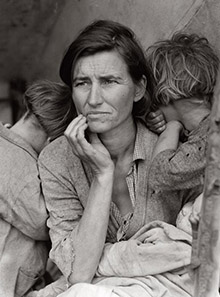
Dorothea Lange took the famous (if not somewhat controversial) picture called Migrant Mother.
Lange's Graflex
I own a 5x7" Press Graflex, and looking at the size of her hand compared to the size of the camera, I think this camera is a 4x5" Graflex, not a 5x7". The arrangement of the metal parts on the side that is visible would identify it as a Series D or Super D, which is a later camera than my Press Graflex.
5x7 Graflex
Looks like a 5x7 Graflex to me.
It's a Graflex SLR alright
Yep, definitely a Graflex. They generally used large-format sheet film. This looks like a 4x5 model given the size of the thing, maybe even a 5x7. The folding hood at the top provided shade for the large ground-glass viewfinder. The flap at the front acts folds down to shield the lens and bellows when not in use. These were rather bulky but very robust cameras, just what you'd need on a long dusty roadtrip in 1936.
Graflex
Sneakers
The Converse All Star type shoe was started in the late 1910's, looks like Converse type sneakers....
What a car!
The wood on this "woody" came from Henry Ford's mill at Alberta, Michigan just south of L'Anse in the Upper Peninsula, this mill still exists in its entirety but as a museum ---- The plant for Ford's "woodies" was located also in the Upper Peninsula at Kingsford, Michigan ---- the last vestage of the plant were the towering twin smoke stacks which stood alone until about two years ago when they were considered a hazard and torn down.
what a camera !
it is a beautiful camera, which brought all the grandeur of those golden days. what is wrong with it ?
sneakers
who can identify her sneakers?
I didn't know they had them back then
Dorothea Lange's giant camera
 Shorpy.com is a vintage photography site featuring thousands of high-definition images. The site is named after Shorpy Higginbotham, a teenage coal miner who lived 100 years ago. Contact us | Privacy policy | Accessibility Statement | Site © 2024 Shorpy Inc.
On Shorpy:
Today’s Top 5