


Framed or unframed, desk size to sofa size, printed by us in Arizona and Alabama since 2007. Explore now.
Shorpy is funded by you. Patreon contributors get an ad-free experience.
Learn more.



- Baldwin 62303
- Baldwin VO-1000
- Cold
- No expense spared
- Tough Guys
- Lost in Toyland
- And without gloves
- If I were a blindfolded time traveler
- Smoke Consumer Also Cooks
- Oh that stove!
- Possibly still there?
- What?!?
- $100 Reward
- Freeze Frame
- Texas Flyer wanted
- Just a Year Too Soon
- WWII -- Replacing men with women at the railroad crossing.
- Yes, Icing
- You kids drive me nuts!
- NOT An Easy Job
- I wonder
- Just add window boxes
- Icing Platform?
- Indiana Harbor Belt abides
- Freezing haze
- Corrections (for those who care)
- C&NW at Nelson
- Fallen Flags
- A dangerous job made worse
- Water Stop

Photos submitted by Shorpy members!
Print Emporium
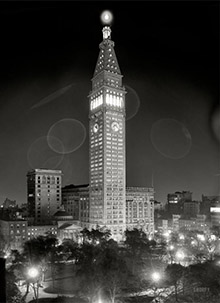




Ghost Hotel: 1905
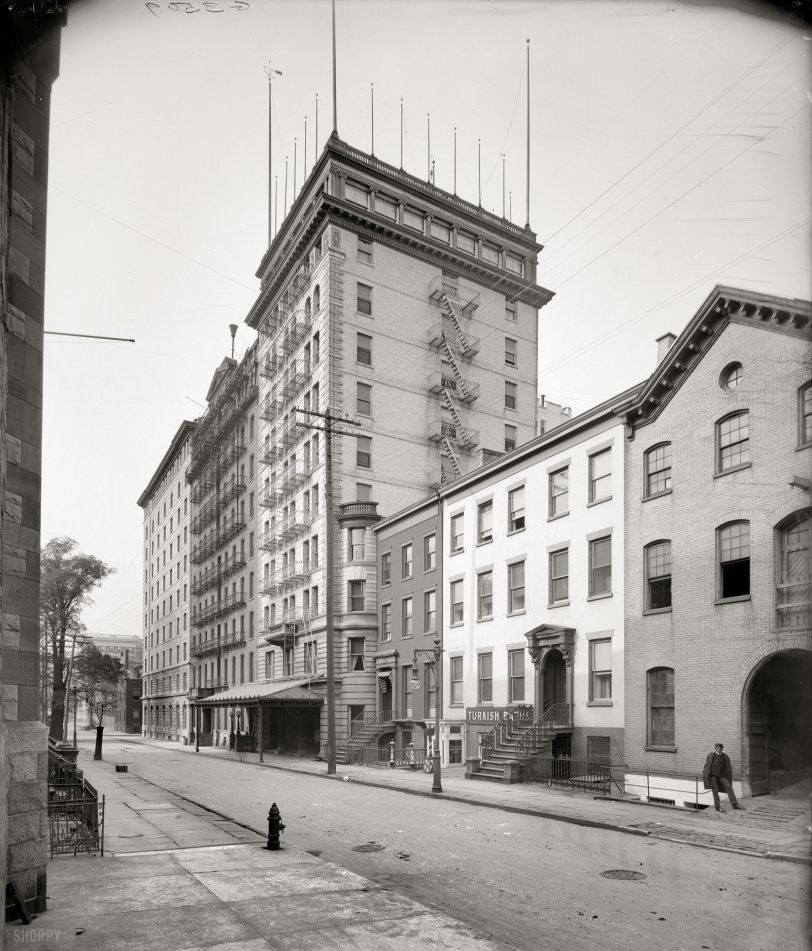
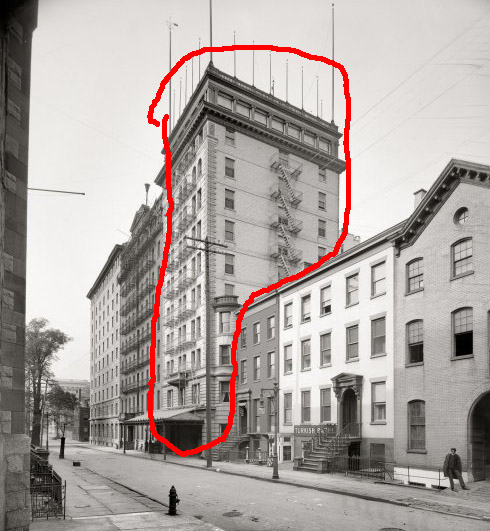
"Hotel St. George, Brooklyn, circa 1905." Plus a ghost or two in this time exposure of the hotel's Clark Street facades. This Brooklyn Heights landmark, which by the 1930s was New York's largest hotel, with 2,632 rooms in a complex of buildings spread over a block, started with the 10-story dark brick structure, completed in 1885. After more than a century, it was destroyed by fire in 1995. The adjoining white building with the flagpoles, designed by Montrose Morris in the 1890s, still stands. Detroit Publishing Co. glass negative. View full size.
Lifeguard, Mid 1950's. Pool Reputation?
My father worked as a lifeguard in the mid 1950's, at Coney Island in the summer and at the Hotel St. George in the winter. He had stories about the St. George pool and his "interactions" with the clientele that I'd like to discuss/corroborate, in general terms, as I'm researching for a memoir. The final scene revolves around these stories and I need more detail.
Anyone with first hand memories of the hotel pool, homosexual activity, Police leniency on some clients during raids, etc.
Thanks in advance. email folboteur@gmail.com if you have any input to offer.

Luca Brasi sleeps with the fishes
I've read that the scene in The Godfather where Luca Brasi is garrotted was filmed partially in the Edison Hotel on 47th Street in Manhattan but the actual killing took place in the Hotel St. George. Can anyone confirm this and, if it is correct, is the wall with the carved glass fishes, through which much of the scene is shot, still in existence and can it be viewed?
[This is addressed near the bottom of this page. -tterrace]
My daughter lives in this building today!
I'm surprised I missed this when it first appeared. We moved my college freshman daughter into this building in late August. It's a college dorm, operated by studenthousing.org. Her double room is huge, with its own bathroom.
The subway is underneath the building, making her commute to college three stops away in TriBeCa about 15 minutes from door to door.
For a suburban girl who never wanted to learn to drive, she is suddenly liberated living in Brooklyn Heights, able to go just about anywhere she pleases.
If I'd moved to NYC when I first graduated from high school, it would have been during the city's most dire financial period: 1975. Remember the famous headline? "Ford to City: Drop Dead." October 1975. How times have changed.
+106
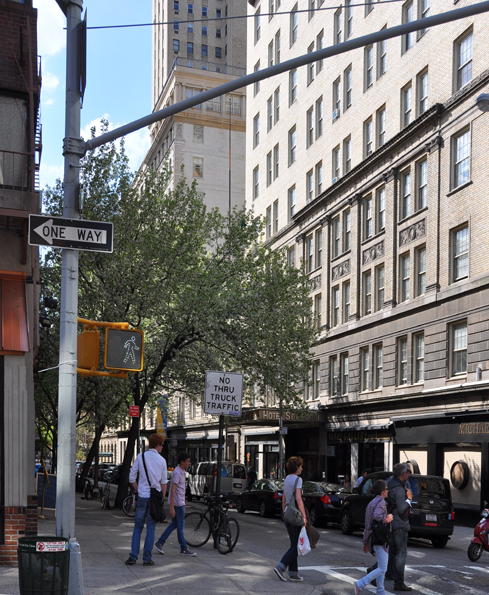
Below is the same view from April of 2011.
Worked as lifeguard at Hotel St. George pool
I would ride the ferry from Staten Island to Manhattan for a nickel, and for 15 cents ride the IRT to Clark Street. The elevator from the platform opened into the St. George Hotel lobby. I don't recall the pool fee, but it was very inexpensive. It had a balcony, mirrors on all four walls and the ceiling, heat lamps, a hot room, and the locker room had a great steam room. On the hour the waterfall at the shallow end was turned on. We and most of the other kids dashed down to stand beneath the cascading water. When I obtained my Red Cross senior Lifesaving badge I worked during college as a beach lifeguard for the Metropolitan Parks Dept. After graduating, during the winter of 1956-57 I lived in a dingy Greenwich Village room and worked at Goldwater Memorial Hospital on Welfare Island during the day. I got an evening job at the St. George pool as a lifeguard, which gave me free access and a personal locker there. I entered the hotel via an employee entrance and tunnel rather than the lobby elevator. This, for me, was the greatest poor boy's arrangement in the world. My recollections of the St. George Hotel pool are among the fondest memories of those younger years.
Marie's Tea Room
Back in the 30's my aunt owned a tea room right across from the Hotel St. George. Does anyone know how I can find information on this tea room?
I stand correction-corrected.
I came back to correct my own correction (I walked by the building on my way home after work) and said, I got it all wrong!) but you beat me to it. I was only testing you-yeah, right. Keep up the good work.
J
Small correction
The building with the overhang is not in that photograph. It wasn't built yet. That is a later addition to the St. George complex. The nice hanging glass surrounding the overhang is a recent addition surely meant as an ode to the lost St. George overhang. I live in what used to be Hotel St. George. The main original building (the one with the flagpoles and fancy overhang and the darker one to the left of it both burned down in a huge fire in 1995:
More info with sad, spectacular photos of those two buildings burning. And some more info.
Finally, some sadly ironic promotional material from better days at the St. George.
The last building on the block, the Grill Building, is still there. It still looks pretty much the same. It is now attached to the larger St. George tower around the corner that was build in 1929 and is seen in some of the postcards others have posted.
==============================================
[Correcting your correction: The Montrose Morris building in the 1905 photo with the flagpoles (the one with the overhang in the Google Street View farther down) was damaged in the 1995 fire but still stands. - Dave]

Before "Classy" Became History
I made the big move from Cleveland to New York City in 1962, inspired by an advertising job at a major publisher, as well as the notion that I'd be seeing steel-and-glass buildings. After all, at the time, few of these existed in Ohio! But on my first night here, the friend I was staying with insisted that I take the Number 2 over to the Heights and see not only the Promenade, but possibly the most elegant hotel ever constructed--the St. George. Even in the 1960s there were still red-clad uniformed men in front of its doors assisting people getting out of cabs with their luggage. We politely asked if we could go in and check out the still well-kept lobby and be greeted by smiling employees. I know I was naive, but I commented that I'd never seen any structure that tall or so cleanly kept. I got my job that week, and 47 years later I am still here, retired, and living right around the corner on Henry Street. The hotel now amounts to a dormitory for college kids, but that hasn't kept me from doing all the reading I can about it while at my desk. After all, it's just on the other side of my window! Golly, to go back to about 1900 and see what those lucky great-grandparents of us saw!
Current events
NY Times article on DC current in NYC:
http://cityroom.blogs.nytimes.com/2007/11/14/off-goes-the-power-current-...
K of C Basketball
In 1950 and 1952 I played in the Knights of Columbus High School Basketball tournament at the Hotel St. George in Brooklyn. Tommy Heinsohn played for St. Michael's of Union City, N.J. He went on to a great career with the Boston Celtics and later broadcasting and coaching.
Hotel St George pool
I spent what I recall as magical times at that pool. I felt I was in an Esther Williams movie! An Art Deco dream! I was very saddened to learn that it had been closed. New York seems to be a city that shows little value to its architectural gems. How sad!
NYC DC
I stayed for three nights at the St. George around Thanksgiving 1963, in connection with the West Point Glee Club's appearances on the Bell Telephone Hour, recorded in Brooklyn. Fell in lust with the studio receptionist and wound up spending the weekend in that borough. My Thanksgiving dinner (I'm a Californian, and could not get home that year) was a pastrami on rye and a Rheingold in a nearby diner, perhaps the one already mentioned. What I most remember about the St. George, aside from that aroma that only an old NYC hotel can have imbued in its carpets and furnishings, was the notice in the bathroom to electric shaver users that the hotel current was DC, not AC. I guess Edison's plan for a DC generator plant on every street corner died later in Brooklyn than elsewhere in the Big Apple.
St. George swimming pool
This essay about the Hotel St. George pool appeared in the anthology "Brooklyn Was Mine," in slightly different form, but the gist is the same:
Burger Joint
I do believe your old burger joint is still in business, now called Clark's Diner, on the corner of Clark and Henry Streets. (I highly recommend their scallion and feta cheese omelette.)
And the stable was torn down for a liquor store several decades ago, so hurray for progress.
Stable
Wish more of the building on the right was in the photo!
[Alas. But you can check out Clark Street today. The building below with the overhang is the flagpole building in the main photo. - Dave]
Cures Cancer Too!
Wow! I see why the pool made an impression on so many of the posters here. Kid paradise. Thanks for putting up the postcard.
I love the line about "crystal clear pure natural artesian salt water." I could easily see something advertised as such now, only now it would also include something about "age-defying" and also the word "organic" for good measure.
Amended: I still think the description is pretty overblown and funny. However, I misread "artesian" as "artisan." Then I looked up "artesian" and found out what it was. While it makes the description less funny, finding out that it actually was an apt description for the pool makes the pool even cooler in my book. (Not sure that I'd want to swim in water that had been hanging out under NYC, however. Or how such water could accurately be called "crystal clear" or "pure." Surely no worse than your average ocean, I suppose.)
St. George salt-water pool
Linen postcard. Click to enlarge.
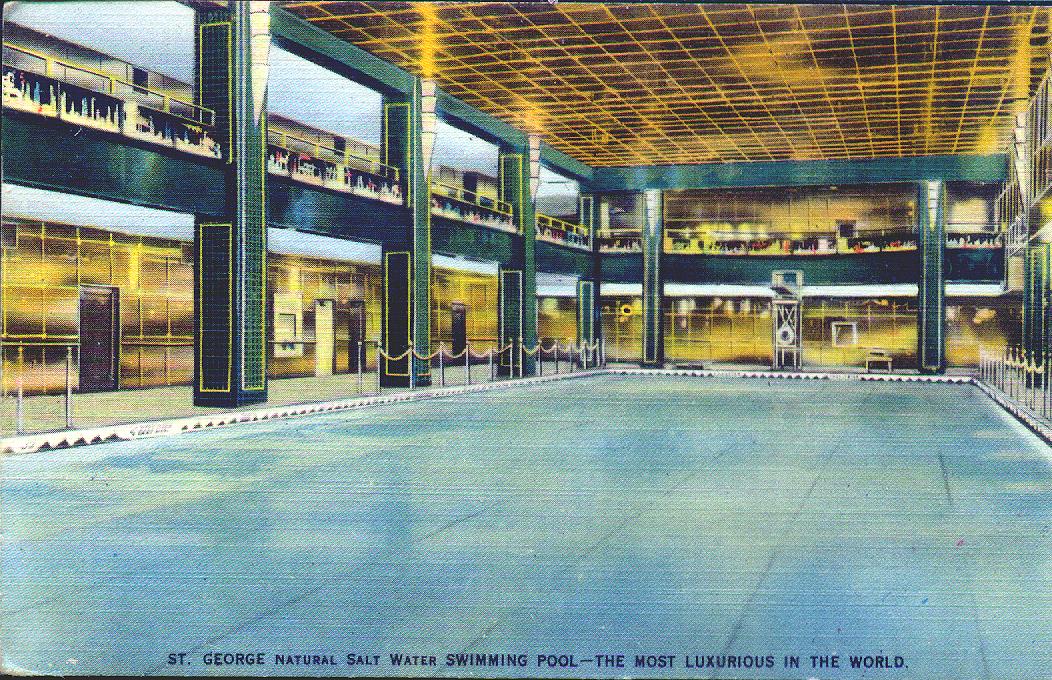
THE ST. GEORGE SWIMMING POOL, located in the Hotel St. George, Clark St., Brooklyn, the largest in New York (120' x 40'), was constructed at a cost of $1,263,000. Crystal clear pure natural artesian salt water is used. Swim and gym suits, showers, steam rooms, battery of sun lamps, and air-conditioned gymnasium are included in the admission charge! 4 minutes from Wall St., 15 from Times Sq.; Clark St. Station of 7th Ave. I.R.T. Subway in hotel.
I only had a quick peek at it in 1954. The main reason that my parents and I were there was because my father had stayed at the St. George in August 1951 on his way to England on the USNS Gen. Maurice Rose. Click here for an account of our stay.
More about the hotel and the swimming pool here, and on the 1995 fire here.
The St. George Swimming Pool
Can you scan your postcard showing a view of the pool and put it up here at Shorpy? In 1961 I was living on West 12th Street in Manhattan as a fledgling employee of Union Carbide, and went by subway over to the Saint George in Brooklyn to swim in that great pool. My other visits to Brooklyn back then were to the Cypress Hills Cemetery to visit the graves of my paternal Wilson grandparents who lived on Madison Street in Bed-Stuy at the turn of the 20th Century. I had commissioned a stonecarver to complete a gravestone inscription for my grandmother. In that effort, I got the birth and death years and month correct for her, but missed the days of the month in each case by a few.
A Dim Memory
I remember staying there for one night in the early 1950's with my family. My only recollection is of the swimming pool.
Saltwater Pools
I've never heard of a salt-water swimming pool ... was that common in the past?
[Lots of hotels, resorts and even private homes have saltwater swimming pools. - Dave]
Back in '62
Back in 1962, I was a student at the RCA Institutes in lower Manhattan. I worked at the GE building at 570 Lexington Avenue, so I took the 7th Avenue IRT to the school after work. Boy, was I tired. One night I fell asleep and ended up going under the river. I woke, panicked and got off at the first stop in Brooklyn. It was the St. George Hotel. I was amazed that a hotel had its own subway stop, so to speak. Those were the days!
Swimming
I remember going to the St George in the 1950s to swim. They had an enormous swimming pool in the basement. It was a coed attraction for young college kids and singles. It probably didn't cost more than a couple bucks for admission and suit rentals.
Hotel St. George: 1954
In 1954 I stayed with my parents at the Hotel St. George the night of July 30-31 after returning from two years in the UK as a USAF dependent. I might even have the room number in a crude diary from the time.
We sort of aborted our first full meal back in the U.S. in one of its dining rooms in favor of a walk down and across the street to the east to some burger joint to sit on stools at the counter!
I got a US Road Atlas from its lobby bookstore for the impending seven-day cross-country road trip to the SF Bay Area. I also got one those automated photos done in a booth there, but it's far too poor to even think about scanning.
One of the postcards obtained there (click image for details):
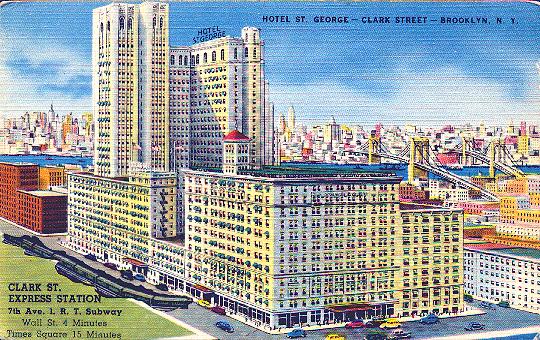
I've another one showing their famous 120-foot indoor salt-water swimming pool. It all certainly went into a fast decline by just a few decades later.
 Shorpy.com is a vintage photography site featuring thousands of high-definition images. The site is named after Shorpy Higginbotham, a teenage coal miner who lived 100 years ago. Contact us | Privacy policy | Accessibility Statement | Site © 2024 Shorpy Inc.
On Shorpy:
Today’s Top 5