


Framed or unframed, desk size to sofa size, printed by us in Arizona and Alabama since 2007. Explore now.
Shorpy is funded by you. Patreon contributors get an ad-free experience.
Learn more.



- Side Winder
- Air Quality?
- Sojourner Truth riot
- None were so blind(ed)
- The less famous sister
- Good ol' days?
- Rise and Fall
- Goo Goo Ga Joob
- Ticket Retention
- Not the only one
- Vagaries of War
- Killed by Amtrak
- Back to the Future
- Wanted --
- If you can't stand the light
- Centralized Traffic Control, I believe
- What's really happening
- Heckuva remote control!
- Sometimes — Things Go Bump!
- I SEE THE LIGHT
- Union Switch and Signal Company
- Get That Light Out Of My Eyes
- Eggs. Eggs. Eggs. The Egg Man is Here!
- Foreboding caption
- Famous Hollywood faces
- Not just S&P
- re: Those things in the jar
- Up In Smoke
- Medical Smoking
- Quick fix
Photos submitted by Shorpy members!
Print Emporium
Indy Imperial: 1904
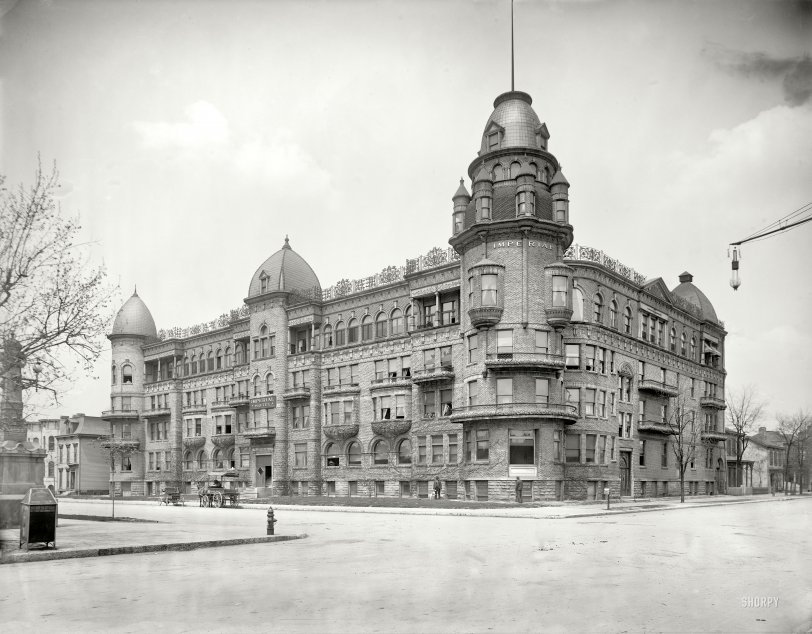
Indianapolis, Indiana, circa 1904. "Imperial Hotel." Whose architectural style might be described as Romanesque Rococo Curlicue Baroque, and whose slogan could be "every exterior surface embellished." Note the early automobile. 8x10 inch dry plate glass negative, Detroit Publishing Company. View full size.
A little more history
Sadly, this whimsical building was demolished in the late 1940s for a parking lot. It was built as the National Surgical Institute in the mid 1890s, but quickly went bankrupt. After serving as a medical school for a short time, it was converted into a hotel. The name changed from Imperial Hotel, to Hotel Metropole in the 'teens, and finally Hotel Roosevelt. By 1949 the site was called the Roosevelt Car Park.
More photographs in an article I wrote for Historic Indianapolis are at this link.

A hotel with an "institute"
A hotel with an "institute" (and sanitarium? Guy is blocking that window) in the basement. Classy place!
Feel like zooming in on any of those basement windows? It looks like one of them is advertising a "massage" but perhaps my imagination is being overactive.
[From left to right, the windows say ... - Dave]
DR CALDWELL'S INSTITUTE
Waiting Room
Treats diseases of Skin, Blood & Nerves
FACIAL TREATMENT
By Electric Massage
NEW PROCESS.
[Illegible]
HOMEOPATH
OSTEOPATH
WATER and ELECTRICAL TREATMENT
Every form.
Entrance on Cap. Ave.
CALDWELL'S SANITARIUM
and
[Medical?] Institute
MECHANICAL and MANUAL
MASSAGE
and
[Something] BATHS
ELECTRO-HYDROPATHIC INSTITUTE
A shocking treatment regimen
"Dr. Caldwell's Institute" in the basement offers "Water and Electrical Treatment".
Not simultaneously, one hopes.
A Textbook Example
of Romanesque Rococo Curlicue Baroque if I've ever seen one!
Dingy medicine!
All that's left of the "National Surgical Institute" is Dr. Caldwell's Clinic/Sanitarium in the basement. Great for "electric treatment" and "facials." Must have been so incredibly dark and creepy down there too.
Early automobile
Does anyone know what that "early automobile" is?
I don't even see where the engine is.
Magnificent Embellishments
I am imagining just a few years earlier, little Georgie Amberson Mainifer tearing around the corner in his pony cart. It appears that Georgie and the National Surgical Institute both got their comeuppance.
Now I am off the the library to pick up an armload of Booth Tarkington.
Doorway to the future
What's with that strange entrance on the left? It looks like a sheet of plywood with a doorway and diamond-shaped window cut out. That's a bad 1950s remodel, in 1904.
What a melting pot
of ideas and designs we're seeing lately here at Shorpy. I'm fascinated by the influences and styles that a growing USA built in these formative decades.
More please Sir.
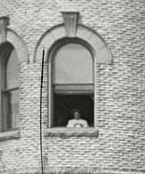
Rapunzel in the city
This lady made me think of Rapunzel, all alone in the far tower of her curlicue castle/hotel. Perhaps the man opening the window below is her prince.
Architectural horrors!
Someone accidentally dropped the blueprint in a blender or possibly there was an explosion at the brick factory, or both. That's all I can think of.
Woof
Yes, Dave, there are people in the shot. And a frisky doggie, too.
Wrteched Excess
What a grand building; very democratic: something for everyone! No style too unimportant to include. It's a shame it's gone. Maybe this is what Carole King had in mind when she wrote that song?
Look in the windows
Once you enlarge the picture it's really interesting to see the people in the windows & on the street - the guy with his dog is my favorite!
Indiana Picture
Thanks for a picture from Indianapolis and would love to see more Indiana pics, especially Lafayette, Indiana, if you have then. Thanks again!
Really neat light bulb
Don't you just love that light bulb in the picture? Bet you don't find many of those around any more.
[What looks like a big light bulb is the globe of a carbon arc lamp. - Dave]
Cheat Sheets
You may ask yourself "what's holding up those balconies?" Well, not much. I've found that an awful lot of what passes for carved stone in these old buildings, in particular the elaborate cornices, were in fact pressed sheet metal. Sheet metal rusts, and that's why a lot of old buildings lost their cornices by the 1940's - they got rusty and unsafe.
Imperial Hotel (aka National Surgical Institute)
Formerly the National Surgical Institute, the hotel stood at the northwest corner of Capitol Avenue and Ohio Street.
In January 1892 the old home of the National Surgical Institute burned and 19 patients were killed. This building was built following that disaster as the new home of the hospital. The Institute soon went bankrupt and by 1898 the building housed the Medical College of Indiana. By 1901 this institution had also vacated the building and the current tenant was the Imperial Hotel. Now a parking lot.
A Desire for a Streetcar
Strange that the Imperial, a substantial hotel, wasn't located on a streetcar line, at least initially. But then we find that it wasn't built as a hotel at all: rather it originally housed, starting in the mid-1890s, the National Surgical Institute (click for an interesting history of the curlicue colossus).
The fancy ironwork up top wasn't just for show; patients and visitors to the institute were allowed to stroll on the roof, presumably to take in the surrounding sights and the rarefied air.
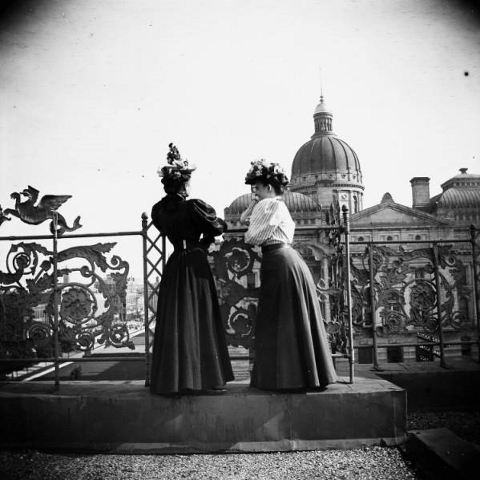
The details
The large-size version of this is great - love the detail. Some houses like these are still standing in Indianapolis (most of them a bit worse for wear after all these years).
All that's left is the base of the monument.
No people!
Even though the buildings are awesome, many pre-automobile era pictures show cities with no people walking around.
[I count at least five or six people here. - Dave]
"Rococo Curlicue Baroque"
My new favorite architectural style!
 Shorpy.com is a vintage photography site featuring thousands of high-definition images. The site is named after Shorpy Higginbotham, a teenage coal miner who lived 100 years ago. Contact us | Privacy policy | Accessibility Statement | Site © 2024 Shorpy Inc.
On Shorpy:
Today’s Top 5