


Framed or unframed, desk size to sofa size, printed by us in Arizona and Alabama since 2007. Explore now.
Shorpy is funded by you. Patreon contributors get an ad-free experience.
Learn more.




- Alas, hidden from view
- Exclusive pump
- Details, Details
- What's that building to the left of the tower?
- Coal Barges
- Bromo-Seltzer
- Inner harbor
- The Basin
- What a headache!
- Giant stepladder?
- Baldwin 62303
- Baldwin VO-1000
- Cold
- No expense spared
- Tough Guys
- Lost in Toyland
- And without gloves
- If I were a blindfolded time traveler
- Smoke Consumer Also Cooks
- Oh that stove!
- Possibly still there?
- What?!?
- $100 Reward
- Freeze Frame
- Texas Flyer wanted
- Just a Year Too Soon
- WWII -- Replacing men with women at the railroad crossing.
- Yes, Icing
- You kids drive me nuts!
- NOT An Easy Job

Photos submitted by Shorpy members!
Print Emporium

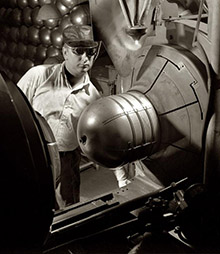






Private Hospital: 1939
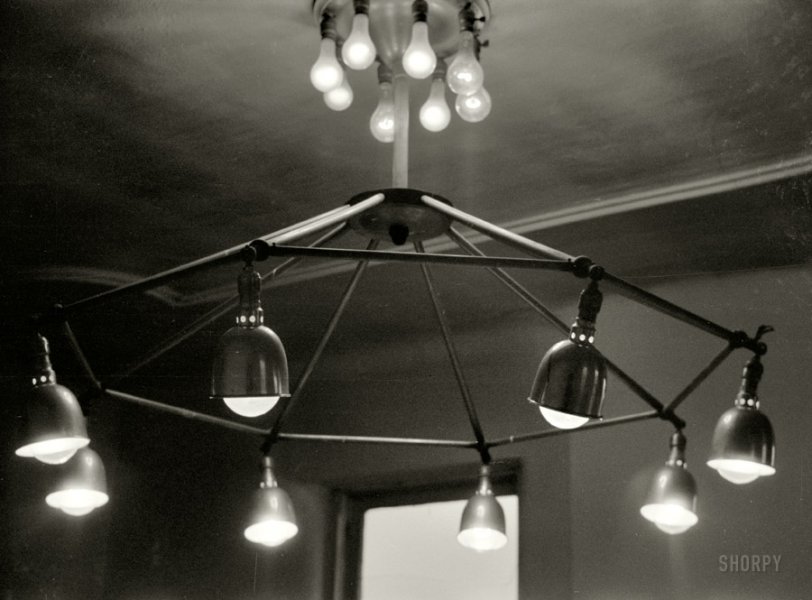
January 1939. Herrin, Illinois. "Operating room at Herrin Hospital (private)." 35mm nitrate negative by Arthur Rothstein. View full size.
More than 25 watts
Judging from the physical size, these are 150 watts or larger, as appropriate for the application. Very large incandescents are hard to come by nowadays, having been supplanted by halogen in this type of environment, and fluorescent or HID elsewhere.
And no, one need not spend $5 for a compact fluorescent. At my local store, I can buy 60W incandescents for 32 cents each, vs. $2 each for a 14W CFL (four-packs). Even if the CFL only lasts 2,000 hours rather than 10,000, it will still save $10 in electricity. And yes, I have metered it. The math doesn't lie.

No More Incandescent Bulbs
After more than 100 years of successfully using Edison's invention for lighting up the night, we are all in for a shock come January. The bulbs that now sell for about 25 cents each will no longer be available. Our alternate choices will be costing us anywhere from $5 each to $50 each. Having personally used fluorescent lights occasionally, I found it to be a hassle and hazard to dispose of them (mercury and gas) and a few burned out within a couple of months. The LED's give a different light and cost more. The "halogen" bulbs get as hot as 800 degrees and start fires. This issue will come as a surprise to many low income people who can barely buy food and/or pay rent who will not have the money to replace $50 or even $5 lightbulbs. Just the facts ma'am, just the facts.
[Mistaken notions vs. the facts. - Dave]
How many 25 watt bulbs does it take to perform an appendectomy?
I hope the maid got all the dust off those fixtures!
Now fetching $1,100.00 on FleaBay
Or at some hipster antique shop near you.
 Shorpy.com is a vintage photography site featuring thousands of high-definition images. The site is named after Shorpy Higginbotham, a teenage coal miner who lived 100 years ago. Contact us | Privacy policy | Accessibility Statement | Site © 2024 Shorpy Inc.

On Shorpy:
Today’s Top 5