



Framed or unframed, desk size to sofa size, printed by us in Arizona and Alabama since 2007. Explore now.
Shorpy is funded by you. Patreon contributors get an ad-free experience.
Learn more.



- Baldwin 62303
- Baldwin VO-1000
- Cold
- No expense spared
- Tough Guys
- Lost in Toyland
- And without gloves
- If I were a blindfolded time traveler
- Smoke Consumer Also Cooks
- Oh that stove!
- Possibly still there?
- What?!?
- $100 Reward
- Freeze Frame
- Texas Flyer wanted
- Just a Year Too Soon
- WWII -- Replacing men with women at the railroad crossing.
- Yes, Icing
- You kids drive me nuts!
- NOT An Easy Job
- I wonder
- Just add window boxes
- Icing Platform?
- Indiana Harbor Belt abides
- Freezing haze
- Corrections (for those who care)
- C&NW at Nelson
- Fallen Flags
- A dangerous job made worse
- Water Stop

Photos submitted by Shorpy members!
Print Emporium



I Am the Egg Man: 1938
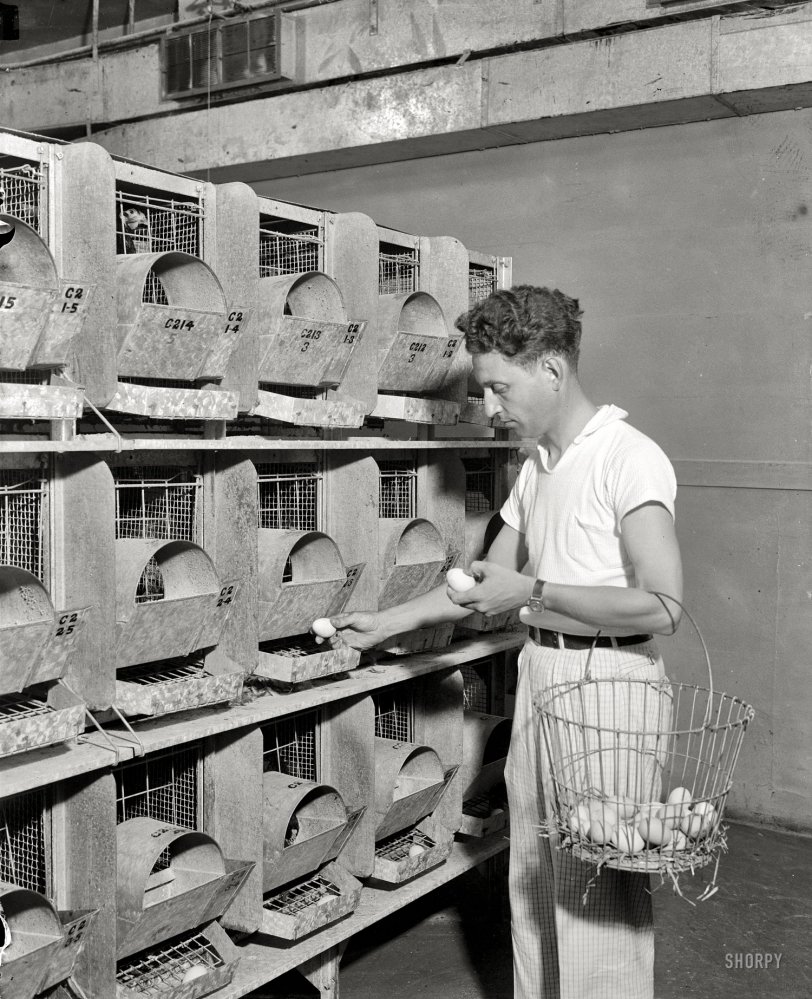
August 9, 1938. Washington, D.C. "Air conditioned hen house is latest. Biddy increases the production of eggs in an air-conditioned hen house, U.S. Department of Agriculture experts have discovered after extensive experiments. The first temperature controlled maternity ward for hens has just been put into operation at the governmental experimental farm here. The hens have voiced their approval by laying more frequently; also a more uniform egg. R.B. Nestler, poultry expert, is pictured as he removes the eggs from the automatic chute in the new room. Note the air conditioning apparatus on the ceiling." So this poultry man with the wonderful name of Nestler is, contrary to USDA Best Practices, putting all his eggs in one basket. Harris & Ewing glass negative. View full size.
Ornithologist
Pictured is Ralph Bernard Nestler who was born in the District of Columbia to William and Susie [nee Bernard] Nestler on April 27, 1906. He earned a Bachelor of Science degree from the College of Agriculture at the University of Maryland, College Park in 1929. He then started a career within various entities of the U.S. Department of Agriculture.
At least ten years of his career were spent at the Patuxent Wildlife Research Refuge near Fort Meade, Maryland. Here he was involved in quail nutrition studies, and he was the Chief Warden for the air raid protection program during WWII. His later career was at the U.S.D.A. Division of Grant-Fund Administration and several other positions.
Nestler had many published papers during his long career including "Vitamin A Deficiency in Bobwhite Quail," which is likely one of his most significant. Another paper was "Nutrition of Bobwhite Quail," and the one with the most interesting title was probably, "Common Salt As A Curative For Cannibalism Among Game Birds In Captivity," which was published in 1940.
In the 2010 book Texas Bobwhites, A Guide to Their Foods and Habitat Management by Larson, Fulbright, Brennan and Hernandez, they state the following on page 7.
"Much of what is known about bobwhite nutrition can be attributed to the work of Ralph B. Nestler .... During the 1940s, Nestler began a series of experiments to determine the nutrients necessary for growing, breeding, and non-breeding bobwhites. His research focused on several macronutrients and minerals, including protein, calcium, phosphorous, and vitamin A."
Nestler was a Seventh-Day Adventist and a conscientious objector. The 1942 edition of the Adventist publication "Harmony" had the following quote.
"'Whatever happens, follows, hold fast to your faith. Do not let discouragement and public opinion change you from what you believe to be right.' Such were the words of encouragement at the end of a talk about the Christian in a world at war given by Ralph Nestler of the Patuxent Refuge staff on Sunday, May 2, at the morning devotions period."
Another Adventist publication stated, "Ralph B. Nestler is known to many Adventists in the Greater Washington, D.C. area. He has been an active layman for many years, and has preached in open-air meetings in Lafayette Park in downtown D.C. He has also been a literature evangelist, and a lay chaplain at Leland Memorial Hospital, Riverdale, Maryland. He has served as an elder in several churches and as lay activities leader." ("Columbia Union Visitor," November 6, 1975, page 7)
Ralph Nestler eventually retired from the U.S.D.A. He was married to Jeanette Blakeney on December 24, 1930 in Washington, D.C. She died in 1981, and he died on August 13, 1991 in Warrenton, Virginia. They had at least one child, John, who died in 1985.

Unfortunately
You just don't see haircuts like that anymore.
Is it a Titleist?
Here we have our egg collecting person, one Cosmo Kramer.
Chickens I have known and loved.
When I was six, my grandfather who lived with us ordered several dozen little yellow chickens (through a mail order catalog) because he decided he wanted to try his hand at the skill of raising our own poultry. My siblings and I were thrilled the day they were delivered by a mailtruck and proceeded to be totally engrossed in observing them grow and do what comes naturally. We checked our coop every morning for eggs which was much better than an Easter egg hunt and were rewarded with wonderful breakfasts, lunches and suppers of eggs. We scrambled (no pun intended) to be the ones who threw feed every day and fill the watertrays with fresh water. However, when the chickens' doomsdays arrived, we were somewhat jolted out of our euphoria to see that they were being murdered, singed of pinfeathers and dismembered. Talk about an "eye-opener" for us as to the ultimate purpose of our altruism to chickens. I must say though that they were scrumptious, unlike any chickens one might purchase today. A detail that stands out in my memory is the "decoys" of white porcelain and/or milkglass eggs that would be left on display in all the nests to encourage the chickens to lay (at least that was the legend at the time). Does anyone know if they still use the fake eggs to fool the hens? I have not seen them at antique shows. Too bad Mr. Nestler's first name wasn't Nestor. Carry on.
 Shorpy.com is a vintage photography site featuring thousands of high-definition images. The site is named after Shorpy Higginbotham, a teenage coal miner who lived 100 years ago. Contact us | Privacy policy | Accessibility Statement | Site © 2024 Shorpy Inc.
On Shorpy:
Today’s Top 5