



Framed or unframed, desk size to sofa size, printed by us in Arizona and Alabama since 2007. Explore now.
Shorpy is funded by you. Patreon contributors get an ad-free experience.
Learn more.



- Baldwin 62303
- Baldwin VO-1000
- Cold
- No expense spared
- Tough Guys
- Lost in Toyland
- And without gloves
- If I were a blindfolded time traveler
- Smoke Consumer Also Cooks
- Oh that stove!
- Possibly still there?
- What?!?
- $100 Reward
- Freeze Frame
- Texas Flyer wanted
- Just a Year Too Soon
- WWII -- Replacing men with women at the railroad crossing.
- Yes, Icing
- You kids drive me nuts!
- NOT An Easy Job
- I wonder
- Just add window boxes
- Icing Platform?
- Indiana Harbor Belt abides
- Freezing haze
- Corrections (for those who care)
- C&NW at Nelson
- Fallen Flags
- A dangerous job made worse
- Water Stop

Photos submitted by Shorpy members!
Print Emporium





Safety First: 1925
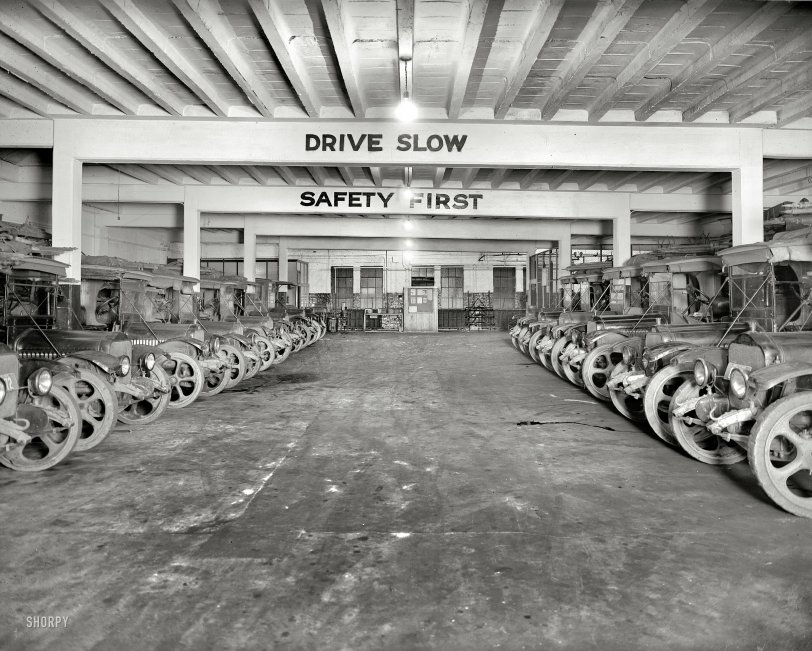
Washington, D.C., circa 1925. "C & P Tel. Co." The Chesapeake & Potomac telephone company garage, and a fleet of White trucks with solid rubber tires. National Photo Company Collection glass negative. View full size.
Classic
This is a classic Bell System garage layout, used for decades all over the country. Every morning the foremen would come down and meet with their respective crews in front of their trucks, where the day's orders were handed out and other matters covered. The "cages" at the far end were for supplies. One contained revenue equipment - phones and accessories. The other contained the tools and supplies. There was only one supplier: Western Electric. Everything from screws, climbing gear, telephones, wooden phone booths, batteries in distinctive gray color ... all of it came from Western Electric.

Muddy Roads
Narrow tires and muddy dirt roads were the norm. Having a place to attach a chain or rope to pull the vehicle free from a mud hole was a necessity.
Hey Abbott!
If Safety is First, why is it second?
Reliability
It looks like every truck has a hook in front so it can be towed home. Could that be?
Grammmar
It heartens me to see that the problem of management (who ordered the sign) and labor (who painted the sign) misunderstanding the difference between adjectives and adverbs existed even when our schools did not teach "whole language". The sign should read: Drive Slowly
p.s. No flat tires!
[Grammmar, as opposed to spellling. -Dave]
Rack-o-Axles
The somethings that used up axles were Model T Fords. You can see the single arched, transverse springs and the wishbones (radius rods) that held everything straight. The White trucks have longitudinal, semi-elliptic springs and the axles are way heavier than the Fords.
Rack of Axles
Looks like they had to replace the front axles with some regularity judging by the rack of replacements against the back wall!
 Shorpy.com is a vintage photography site featuring thousands of high-definition images. The site is named after Shorpy Higginbotham, a teenage coal miner who lived 100 years ago. Contact us | Privacy policy | Accessibility Statement | Site © 2024 Shorpy Inc.

On Shorpy:
Today’s Top 5