


Framed or unframed, desk size to sofa size, printed by us in Arizona and Alabama since 2007. Explore now.
Shorpy is funded by you. Patreon contributors get an ad-free experience.
Learn more.




- Heckuva remote control!
- Sometimes — Things Go Bump!
- I SEE THE LIGHT
- Union Switch and Signal Company
- Get That Light Out Of My Eyes
- Eggs. Eggs. Eggs. The Egg Man is Here!
- Foreboding caption
- Famous Hollywood faces
- Not just S&P
- re: Those things in the jar
- Up In Smoke
- Medical Smoking
- Quick fix
- A Quink Comment
- If You’re Like Me, Never
- Delivering the News
- U.S.A.
- S&P
- 1940 Zenith radio model 6G601
- Quality goes in before the name goes on!
- Snazzy skirt
- Carbon Arc Lamps
- Illuminate us
- I remember it well
- I can't prove it
- Complicated then, forgotten now
- Bryan-Stevenson
- Skinny is as skinny does
- How do you rest in peace
- Riding the footboards

Photos submitted by Shorpy members!
Print Emporium











De Forest Wireless: 1905
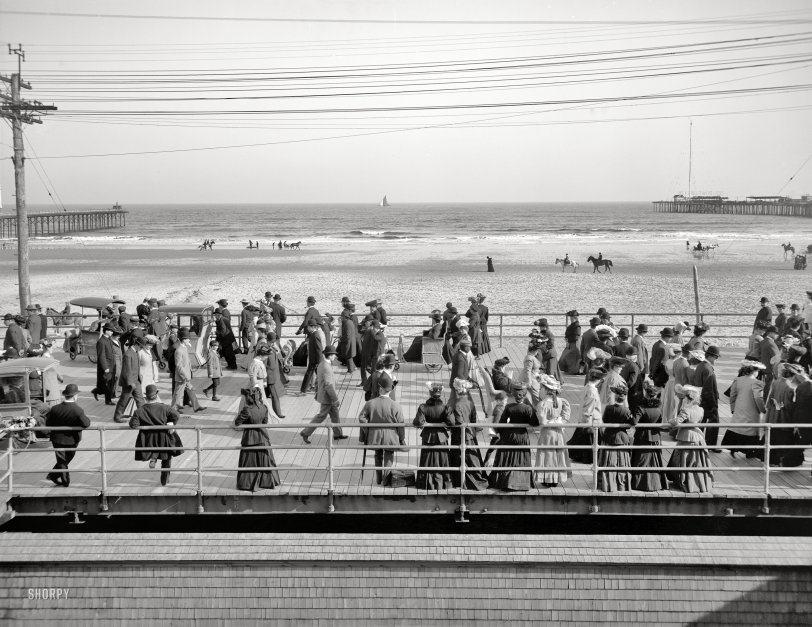
The Jersey Shore circa 1905. "Along the beach, Atlantic City, N.J." Note the radio mast at right on Young's Pier. Detroit Publishing glass negative. View full size.
Bowler Hat Concession
There doesn't seem to be much non-conformity in the men's headwear department.I wish I would have had the Jersey Shore bowler concession back then.

"Read all about it!"
Those newsies sure do get around on Shorpy. I spot 2 just on this short stretch of boardwalk. I also see one satisfied customer leaning on the near railing.
This broadcast
This broadcast provided as a public service to all wireless-mast non-believers (seen in a number of Shorpy photos atop tall urban buildings) out there: Yes, they did have them back then and yes, they looked like that.
Why the name DeForest ?
Lee DeForest was an American inventor that created what we would now call a triode tube. It was the first device that amplified a signal. That meant we could detect radio signals from a lot further or listen to music louder then the way it was recorded. He was brilliant and way ahead of his contemporaries.
Why do I know this ? My first girlfriend lived next door to a gentleman that worked in his lab in Jamaica Queens. I was a young student at Brooklyn Tech and was trained on triodes in my junior year. To listen to Mr Whitman was such a thrill. Such a nice guy, so humble, but he was there when it happened.
To put it in perspective, I'd rank this second only to the Edison light bulb.
Drool drool
Ham Radio operators dream of a salt water ground but to have a station out on a pier is the cat's pajamas.
Just don't step on the alligator
There, between the fourth guy from the left and the mam'selle, rests an alligator-skin bag. Speaking of mam'selle, one of the most successful lyricists in American music, Mack Gordon, wrote the song so named, along with Chattanooga Choo-Choo, Did You Ever See a Dream Walking?, I Can't Begin to Tell You, I've Got a Gal in Kalamazoo, Serenade in Blue, The More I See You, There Will Never Be Another You, Time on My Hands, You Make Me Feel So Young and You'll Never Know (Oscar winner in 1943 and the first song Barbra Streisand ever recorded). Oh, and he wrote "On the Boardwalk at Atlantic City," released in 1945.
Dr. Lee De Forest comment
" I came-I saw-I invented-It's that simple-No need to sit and think-It's all in your imagination"
Variety
I see five pushmobiles in this scene and they are all of a different design. Nowadays the pushmobile concession would be held by one company and all of them would be identical, same color and design. Much more interesting back then.
Spring is in the air
This looks like the Easter Parade with everybody wearing brand spankin' new clothes, flowery hats, new shoes, etc. and there doesn't seem to be anyone in swimwear. And I'd be reluctant to lie around on that beach with galloping horses running roughshod.
 Shorpy.com is a vintage photography site featuring thousands of high-definition images. The site is named after Shorpy Higginbotham, a teenage coal miner who lived 100 years ago. Contact us | Privacy policy | Accessibility Statement | Site © 2024 Shorpy Inc.
On Shorpy:
Today’s Top 5