


Framed or unframed, desk size to sofa size, printed by us in Arizona and Alabama since 2007. Explore now.
Shorpy is funded by you. Patreon contributors get an ad-free experience.
Learn more.



- Complicated then, forgotten now
- Bryan-Stevenson
- Skinny is as skinny does
- How do you rest in peace
- Riding the footboards
- Alas, hidden from view
- Baldwin Diesels
- Exclusive pump
- Bananas, Oysters and Smokey Joe
- Details, Details
- What's that building to the left of the tower?
- Coal Barges
- Bromo-Seltzer
- Inner harbor
- The Basin
- What a headache!
- Giant stepladder?
- Yeah, it was cold
- Love those coats
- Link & Pin Days Remnant
- Baldwin 62303
- Baldwin VO-1000
- Cold
- No expense spared
- Tough Guys
- What's your hurry, where's your hat?
- Sheriff's Signature
- Relocated in the Eighties
- Lost in Toyland
- And without gloves
Photos submitted by Shorpy members!
Print Emporium

Money Machine: 1920
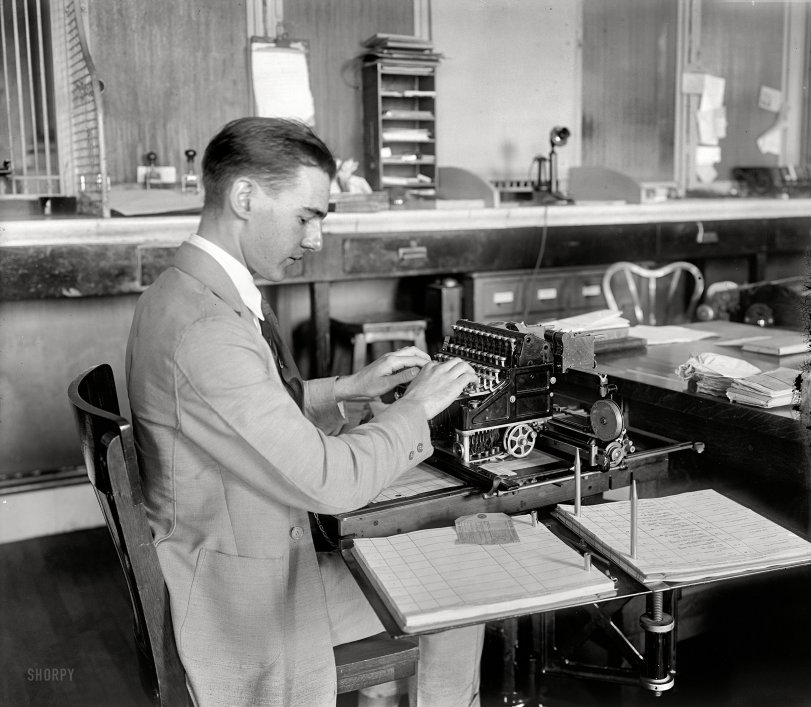
Washington, D.C., circa 1920. "Post Office money order machine." A sort of typewriter-cash register hybrid. Harris & Ewing glass negative. View full size.
Safety pin
Did anyone notice a safety pin in back of this fellow's tie? Dressing tricks have been used a very long time.

Other picture?
tterrace references another photo that shows a money order being fed into the machine; where do I go to see that photo?
[Library of Congress online catalog here. - tterrace]
Money Order Form
Here is the money order form he is working on.
[That's the C.O.D. mailing tag that had been attached to the parcel. It has the names and addresses for both sender and addressee along with the amount to be collected, here $5.91 + $.08 money order fee, total $5.99. The Post Office gets to keep the 8¢. - tterrace]

Repetitive
A little Photoshoppery shows us the details of the page in the ledger (click for larger image):

It's interesting that the amount appears numerically in two columns and spelled out in a third. I guess they *really* didn't want any misunderstandings or errors, especially with such high finance (that $8.77 to Hayes Wheel must have nearly broken the bank).
[Note also the figures in the sixth column: 05 & 08; those are the money order fees, which the recipient would have paid in addition to the amount due the sender. Apparently 5¢ for under $5 and 8¢ for over. - tterrace]
[UPDATE: the other shot taken at the time shows a money order being fed into the machine, so the spelled-out dollar amount is probably done to be imprinted on the order, and the same operation prints all the details on the ledger. - tterrace]
M.O. purpose
He's making out a money order for a delivered C.O.D. parcel; that's a USPOD C.O.D. mailing tag on the ledger.
Also, talk about shallow depth of focus; looks like about 8 inches, max.
 Shorpy.com is a vintage photography site featuring thousands of high-definition images. The site is named after Shorpy Higginbotham, a teenage coal miner who lived 100 years ago. Contact us | Privacy policy | Accessibility Statement | Site © 2024 Shorpy Inc.
On Shorpy:
Today’s Top 5