



Framed or unframed, desk size to sofa size, printed by us in Arizona and Alabama since 2007. Explore now.
Shorpy is funded by you. Patreon contributors get an ad-free experience.
Learn more.



- Illuminate us
- I remember it well
- I can't prove it
- Complicated then, forgotten now
- Bryan-Stevenson
- Skinny is as skinny does
- How do you rest in peace
- Riding the footboards
- Alas, hidden from view
- Baldwin Diesels
- Exclusive pump
- Bananas, Oysters and Smokey Joe
- Details, Details
- What's that building to the left of the tower?
- Coal Barges
- Bromo-Seltzer
- Inner harbor
- The Basin
- What a headache!
- Giant stepladder?
- Yeah, it was cold
- Love those coats
- Link & Pin Days Remnant
- Baldwin 62303
- Baldwin VO-1000
- Cold
- No expense spared
- Tough Guys
- What's your hurry, where's your hat?
- Sheriff's Signature
Photos submitted by Shorpy members!
Print Emporium



On the Road: 1936
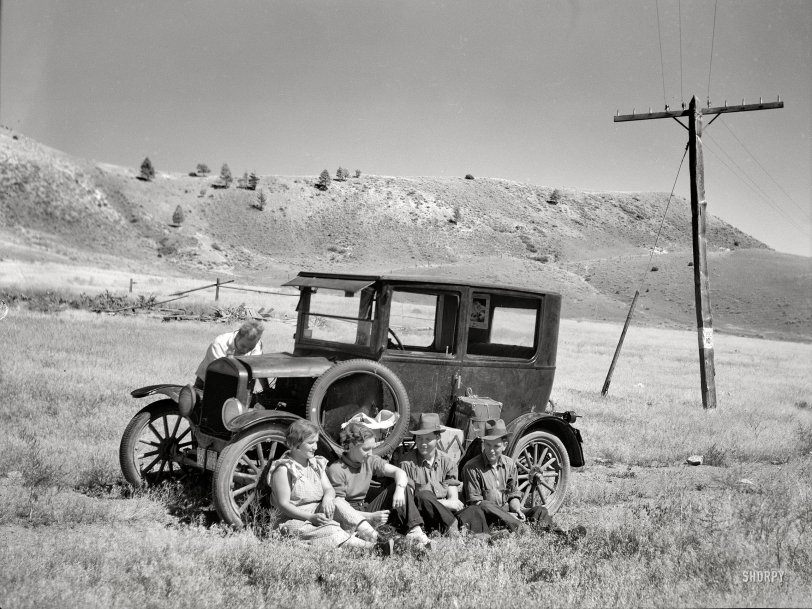
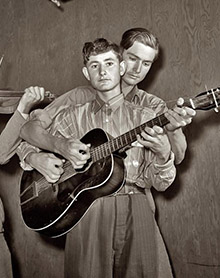
July 1936. "Vernon Evans and family of Lemmon, South Dakota, near Missoula, Montana, Highway 10. Leaving the grasshopper-ridden and drought-stricken area for a new start in Oregon and Washington. Make about 200 miles a day in Model T Ford." Our second glimpse of these travelers, last seen here. Medium-format negative by Arthur Rothstein, Resettlement Administration. View full size.
This is my aunt and uncle
If finding Vernon was difficult because his name was Clarence then you would have had a hell of a time finding him if you heard us call him Pete! That is all I ever knew him by except by Aunt Flora who always called him Vern. I grew up a mile from them. These photos pop up every so often and they gained quite a lot of attention from them over the years. Even made it on CBS Sunday Morning with Charles Kuralt. Very kind couple who led a simple life with dash of "Grapes of Wrath"!!

Driver's door not needed
With Model T and Model A Fords, it was no big deal if the driver's door didn't open. The first Ts had a "dummy" door (looked like a door, but didn't open), and the driver just slid over (the front seat pair was very narrow, anyhow, only about 44"). In sedans, the front seats could be tilted forward to allow entry to the rear.
All five passengers could easily have entered and exited this car through the passenger-side door, leaving the driver's side running board free to carry luggage.
Note the absence of hood sides on this car, must have made maintenance quicker and easier, even if it left the hood to flap in the wind.
Driver's side door
Back in the day, it wasn't uncommon for people to use the passenger side door to enter/exit vehicles more often than not. If you were the driver you would enter on the passenger side, since it was the side adjacent to the curb, and then just slide over on the bench seat to get behind the wheel. It was considered "unsafe" enter/exit a vehicle from the street side where all the traffic was. That's why you'll see stuff blocking the driver's side door in old traveling photos.
I had a 1950 Ford F1 Pickup for years, and it only had a keyhole for unlocking the door on the passenger side, because that's the door you would enter/exit from.
Five adults and 200 miles a day
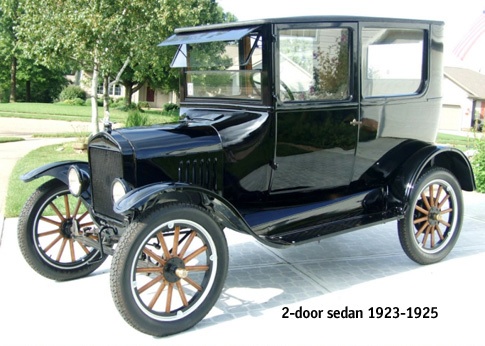
was a lot of hard driving in a Model T Ford. As durable as these cars were, I’m sure these folks made it to their destination. This particular car looks like a 1923-1925 model.
Clarence Vernon Evans
Took me a little while to find our Vernon because his first name is Clarence. His wife is Flora. By 1940 he was working for the railroad and they had a daughter Ester Violet. He died in North Dakota 20 April 1998. Flora must have returned to Lemmon South Dakota where she died 23 Sept 2008.
Utility Pole
Don't believe I've ever seen a square one made of wood.
Younger here
They look really young in this picture, much younger than in the previously-posted picture, even though the pictures were all taken in the same session. It would be interesting to read a day-to-day journal of what happened in that Model T between SD and OR.
Trunk
It's hard to tell for sure, but it looks like the suitcase is resting on the running board, and tied with a wire to the door handle. Once it's affixed like that, how would the driver open the door to get out without interfering with the wire?
Re: Seinfeldesque
I thought Vernon's hair in the previous shot might have been caught with a gust of prairie wind, but this makes it seem more like a style choice!
 Shorpy.com is a vintage photography site featuring thousands of high-definition images. The site is named after Shorpy Higginbotham, a teenage coal miner who lived 100 years ago. Contact us | Privacy policy | Accessibility Statement | Site © 2024 Shorpy Inc.
On Shorpy:
Today’s Top 5