



Framed or unframed, desk size to sofa size, printed by us in Arizona and Alabama since 2007. Explore now.
Shorpy is funded by you. Patreon contributors get an ad-free experience.
Learn more.



- Heckuva remote control!
- Sometimes — Things Go Bump!
- I SEE THE LIGHT
- Union Switch and Signal Company
- Get That Light Out Of My Eyes
- Eggs. Eggs. Eggs. The Egg Man is Here!
- Foreboding caption
- Famous Hollywood faces
- Not just S&P
- re: Those things in the jar
- Up In Smoke
- Medical Smoking
- Quick fix
- A Quink Comment
- If You’re Like Me, Never
- Delivering the News
- U.S.A.
- S&P
- 1940 Zenith radio model 6G601
- Quality goes in before the name goes on!
- Snazzy skirt
- Carbon Arc Lamps
- Illuminate us
- I remember it well
- I can't prove it
- Complicated then, forgotten now
- Bryan-Stevenson
- Skinny is as skinny does
- How do you rest in peace
- Riding the footboards

Photos submitted by Shorpy members!
Print Emporium





The Cootie: 1922
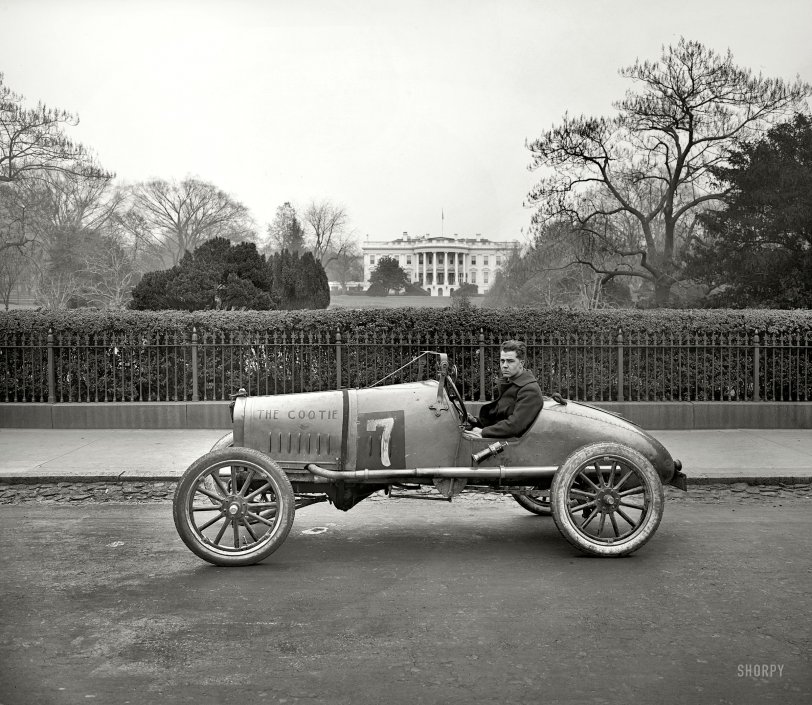
Washington, D.C., 1922. "Capt. Kopper and 'Cootie' at White House." National Photo Company Collection glass negative. View full size.
Junior
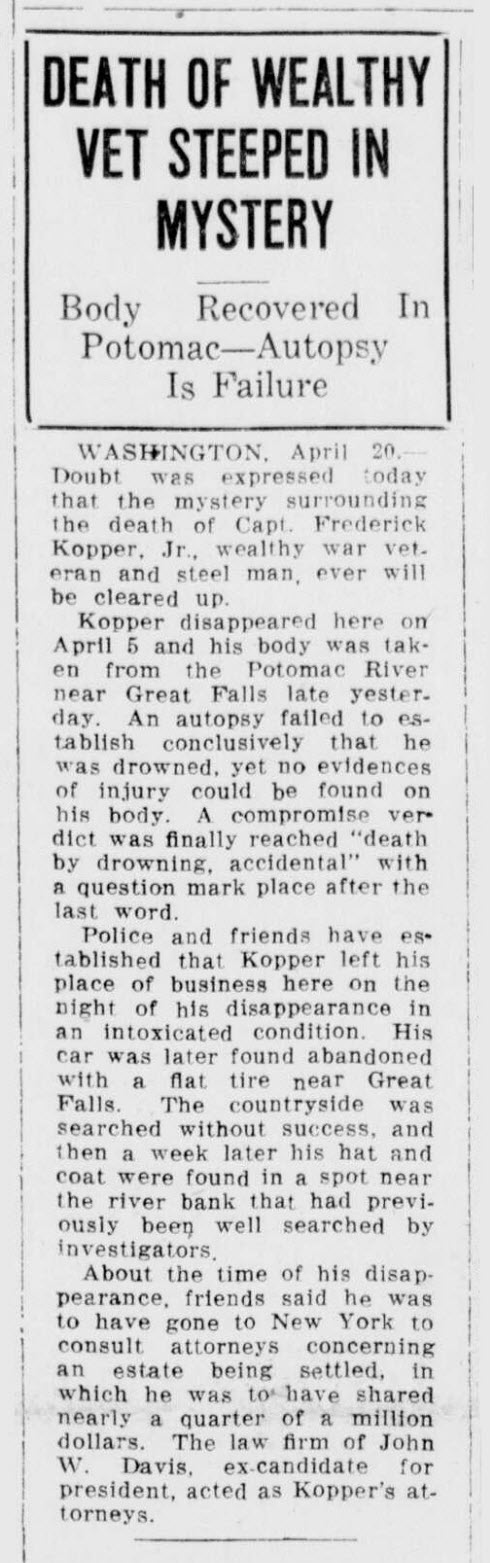
This is Captain Frederick Kopper, Jr., son of the former commander of New York's 71st Infantry Regiment from 1897 - 1891. He died under mysterious circumstances as stated in the article below from the Xenia [Ohio] Evening Gazette of April 20, 1927. Born in Vermont in 1880, he was a veteran of both the Spanish-American War and World War I. He was buried at Arlington National Cemetery.
In 1906 Kopper was involved in creating an automobile company (Lewis Power Company) which probably never produced any cars, and he patented a muffler in 1924 (US 1483354 A applied for in 1919). He held $800,000 in New York property in 1920, and his family was involved in both the real estate business and steel production. After moving to Washington, D.C. circa 1919, he worked at the Dept. of Commerce and the Bureau of Standards before opening up his own mechanical engineering practice, an auto repair shop, and a machine shop.

Dangerous
By 1922 serious racers didn't drive on wooden, artillery wheels. If these broke up the car invariably turned over.
Aooo-gah
That thing that looks like a fuel pump is actually a hand-operated Klaxon horn—like the Model No.3 in the lower left of the ad below. A bit pricey at $4.00 in 1918, but more affordable than the electric versions.

Fuel Pump
The apparatus on the outside of the car by his left forearm is part of the fuel system. Periodically the driver would have to work this pump to increase the air pressure in the fuel tank to maintain enough pressure to force fuel from the tank to the engine. This system required a great deal of hand pumping as the liquid volume of the gasoline in the tank was replaced by air as the fuel was used up.
Cootie Zeitgeist
Thanks for the technical details, Horace T. Water -- I had thought, when I first saw the photo, that the "Cootie" might be a Model T underneath. In 1923, when he was 19 years old, my father (the original/real Ormington) built a Ford-based race car that must have looked something like that. No photos survive, nor did the car itself for long. In one of my father's first races, there was a major accident, with another driver killed, and my father's right arm badly mangled. He kept his arm and gradually regained full use of it, but his family prevailed on him to get into a "safer" form of motorsports if he was determined to keep at it, so he took up boat racing, in outboard-powered hydroplanes, and did that for thirty years, with some flipovers but no serious injuries. Still, he never got over wanting to race cars, and in his 70's, my father (with that same salvaged right arm exercising its usual creativity) built a replica 1920's race car made of parts from Mustangs and Austin-Healeys and other items he had on hand, which he then exhibited at car meets. He died in 1991 -- I wish he could have seen this "Cootie" photo, as I know he would have loved it.
Gow Job
A Ford, Model T based, speedster. An early hot rod. The exhaust exiting from the left side indicates a high performance overhead valve cylinder head, possibly a RAJO, built in Racine, Wisconsin
Well now
Isn't he just to coolest thing since (or before) James Dean.
 Shorpy.com is a vintage photography site featuring thousands of high-definition images. The site is named after Shorpy Higginbotham, a teenage coal miner who lived 100 years ago. Contact us | Privacy policy | Accessibility Statement | Site © 2024 Shorpy Inc.
On Shorpy:
Today’s Top 5