



Framed or unframed, desk size to sofa size, printed by us in Arizona and Alabama since 2007. Explore now.
Shorpy is funded by you. Patreon contributors get an ad-free experience.
Learn more.




- Baldwin 62303
- Baldwin VO-1000
- Cold
- No expense spared
- Tough Guys
- Lost in Toyland
- And without gloves
- If I were a blindfolded time traveler
- Smoke Consumer Also Cooks
- Oh that stove!
- Possibly still there?
- What?!?
- $100 Reward
- Freeze Frame
- Texas Flyer wanted
- Just a Year Too Soon
- WWII -- Replacing men with women at the railroad crossing.
- Yes, Icing
- You kids drive me nuts!
- NOT An Easy Job
- I wonder
- Just add window boxes
- Icing Platform?
- Indiana Harbor Belt abides
- Freezing haze
- Corrections (for those who care)
- C&NW at Nelson
- Fallen Flags
- A dangerous job made worse
- Water Stop

Photos submitted by Shorpy members!
Print Emporium









Tenement Stairs: 1905
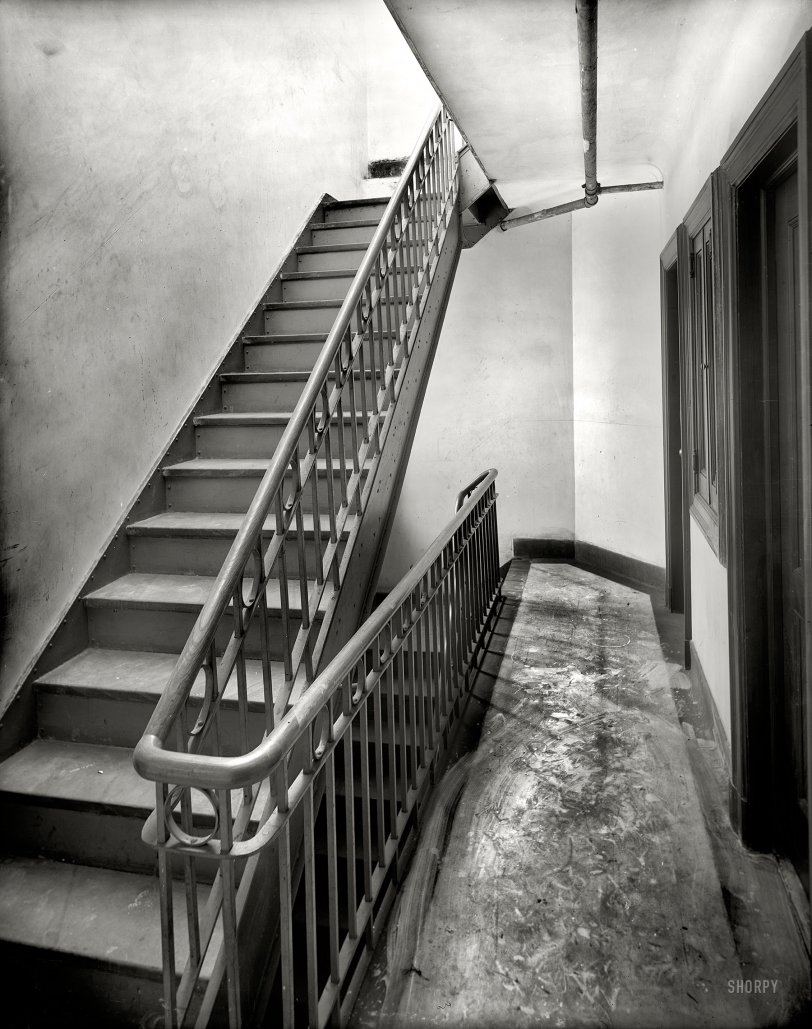
Circa 1905. "Tenement stairway and hall, New York City." The Trudge Report. 8x10 inch dry plate glass negative, Detroit Publishing Company. View full size.
Kudos
To the sharp-eyed Shorpy viewers for noticing all the minute details of this photo, and that the building was indeed probably going through a renovation rather than just being a dirty old mess! I never caught all this until I read these astute observations.

Not Originally A Pejorative
The frequent affixing of adjectives like "squalid" or "reeking" or "crumbling" to the word tenement in contemporary news articles and essays reveals that the noun was not always a pejorative. Indeed, it refers to an arrangement of flats in a multi-storied building served by a central staircase, usually constructed with one or two walls in common with adjacent buildings. (The Romans had 'em; you can look it up!) Because it was a cheap and profitable way to provide housing for the many, and because "many" and "impecunious" are often closely associated, the "old law" tenement maximized density and minimized cost to the detriment of access to light and fresh air, resulting in a gradual acceptance of the term as the equivalent of "slum." Well, that and the presence of four generations in a one-bedroom, picking rags and praying for the Bronx.
Ready for the Painters!
This hallway view shows new construction. The wrought iron railing and stair stringers have not been painted yet and a scribed line in the plaster is visible about three feet above the floor where the separation of paint colors will be. A darker color below to hide scuffs and fingerprints.
No sense in mopping the floor until the painters have finished.
Plaster spillage?
The wall at left seems to show evidence of plaster repairs to holes, and there's further evidence of plaster work at the top of the stairs. I think the two white circles on the hall floor are where buckets of plaster stood, and the nearer bucket got tipped over so that its contents ran along the floor.
Don't Jump to Conclusions
Looks less like 'sloppy' than partway through renovations. The stuff on the floor could be old mastic.
Ragg Mopp
Have these people never heard of a Mop?
 Shorpy.com is a vintage photography site featuring thousands of high-definition images. The site is named after Shorpy Higginbotham, a teenage coal miner who lived 100 years ago. Contact us | Privacy policy | Accessibility Statement | Site © 2024 Shorpy Inc.
On Shorpy:
Today’s Top 5