


Framed or unframed, desk size to sofa size, printed by us in Arizona and Alabama since 2007. Explore now.
Shorpy is funded by you. Patreon contributors get an ad-free experience.
Learn more.



- Baldwin 62303
- Baldwin VO-1000
- Cold
- No expense spared
- Tough Guys
- Lost in Toyland
- And without gloves
- If I were a blindfolded time traveler
- Smoke Consumer Also Cooks
- Oh that stove!
- Possibly still there?
- What?!?
- $100 Reward
- Freeze Frame
- Texas Flyer wanted
- Just a Year Too Soon
- WWII -- Replacing men with women at the railroad crossing.
- Yes, Icing
- You kids drive me nuts!
- NOT An Easy Job
- I wonder
- Just add window boxes
- Icing Platform?
- Indiana Harbor Belt abides
- Freezing haze
- Corrections (for those who care)
- C&NW at Nelson
- Fallen Flags
- A dangerous job made worse
- Water Stop

Photos submitted by Shorpy members!
Print Emporium



Vroom: 1949
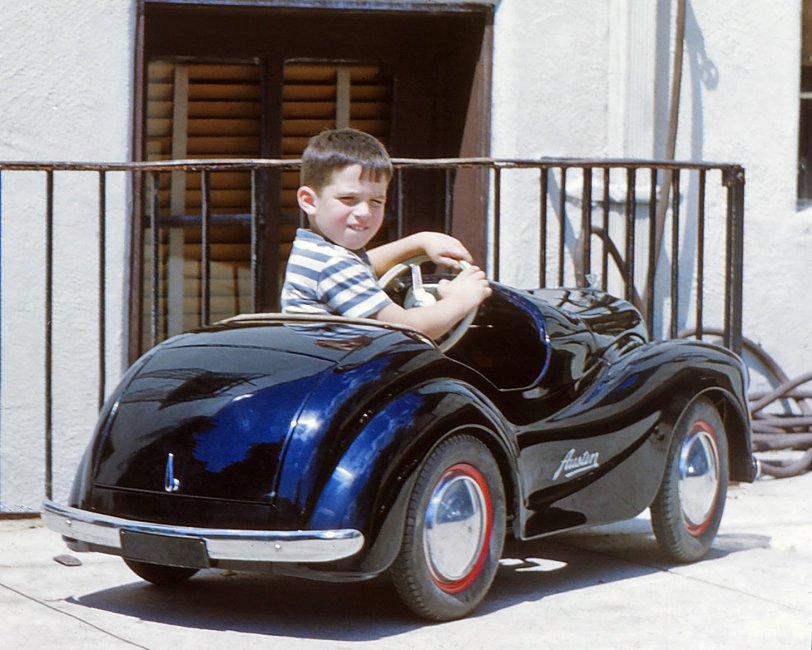
Young motorist in an Austin pedal car circa 1949. From a set of 35mm Kodachromes I acquired in northern New Jersey. Here is another view. View full size.
Wow Seconded
That kid grew up in a completely different world than what I knew. I too looked through the Sears and Wards Christmas Edition Catalogs and dreamed of having a cool pedal car. Tonka was as close as I would ever get.

Wow
I remember as a kid looking through JC Penney, Montgomery Ward, and Sears catalogs dreaming of owning a pedal car. Being one of seven children I knew the closest I would ever get was whatever my mind could dream about. That was in the 60's and I don't think I ever saw one this beautiful. Heck I would have easily traded away 2 of my sisters for this beauty.
Beautiful
And, if I remember correctly, the full size Austin was just a tad larger. That is a dandy and one very lucky kid.
Austin J40 cars
The Austin J40 is something of a British motoring institution. The pedal car was built at the Austin Junior Car Factory in Bargoed, South Wales. This dedicated factory began Austin pedal car production in 1949, with the plant funded by the British Government. It was run on a not-for-profit basis, purely for the employment of disabled coal miners, with 250 men assembling both the J40 pedal car, plus the racy Pathfinder, loosely based around a single-seater competition Austin Seven. Production ended in 1971. Values vary depending on condition, between 1 and 3,000 pounds sterling.
The J40 Story
The J40 was manufactured in the UK by the Austin company. There is a full history here.
Beyond my folks' budget
This looks like an expensive toy and sure enough, according to the pedal cars page at austinworks.com: "The J40 sold for 27 pounds plus 6 pounds added purchase tax, while the Pathfinder cost 20 pounds plus 5 pounds purchase tax. At the time the average working man would have to save 2 or 3 weeks full wages to buy a J40."
[Prior to the 1949 devaluation of the Pound Sterling the exchange rate was approximately £1 = $4; after devaluation, £1 = $2.80. - tterrace]
Just like the one Dad drives!
Wow, that kid must have been on cloud 9 to get something like that!
All metal, real tires, real paint and chrome, compare that to the all plastic, no sharp edges boring junk today.
Downside is it must have weighed a ton.
Any Pedal Car collectors out there who can give us a ballpark value on that car today?
You can never be too careful
I see they blacked out the license plate for privacy protection.
Lucky Kid!
What a beauty. Looks like the trunk lid is operational too. The tires look pneumatic, almost real car like.
 Shorpy.com is a vintage photography site featuring thousands of high-definition images. The site is named after Shorpy Higginbotham, a teenage coal miner who lived 100 years ago. Contact us | Privacy policy | Accessibility Statement | Site © 2024 Shorpy Inc.
On Shorpy:
Today’s Top 5