



Framed or unframed, desk size to sofa size, printed by us in Arizona and Alabama since 2007. Explore now.
Shorpy is funded by you. Patreon contributors get an ad-free experience.
Learn more.




- Air Quality?
- Sojourner Truth riot
- None were so blind(ed)
- The less famous sister
- Good ol' days?
- Rise and Fall
- Goo Goo Ga Joob
- Ticket Retention
- Not the only one
- Vagaries of War
- Killed by Amtrak
- Back to the Future
- Wanted --
- If you can't stand the light
- Centralized Traffic Control, I believe
- What's really happening
- Heckuva remote control!
- Sometimes — Things Go Bump!
- I SEE THE LIGHT
- Union Switch and Signal Company
- Get That Light Out Of My Eyes
- Eggs. Eggs. Eggs. The Egg Man is Here!
- Foreboding caption
- Famous Hollywood faces
- Not just S&P
- re: Those things in the jar
- Up In Smoke
- Medical Smoking
- Quick fix
- A Quink Comment

Photos submitted by Shorpy members!
Print Emporium













Hubcap Heaven: 1939
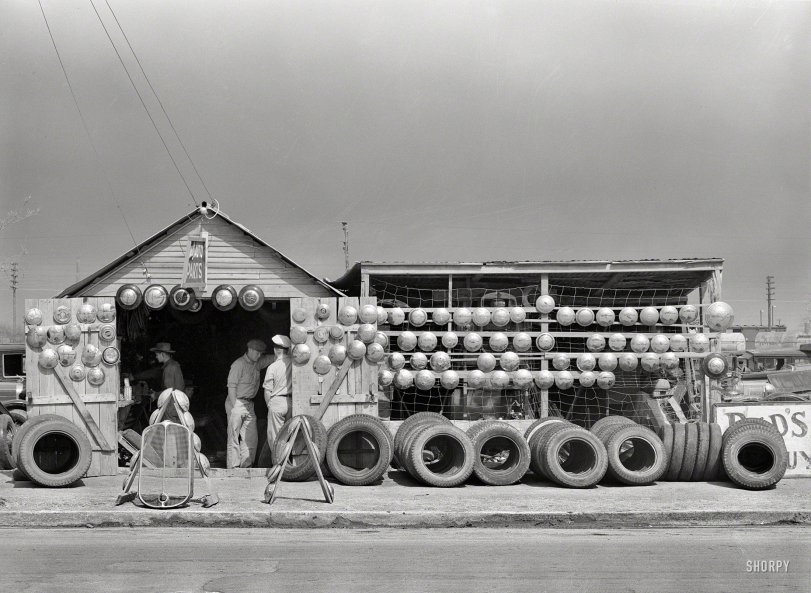
February 1939. "Auto parts store in Corpus Christi, Texas." Welcome to Dad's. Medium-format nitrate negative by Russell Lee. View full size.
Grille talk
That sidewalk grille reminded me of the time many years ago that I was scouting for parts for the 1933 Ford three-window coupe I had just bought for (drumroll) $200. In the dusty storage space above a small Bedford, Pennsylvania, Ford dealer's showroom (some showroom, I think it held two cars) I found a new still-in-the-brown-paper-factory-wrapping '33 grille, for which I paid all of $25.

By any other name
You can call it a parts store, or you can call it an automotive recycling facility, or you can call it what it is--a junkyard.
Hubcap-O-Rama
And every one dilligently policed up from the side of the highway. The combination of cheap, pressed-steel wheels and high-pressure, bias-ply tires meant that hub caps were easily shed through excessive wheel deformation on encountering significant perturbations in the paving surface at speed -- short version, hit a pothole at 40 mph, lose a hubcap. "Re-purposers" frequently picked them up for sale to places like this, where people who belatedly discovered they'd lost a hubcap might go to get a cheap replacement. It's not unlikely that many people purchased the very hubcaps they'd lost a short time before.
 Shorpy.com is a vintage photography site featuring thousands of high-definition images. The site is named after Shorpy Higginbotham, a teenage coal miner who lived 100 years ago. Contact us | Privacy policy | Accessibility Statement | Site © 2024 Shorpy Inc.
On Shorpy:
Today’s Top 5