



Framed or unframed, desk size to sofa size, printed by us in Arizona and Alabama since 2007. Explore now.
Shorpy is funded by you. Patreon contributors get an ad-free experience.
Learn more.




- Killed by Amtrak
- Back to the Future
- Heckuva remote control!
- Sometimes — Things Go Bump!
- I SEE THE LIGHT
- Union Switch and Signal Company
- Get That Light Out Of My Eyes
- Eggs. Eggs. Eggs. The Egg Man is Here!
- Foreboding caption
- Famous Hollywood faces
- Not just S&P
- re: Those things in the jar
- Up In Smoke
- Medical Smoking
- Quick fix
- A Quink Comment
- If You’re Like Me, Never
- Delivering the News
- U.S.A.
- S&P
- 1940 Zenith radio model 6G601
- Quality goes in before the name goes on!
- Snazzy skirt
- Carbon Arc Lamps
- Illuminate us
- I remember it well
- I can't prove it
- Complicated then, forgotten now
- Bryan-Stevenson
- Skinny is as skinny does

Photos submitted by Shorpy members!
Print Emporium







Where's My Remote: 1938
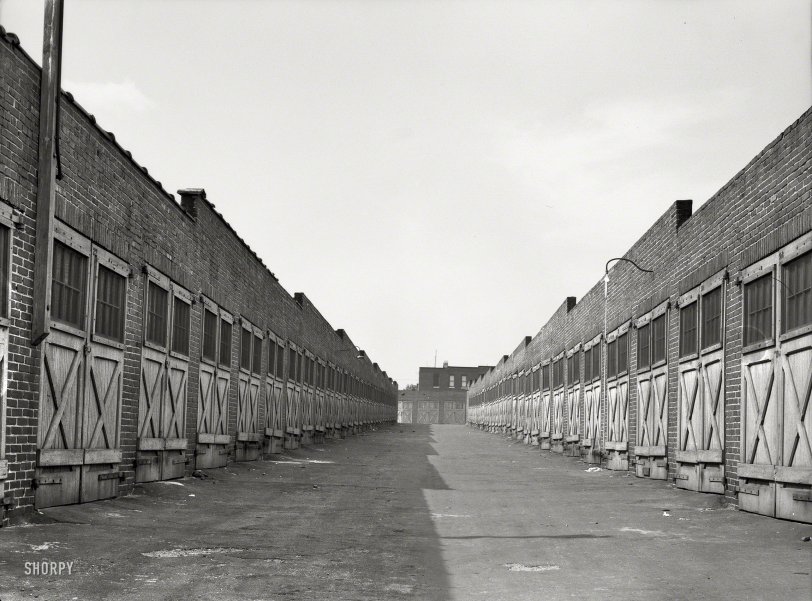
July 1938. "Garages in alley behind row houses. Baltimore, Maryland." Which one is ours again? Medium format nitrate negative by John Vachon. View full size.
ooo-ooo that smell!
As a realtor, I still occasionally get to experience the aroma of old garages here in Tulsa. And it's not just confined to garages. Old homes have their own unique scents as well. Sometimes, too, an old, vacant home can tell you stories if you just observe. For example, I showed one home close to downtown and behind a bedroom door were these different ruler marks notating a child's height as he progressed through life. The years were jotted down - 1930s to 1940s. Old structures will speak to you if you let them.

Garage vs. house width
The garages are probably not directly behind individual houses. I don't know where in the city these particular garages are, but here's another Baltimore example.
I heard through a neighborhood oral history project that back when cars were relatively rare, you weren't allowed to leave them on the street! Had to go in a garage at night. There are some in the alley behind our block, but definitely not one per house (we don't have one).
Traffic Jam
Imagine the fun of backing out of one of these garages when several of your neighbors, next to and across from you, were doing the same.
Old garage aroma solved.
When I built a new garage several years ago, it had the smell of adhesives and curing cement. Ugh. I found an old garage that was about to be demolished not far from my house with a very heavily built 30 foot workbench. At least 50 years old, with paint stains, oil, and who knows what else on it. After liberating it from it's doomed home, my neighbor and I split in half, and now we each have that great smell without the wait.
Eau de 10W40
That aroma dear to car nuts may have been due to the habit of draining the oil directly onto the garage's dirt floor, where it soaked in (harmlessly, as was thought back then) and perfumed the air for an eon or two. Most of the hazmat that has to be remediated when military facilities are turned over for civilian purposes, for example, can be chalked up to motor fuels/lubricants' and used dry-cleaning fluids' being disposed of by dumping -- a common practice for decades and cetainly not restricted to the military. In fact, coastal cities in California (and presumably elsewhere) often have stencilled on curbs above storm drains the legend "No dumping/Drain discharges to ocean."
Thanks, 'jwp'
Hate to come home on a Saturday night and enter this alley from the wrong end. 'The seventh garage on the right side' could turn into a real adventure!
VERY narrow rowhouses?
If the garages are lined up behind the row houses at one garage per, the residences must be very narrow.
Re: Old Garage Aroma
We had a garage similar to this when we lived in Brooklyn in the 50's. I know exactly what Jazznocracy means by the aroma. I often accompanied my Dad on the two block walk to the rented garage to retrieve the '39 DeSoto or the '50 Plymouth when we upgraded. Oddly, one of my better memories of that garage was the "lock protector" that Dad crafted from a piece of an old tire to keep the rain out.
The aroma!
Those old fashioned wooden garages had SUCH a delicious aroma! A blend of old motor oil, dry, unpainted wood, and who knows what else. Strong, pungent aroma. And you have to look far and wide to find one like this any more.
Thought this was Russia
When I first saw this photo I thought it was set in Russia, where I saw many of these garageplexes in every city I visited back in the Soviet days. When you lived in a Stalin-era apartment highrise, you had to have some place to put your car, not so much for parking, but for working on it, because keeping a car running was a challenge back then.
[Not to mention getting one. - Dave]
Overhead is Better
Having endured such a garage (and such garage doors) during a blustery winter in Ft. Leavenworth, I can state unequivocally that getting your car out on a windy morning requires either three people or one driver and two cinder blocks.
Marble Steps
Around front, one set for each garage door.
Malvina Reynolds
wrote "Little Boxes"; Seeger (and others) only sang it. She wrote a whole lot of songs, actually; worth looking up on YouTube.
 Shorpy.com is a vintage photography site featuring thousands of high-definition images. The site is named after Shorpy Higginbotham, a teenage coal miner who lived 100 years ago. Contact us | Privacy policy | Accessibility Statement | Site © 2024 Shorpy Inc.
On Shorpy:
Today’s Top 5