



Framed or unframed, desk size to sofa size, printed by us in Arizona and Alabama since 2007. Explore now.
Shorpy is funded by you. Patreon contributors get an ad-free experience.
Learn more.



- Baldwin 62303
- Baldwin VO-1000
- Cold
- No expense spared
- Tough Guys
- Lost in Toyland
- And without gloves
- If I were a blindfolded time traveler
- Smoke Consumer Also Cooks
- Oh that stove!
- Possibly still there?
- What?!?
- $100 Reward
- Freeze Frame
- Texas Flyer wanted
- Just a Year Too Soon
- WWII -- Replacing men with women at the railroad crossing.
- Yes, Icing
- You kids drive me nuts!
- NOT An Easy Job
- I wonder
- Just add window boxes
- Icing Platform?
- Indiana Harbor Belt abides
- Freezing haze
- Corrections (for those who care)
- C&NW at Nelson
- Fallen Flags
- A dangerous job made worse
- Water Stop

Photos submitted by Shorpy members!
Print Emporium



The House Jack Built: 1940
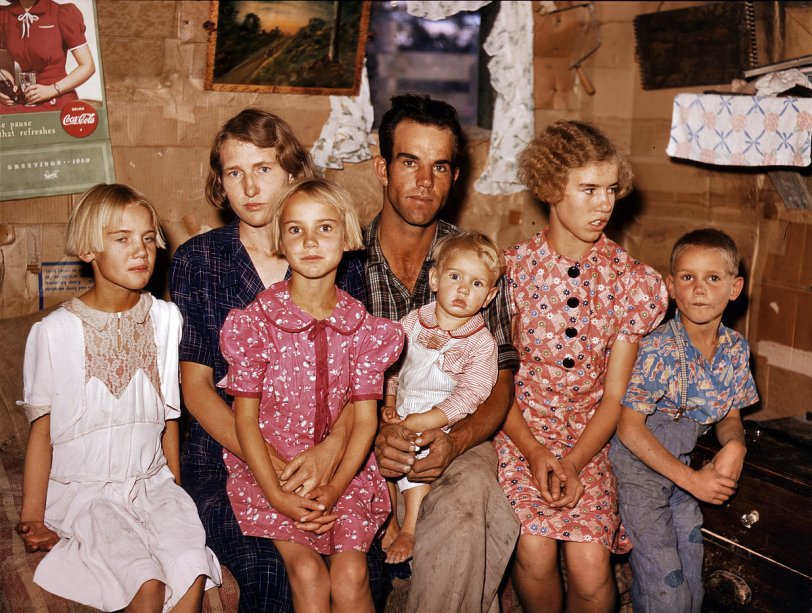
Sept. 1940. The Jack Whinery family in their Pie Town dugout. Homesteader Whinery, a licensed preacher, donates his services to the local church. More on the family below. View full size. 4x5 Kodachrome transparency by Russell Lee.

The Farm Bureau building
The Farm Bureau building still exists. It is now used as the "Community Center" and is the property of the Pie Town Community Council. A porch has been added along the front, and an additon on the side for a kitchen and restrooms, but otherwise it looks pretty much as it did in the Russle Lee photos from 1940.
Information about the Whinery children
I was in Pie Town a few days ago and managed to find the name of all the Whinery children. The oldest girl is Laura; Velva (middle name "Mae") is in pink, and Wanda is in white. The eldest boy is A.J, and the baby boy's name is Lawrence.
I know for certain that Wanda, Velva, and Lawrence have died. Wanda was born in Adrin, Texas on August 29, 1931 and died on May 27, 2007 at the age of 75. She was married twice, to Clifford Miller on Nov 4, 1956, and she had four children, two boys and two girls, and Chester Kosakowski, age 81, on Oct 31, 2005. In her obituary it says that Wanda and Lawrence preceded her in death, Wanda likely unmarried as they referred to her as Wanda Whinery instead of with a married name. It also said that Laura and A.J. survived her, so unless they have passed away in the meantime, Laura is living in Clifton, Colorado, with the married name Murray, and A.J is living in Dayton (it doesn't say which of the 23 Daytons in the US, so I'm guessing it is Dayton, TX)
I talked to a man who lived in Pie town for all of his life, and he said that he doesn't think the Whinery home is still there. Neither is the Farm Bureau building that the children went to school in. On the other hand, one of the other school buildings is still there and being re-stuccoed and made into a residential home. Their current public schools are in Datil and Quemado, none in Pie Town. The current population of Pie Town is approximately 60 people, and the Pie-O-Neer has better pie than The Daily Pie.
The Sack Dress
Feed sacks came in every design imaginable. I have a friend who collects and lectures on them and she has seen literally thousands of different prints. Andover Fabrics out of New York will be doing a line or reproduction fabric based on her collection soon. I've even seen feed sacks printed to look like toile. The variety is astounding.
Feed Sack Fabric
In the late 1800's cotton sacks gradually replaced barrels as food containers. Flour and sugar were among the first foods available in cotton sacks, and women quickly figured out that these bags could be used as fabric for quilts and other needs. Manufacturers also began using cotton sacks for poultry and dairy feeds.
The earliest of these bags were plain unbleached cotton with product brands printed on them. In order for women to use these bags they first had to somehow remove the label, or to make sure that the part of the cloth with the label was not normally visible.
It did take some time for the feed and flour sack manufacturers to realize how popular these sacks had become with women, but finally they saw that this was an opportunity for promoting the use of fabric feedsacks. Their first change was to start selling them in colors, and then in the 1920's began making them with colorful patterns for making dresses, aprons, shirts and children’s clothing. They also began pasting on paper labels that were much easier to remove than the labels printed direstly on the fabric.
By the 1930's competition had developed to produce the most attractive and desireable patterns. This turned out to be a great marketing ploy as women picked out flour, sugar, beans, rice, cornmeal and even the feed for the family farm based on which fabrics and pattern they wanted. I can remember that if my mother was not able to go along when my father went to buy feed, she would often send a scrap of material of the fabric design she needed so that he would be sure to buy the right one. This was during the 1950's.
By the 1950's paper bags cost much less than cotton sacks, so companies began to switch over to this less expensive packaging. The fabric feedsack industry actively promoted the use of feedsacks in advertising campaigns and produced even a television special encouraging the use of feed sacks for sewing, but by the end of the 1960's the patterned feedsack fabrics were no more.
Pink feed sacks...
The girls' clothing is actually relatively new cotton muslin, and in quite good shape. Dad and the baby are wearing the most worn-out clothing of all of them.
I doubt feed sacks came dyed with pink flowers or other feminine designs. The ones I own are just plain off-white.
As an aside, I just noticed that all the kids look just like Mom except the oldest daughter, who looks just like Dad.
clothing
The fabric the clothes are made from has to be flour/feed sacks. Perhaps not the father's but the rest of them surely are.
The parents do look so young. Not more then 30. And yet they must have led a hard life up to this point. Amazing the family
resemblance.
They are all so thin. Not
They are all so thin. Not starved thin as much as built thin.
Thanks for all the comments on who they might have been!
They are interesting reads.
young mothers
>>>"i'm more intrigued with how young they look and how many kiddos they have. wow."
My paternal grandmother was 15 when she married my grandpa 1932 (in Lovington, New Mexico), and they started a family right away. My grandmother preferred to say that she was "almost 16".
They were actually residing at that time around Brownfield, TX, but they drove all day and night (accompanied by the father of the bride) to the nearest courthouse in NM, because at that time, 16 was the legal age for girls to marry in TX.
Apparently, there was nothing shameful or even unusual for girls to marry at 15 in that place and time, though perhaps 14 might have been pushing it.
Both families were fairly strict and god-fearing people-- poor but not destitute. Grandpa's whole family were members of the Primitive Baptist Church.
Scott, in Taiwan
distichum2@yahoo.com
One boy's name was Lawrence,
One boy's name was Lawrence, apparently.
And if the Obit for Velva is right, Wanda Whinery never married - no married name is listed.
They may have been dirt poor, but the kids look healthy and cared for.
names
Interesting how first name fashions come and go. Here we have Jack and Edith (basic early 20th C names) with a Velva and a Wanda, surely exotic names for the time -- though the 30's, when they were born, was a time of experiment in many things... What were the other children called? Bet the boys got more ordinary names.
Sad
How old was that mother when she married? She doesn't look that much older than her eldest child. Sad.
The girl on the right
I think that girl is Wanda Whinery. She's mentioned in the obit as being Velva's deceased sister; a Wanda Whinery shows up in the SSDI from the Grand Junction/Clifton, CO area (where they all seem to have ended up). She was born in 1929, so she'd have been 11 in this photo, an age at which most girls are shy, awkward, and uncomfortable.
You're right about it being a long way; a little girl sitting beside her mother to a great-grandmother in her own right.
Charlene...
thank you for the information! I think you're right: the camera-shy girl on the right is likely well beyond nine, now that I look at her again. The obituary you linked us to shows that Velva certainly came a long way from this Pie Town dugout, eh?
Denny Gill
Chugiak, Alaska
There's a Velva M. Kosakowski who may be the one
Here's her obituary. She's the only Velva in the SSDI born on that date with the middle initial M, and the obit says she's Jack and Edith Whinery's daughter.
It looks like the same Velva Whinery you mention, Denny, but whether she's one of the girls in the photo I don't know. The girl on the right looks far too old to me to be nine (she is almost as tall as her father when sitting plus she has breasts - I'd suggest she was about 12-13), but the girl on the left looks nineish.
me again
1940 = year I was born in Norfolk VA..... :-)
Sunday best
....wonderful how they managed to step up to the plate and present themselves in their "finest'...an amazing and poignant photograph...
Velva Mae
If my research is correct, the Mrs. is Laura Edith, née Evans, and Jack’s full name is Abrim Jack Whinery. The eldest daughter, the camera-shy one on the right, is Velva Mae. If she’s still alive today, she’ll turn 76 on August 29th.
Denny Gill
Chugiak, Alaska
Licensed preacher
Sure there's such a thing as a licensed preacher. In many states, there are 2 distinctions: licensed and ordained. A licensed minister is recognized by the state and can perform weddings, funerals and the like. It kind of depends on the church you attend, but ordination is usually church recognition of a minister's credentials.
Sad eyes
In so many pics of poor families in the 30s/40s, I notice how sad (maybe just tired) the mothers look while the dads somehow show some kind of dignity or at least of being alive.
PIE TOWN
I just talked to some friends who went there this summer. There are still people who bake pies and have a very rural lifestyle. They said it was a great place!
There's such a thing as a
There's such a thing as a "licensed preacher"?
so young
i'm more intrigued with how young they look and how many kiddos they have. wow. looks like the 2 girls on the left are twins.
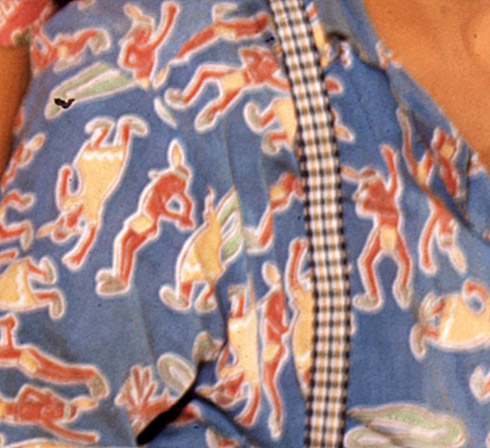
Dancing Africans?
I'm a bit intrigued by the pattern on the boy's shirt.
Stupid comment here
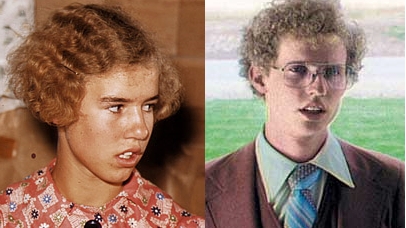
The girl second from the right seems to be channeling Napoleon Dynamite. Sorry to ruin it. Juvenile. Sorry.
[Gyaaah! - Dave]
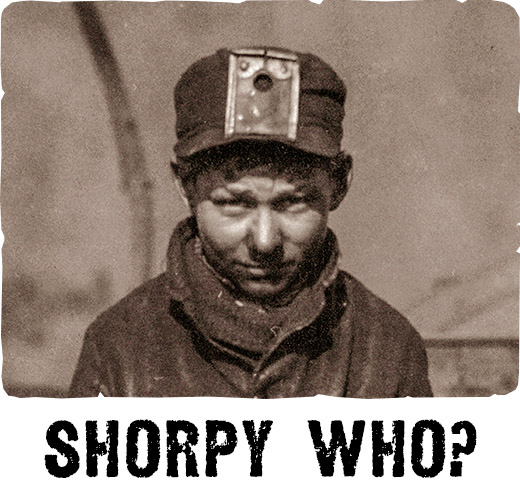
 Shorpy.com is a vintage photography site featuring thousands of high-definition images. The site is named after Shorpy Higginbotham, a teenage coal miner who lived 100 years ago. Contact us | Privacy policy | Accessibility Statement | Site © 2024 Shorpy Inc.
On Shorpy:
Today’s Top 5