



Framed or unframed, desk size to sofa size, printed by us in Arizona and Alabama since 2007. Explore now.
Shorpy is funded by you. Patreon contributors get an ad-free experience.
Learn more.



- What a headache!
- Baldwin 62303
- Baldwin VO-1000
- Cold
- No expense spared
- Tough Guys
- Lost in Toyland
- And without gloves
- If I were a blindfolded time traveler
- Smoke Consumer Also Cooks
- Oh that stove!
- Possibly still there?
- What?!?
- $100 Reward
- Freeze Frame
- Texas Flyer wanted
- Just a Year Too Soon
- WWII -- Replacing men with women at the railroad crossing.
- Yes, Icing
- You kids drive me nuts!
- NOT An Easy Job
- I wonder
- Just add window boxes
- Icing Platform?
- Indiana Harbor Belt abides
- Freezing haze
- Corrections (for those who care)
- C&NW at Nelson
- Fallen Flags
- A dangerous job made worse

Photos submitted by Shorpy members!
Print Emporium




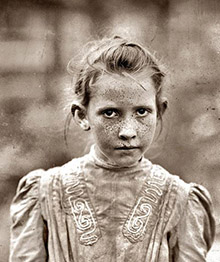
Mold Boy: 1909
![November 1909. Cumberland Glass Works at Bridgeton, New Jersey. A young "holding-mold boy" is seen, dimly, to the left [little kid toward the back]. Negroes, Greeks and Italians are being employed in many glass houses. View full size. Photograph and caption by child-labor reformer Lewis Wickes Hine.](https://www.shorpy.com/files/images/05437u_0.preview.jpg "Mold Boy: 1909")
November 1909. Cumberland Glass Works at Bridgeton, New Jersey. A young "holding-mold boy" is seen, dimly, to the left [little kid toward the back]. Negroes, Greeks and Italians are being employed in many glass houses. View full size. Photograph and caption by child-labor reformer Lewis Wickes Hine.
Can we assume…
…that none of them threw stones?

and...Italians
I just wrote a book on Lewis Hine that should come out next year. When he said "Italians," he meant recent Italian immigrants or their American-born children. Same with Greeks. They probably spoke very little, if any, English. Hine spoke some Italian. What's more curious is "Negroes." To refer to African Americans as "Negroes" (as opposed to the then common "coloreds--or worse) in 1909 was WAY progressive.
The ethnicity base in American became vastly varied in the Ellis Island years. People were adjusting. There were a lot of REALLY bad ways people would speak about especially Italians then. The Klan made a resurgence in that era specifically attacking Catholics, Jews, Anarchists, and Communists (or anyone perceived that way). Italians and Irish were singled out for their Roman Catholicism, and the Italians more so for the Italian origins of Anarchism. Google "Sacco and Vanzetti."
Any questions on Hine, ask.
Best,
Kate
Kate Sampsell-Willmann
Assistant Professor of American History and Photographic Historian
Georgetown University
ksw29@georgetown.edu
re: and Italians?
He may not have had an opinion one way or another, just stating a fact.
and... Italians?
"Negroes, Greeks and Italians are being employed in many glass houses."
Since he felt it worthy of comment I wonder what his opinion was of this development?
 Shorpy.com is a vintage photography site featuring thousands of high-definition images. The site is named after Shorpy Higginbotham, a teenage coal miner who lived 100 years ago. Contact us | Privacy policy | Accessibility Statement | Site © 2024 Shorpy Inc.

On Shorpy:
Today’s Top 5