



Framed or unframed, desk size to sofa size, printed by us in Arizona and Alabama since 2007. Explore now.
Shorpy is funded by you. Patreon contributors get an ad-free experience.
Learn more.



- S&P
- 1940 Zenith radio model 6G601
- Quality goes in before the name goes on!
- Snazzy skirt
- Carbon Arc Lamps
- Illuminate us
- I remember it well
- I can't prove it
- Complicated then, forgotten now
- Bryan-Stevenson
- Skinny is as skinny does
- How do you rest in peace
- Riding the footboards
- Alas, hidden from view
- Baldwin Diesels
- Exclusive pump
- Bananas, Oysters and Smokey Joe
- Details, Details
- What's that building to the left of the tower?
- Coal Barges
- Bromo-Seltzer
- Inner harbor
- The Basin
- What a headache!
- Giant stepladder?
- Yeah, it was cold
- Love those coats
- Link & Pin Days Remnant
- Baldwin 62303
- Baldwin VO-1000

Photos submitted by Shorpy members!
Print Emporium


Missouri Farms: 1938
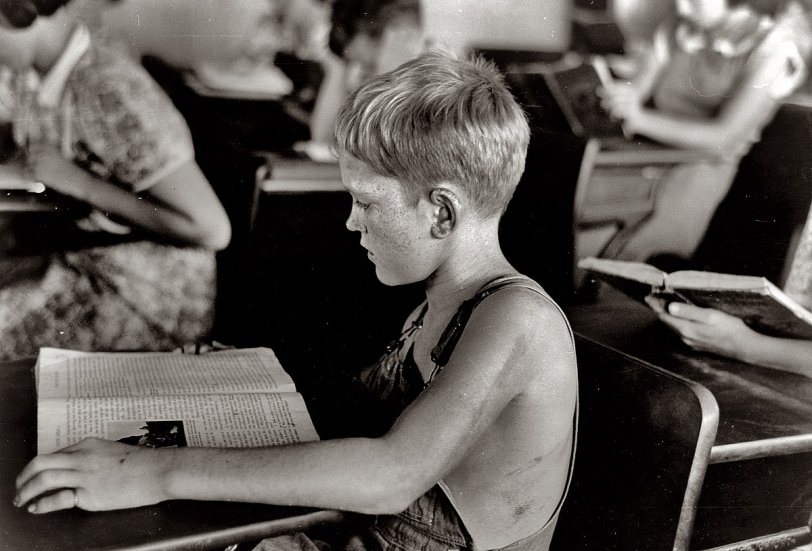
August 1938. Child studying in school. Southeast Missouri Farms, Missouri. 35mm nitrate negative by Russell Lee, Farm Security Administration. View full size.
The Joads
were "tractored off the land," too. (Although it was a Cat bulldozer that leveled their house and set them on the road to California.) I re-watched "The Grapes of Wrath" just last night; such an angry movie, much more angry, I think, than the book Steinbeck wrote.
Denny Gill
Chugiak, Alaska

"Tractored off the land" ?
SEMO (Southeast Missouri to the uninitiated) stopped as a major cotton producer and the reasons for the mechanical cotton pickers (one of which my Great Uncle invented) fell because it no longer became competitive with other areas of the country. 'poor whites, and even poorer blacks' is pandering. Many of the poor whites were equally poor as the poor blacks. There was still a cadre of middle class blacks who wre part of the black community. I picked cotton along with others who had a "Cotton Vacation" from school. I always find it interesting when people with little knowledge speak as experts on a subject of which they know very little.
Tractored off the land
The Missouri Bootheel was historically a land of prosperous planters, poor whites, and poorer blacks. Eventually, mechanical cotton pickers would threaten to make the sharecropping system obsolete.
As the sharecroppers put it themselves, they were being "tractored off the land."
 Shorpy.com is a vintage photography site featuring thousands of high-definition images. The site is named after Shorpy Higginbotham, a teenage coal miner who lived 100 years ago. Contact us | Privacy policy | Accessibility Statement | Site © 2024 Shorpy Inc.

On Shorpy:
Today’s Top 5