


Framed or unframed, desk size to sofa size, printed by us in Arizona and Alabama since 2007. Explore now.
Shorpy is funded by you. Patreon contributors get an ad-free experience.
Learn more.



- Details, Details
- What's that building to the left of the tower?
- Coal Barges
- Bromo-Seltzer
- Inner harbor
- The Basin
- What a headache!
- Giant stepladder?
- Baldwin 62303
- Baldwin VO-1000
- Cold
- No expense spared
- Tough Guys
- Lost in Toyland
- And without gloves
- If I were a blindfolded time traveler
- Smoke Consumer Also Cooks
- Oh that stove!
- Possibly still there?
- What?!?
- $100 Reward
- Freeze Frame
- Texas Flyer wanted
- Just a Year Too Soon
- WWII -- Replacing men with women at the railroad crossing.
- Yes, Icing
- You kids drive me nuts!
- NOT An Easy Job
- I wonder
- Just add window boxes
Photos submitted by Shorpy members!
Print Emporium
Union Station: 1943
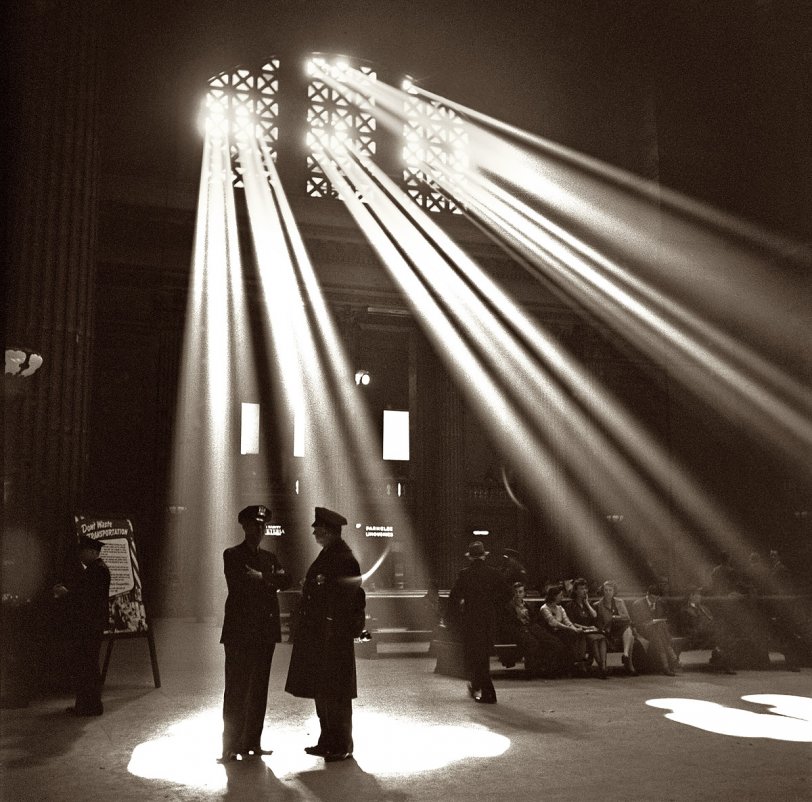
January 1943. The waiting room of Union Station in Chicago. View full size. Medium-format negative by Jack Delano for the Office of War Information.
Beautiful...!
Reminds me of John Collier's excellent grasp of a Norman-Rockwellish scene in Grand Central Terminal — a photo from 1941 also to be found here at Shorpy.

Re: Sunbeams?
I believe this is simply sunlight: the apparent divergence of the rays of light is a common optical phenomenon known as crepuscular rays or "God's Rays."
Sunbeams?
I'm a bit puzzled by this photo – wouldn't sunbeams project as straight, parallel lines? These seem to spread, thus the source of light must be very close.
[Which might mean they're not sunbeams. - Dave]
Atmosphere (Literally)
Good point, Large Format. I once worked for a BBC film producer who used a smoke machine and a water vapor mist machine to create "atmosphere" for interior set shots.
Goober Pea
Rays of Light
We have forgotten how many people smoked at the time. As a kid in Philly's 30th Street station and later as a young adult in Chicago's Union Station, I have seen these rays at both depots at certain times of day. I've tried to re-create them on my 8x10 view camera at both stations. You can't. No one smokes inside so the air is not to be seen.
Magnificent photo
It looks like the photographer used a simple rule regarding black and white film that is still taught today--expose for the shadows. By doing that Mr. Delano captured the details you see: the people and background while the sunbeams blaze through the windows like spotlights. If he had exposed for the highlights, i.e. the windows, there would be no sunbeams, the shadows would likely be dark and this would have been a dull image.
Union Station
Since I posted my original comment, I have spent a few minutes in the main waiting room at different times each afternoon.
I haven't seen the rays coming through, but I think the difference between Jan 1943 and Jan 2008 is level of light in the room. In 1943, energy conservation measures were in place, so only a handful of dim electric lights were on.
In 1992, Union Station was remodeled, and the massive glass roof of the room was cleaned. I recalled reading at the time that the roof had been covered with paint or tar very early in the Stations history, and that the buildings management didnt realize that the massive vaulted ceiling was actually made of glass. That seems a bit unbelivable to me, and I can't find confirmation of that on the web.
Today the room is used extensively for Corporate Events. The benches, which appear to be identical to the ones in the 1943 photo, are moved with forklifts. A large center information kiosk in the middle of the room is hidden under a wood panelled cover.
The Wikipedia entry has a nice daylight shot of the room. You can clearly see how bright the room is now. You can also see the benches and the end of the room as shown in the 1943 photo.
Exposure time
I'm no expert so this may be wrong, but I see it this way--- as you lengthen the exposure time, the beams get brighter, and the dark parts become more visible, but the spots of direct sunlight stay the same because they are already fully exposed in a short time, so they can't get any whiter.
Union Station
I walk through this room every day. I am going to print out this photo on a high resolution color printer and try to figure out where the camera was positioned in the room.
The room is oriented north to south, and the entrance in the photo is either the north or south side. The room as been remodeled extensively, but I would think the camera is pointed south, due to the light rays coming in. Since the sun is in the southern sky, you would not expect to see light rays coming in from the north.
Given that the photo was taken in January, it should be possible to determine what the light conditions were for the photo.
By the way, this room is at the bottom of the stairs made famous in the baby carriage scene from the Kevin Costner / Sean Connery movie "The Untouchables". If my guess about where the camera is set is correct, the stairs are behind the photographer.
Are my eyes playing tricks?!
I have just found this website, actually I was directed here by one of my U.S. friends. This image has stopped me in my tracks, truly an artistic and wonderful image!
Union Station
The blur of the man's foot suggest a fairly long exposure. not THAT long, though, since no one else is blurred. 1/15? 1/8? This is a situation where you use a whole roll of film and get exactly one "perfect" exposure. I wish I knew the aperture and film speed.
[There was no roll here. This is sheet film. - Dave]
Thanks
Thanks, that was the exact sort of response i was looking for.
The eye would see more
"If I was standing in that room would it appear similar to the photo? Or is it being helped along with some clever camera work?"
I suppose if you were there the beams would appear not quite so bright and the darks would present more detail since the eye can work over a wider range of illumination than film can. But the effect would be similar. Enough to make the photographer think "hey, that would make a great picture."
Amazing
Help me out, I'm not a photographer, but not too slow to comprehend the process. If I was standing in that room would it appear similar to the photo? Or is it being helped along with some clever camera work?
Light
Photography is about light and this photograph proves it. How on earth did Jack Delano get the exposure so right? I don't think professional photographers indulged in bracketing in the 1940s, not with expensive sheet film anyway. A truly great photograph. But then again, Delano is my favorite on these pages.
[Jack took dozens of shots in this room. - Dave]
 Shorpy.com is a vintage photography site featuring thousands of high-definition images. The site is named after Shorpy Higginbotham, a teenage coal miner who lived 100 years ago. Contact us | Privacy policy | Accessibility Statement | Site © 2024 Shorpy Inc.
On Shorpy:
Today’s Top 5