



Framed or unframed, desk size to sofa size, printed by us in Arizona and Alabama since 2007. Explore now.
Shorpy is funded by you. Patreon contributors get an ad-free experience.
Learn more.




- Details, Details
- What's that building to the left of the tower?
- Coal Barges
- Bromo-Seltzer
- Inner harbor
- The Basin
- What a headache!
- Giant stepladder?
- Baldwin 62303
- Baldwin VO-1000
- Cold
- No expense spared
- Tough Guys
- Lost in Toyland
- And without gloves
- If I were a blindfolded time traveler
- Smoke Consumer Also Cooks
- Oh that stove!
- Possibly still there?
- What?!?
- $100 Reward
- Freeze Frame
- Texas Flyer wanted
- Just a Year Too Soon
- WWII -- Replacing men with women at the railroad crossing.
- Yes, Icing
- You kids drive me nuts!
- NOT An Easy Job
- I wonder
- Just add window boxes

Photos submitted by Shorpy members!
Print Emporium








Proviso Yard: 1942
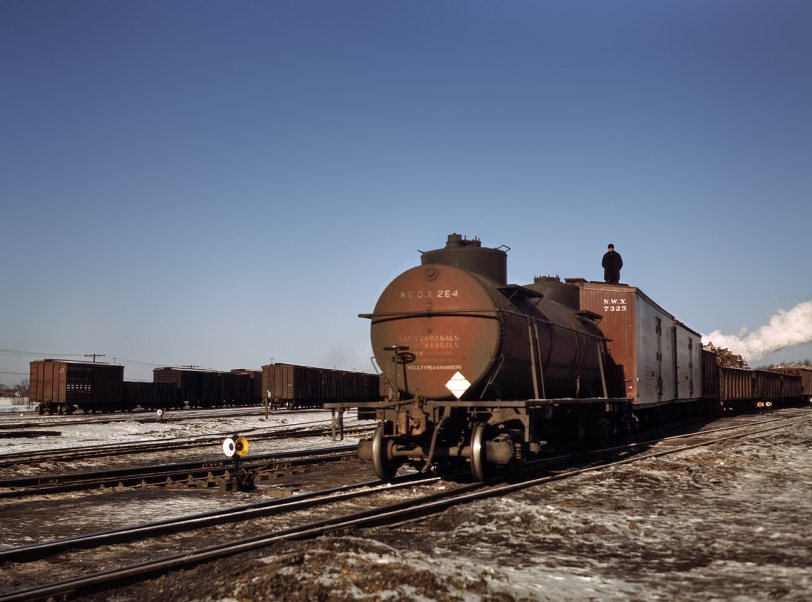
December 1942. Proviso Yard, Chicago & North Western R.R. "A train, or 'cut,' being pushed out of a receiving yard toward the hump. A brakeman rides each train to signal the engineer in the locomotive at the rear." View full size. 4x5 Kodachrome transparency by Jack Delano, Office of War Information.
DOT placard?
Look at the white diamonds on the tanker, looks a LOT like a DOT placard.
I didn't realize they already had the DOT hazardous materials placards back in 1942? I was under the impression that the placard system wasn't started until the early 60's.
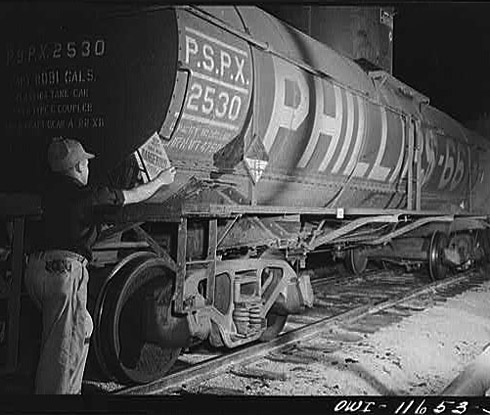
[There was no DOT in the 1940s -- the Department of Transportation was established in 1966. The current system of hazmat placards, hinged in the middle with a four-digit number on them, goes back to the Hazardous Materials Transportation Act of 1975. In the 1940s, tank cars full of gasoline might have a DANGEROUS placard (below), with skull and crossbones. - Dave]

 Shorpy.com is a vintage photography site featuring thousands of high-definition images. The site is named after Shorpy Higginbotham, a teenage coal miner who lived 100 years ago. Contact us | Privacy policy | Accessibility Statement | Site © 2024 Shorpy Inc.
On Shorpy:
Today’s Top 5