


Framed or unframed, desk size to sofa size, printed by us in Arizona and Alabama since 2007. Explore now.
Shorpy is funded by you. Patreon contributors get an ad-free experience.
Learn more.




- Alas, hidden from view
- Exclusive pump
- Details, Details
- What's that building to the left of the tower?
- Coal Barges
- Bromo-Seltzer
- Inner harbor
- The Basin
- What a headache!
- Giant stepladder?
- Baldwin 62303
- Baldwin VO-1000
- Cold
- No expense spared
- Tough Guys
- Lost in Toyland
- And without gloves
- If I were a blindfolded time traveler
- Smoke Consumer Also Cooks
- Oh that stove!
- Possibly still there?
- What?!?
- $100 Reward
- Freeze Frame
- Texas Flyer wanted
- Just a Year Too Soon
- WWII -- Replacing men with women at the railroad crossing.
- Yes, Icing
- You kids drive me nuts!
- NOT An Easy Job

Photos submitted by Shorpy members!
Print Emporium












Gob Is My Co-Pilot: 1923
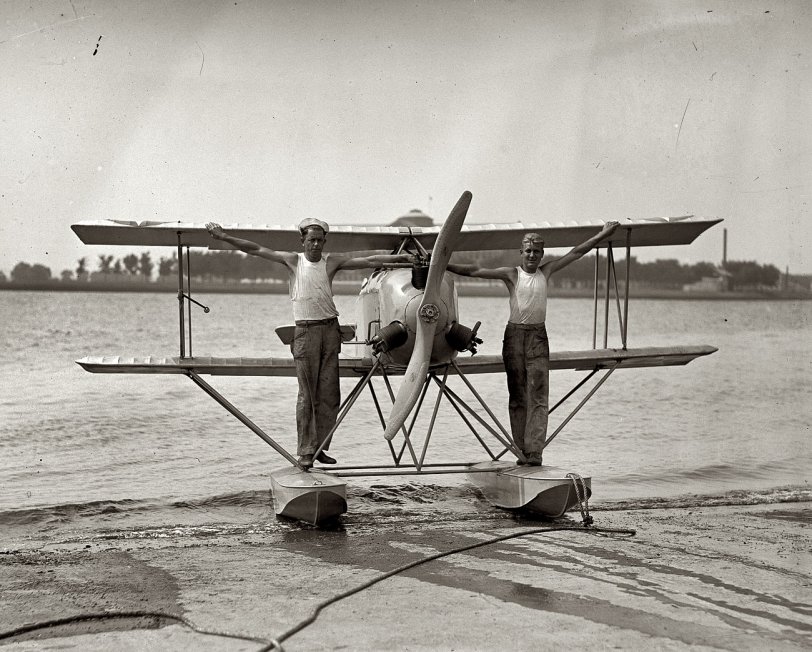
For Dave
Can you note that the comment Parnall Peto refers to the British sub photo that you posted. The Parnall was British and is the Acft in that photo. The subject photo is the Cox-Klemin XS-1 (because of the 3-cylinder engine.)

Parnall Peto
That's a Parnall Peto, built by George Parnall and Company, Ltd.
Cox-Klemin XS-1
Or XS-2, depending on the engine. They both competed in trials during 1926 with the very similar Martin MS-1, before the Navy eventually decided to drop the whole idea.
Submarines
One old adage that I remember came from a friend who was in the submarine service: "There's only two kinds of ships in the Navy-submarines and targets."
Sub Plane
That raises the perhaps stupid question of how the submarine plane was designed and fitted out in order to be submerged? As in strapped on the deck while underwater. Looking at the photo, it seems much of that mini floatplane could be assembled and disassembled readily. And placed in a waterproof chamber perhaps? My father was a WWII submariner, a torpedo man on the USS Raton. Didn't talk about it all that much. But his South Pacific shore leave stories were hilarious.
[Click the photo below. - Dave]
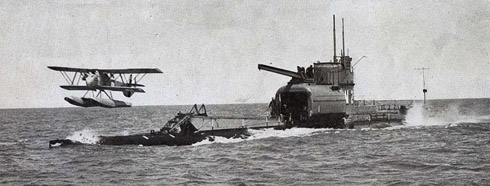
Submarine plane?
Submarine plane...? Hope that name didn't reflect on its ability to stay in the air, and not under water. More likely just another one of those off-the-cuff descriptive titles that didn't last as long as its subject did.
[It's a floatplane that could be launched from a submarine. Who can identify it ... Caspar-Heinkel U-1? - Dave]
 Shorpy.com is a vintage photography site featuring thousands of high-definition images. The site is named after Shorpy Higginbotham, a teenage coal miner who lived 100 years ago. Contact us | Privacy policy | Accessibility Statement | Site © 2024 Shorpy Inc.

On Shorpy:
Today’s Top 5