


Framed or unframed, desk size to sofa size, printed by us in Arizona and Alabama since 2007. Explore now.
Shorpy is funded by you. Patreon contributors get an ad-free experience.
Learn more.



- Side Winder
- Air Quality?
- Sojourner Truth riot
- None were so blind(ed)
- The less famous sister
- Good ol' days?
- Rise and Fall
- Goo Goo Ga Joob
- Ticket Retention
- Not the only one
- Vagaries of War
- Killed by Amtrak
- Back to the Future
- Wanted --
- If you can't stand the light
- Centralized Traffic Control, I believe
- What's really happening
- Heckuva remote control!
- Sometimes — Things Go Bump!
- I SEE THE LIGHT
- Union Switch and Signal Company
- Get That Light Out Of My Eyes
- Eggs. Eggs. Eggs. The Egg Man is Here!
- Foreboding caption
- Famous Hollywood faces
- Not just S&P
- re: Those things in the jar
- Up In Smoke
- Medical Smoking
- Quick fix

Photos submitted by Shorpy members!
Print Emporium






Not a Cloud in the Sky: 1942
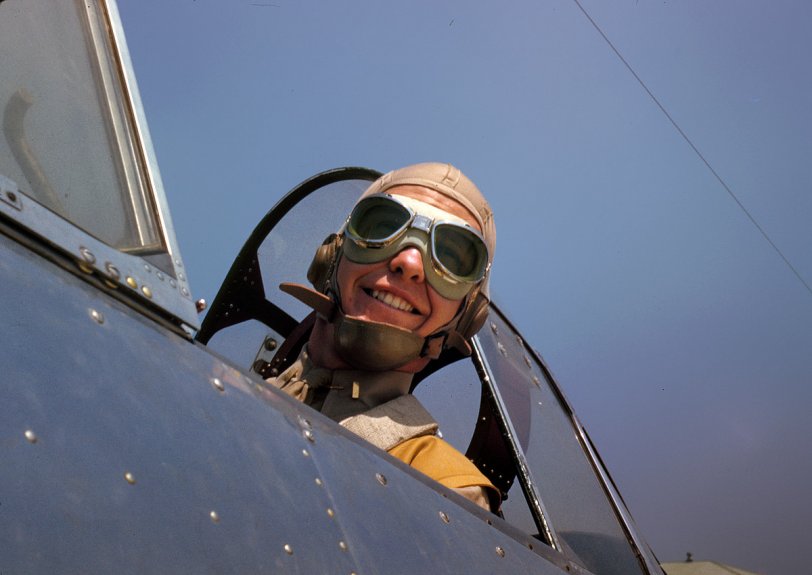
May 1942. Parris Island, South Carolina. "Marine lieutenant glider pilot in training at Page Field." A smilier version of the airman seen here. 35mm Kodachrome transparency by Alfred Palmer, Office of War Information. View full size.
An obscure chapter of Parris Island history
The BT-13 has a triangular window aft of the rear canopy; this one doesn't. Compare to this BT-13 http://ww2db.com/image.php?image_id=3768
The picture is probably an SNJ (Navy/Marines version of North American AT-6). Here's a whole string of photos from that time and place including the same guy http://www.flickr.com/photos/library_of_congress/2179093655/in/set-72157...
The Marine Corps Glider Group 71 was an unusual experiment for the Marines. After watching the Germans take Holland in 1940 with gliders, the Marines thought some catching up was in order, so they set up a glider training group at Parris Island in 1942. After a year, it was shut down when they realized it would not be effective in the Pacific theatre against the Japanese. Today Page Field is thick with vegetation and no longer has aircraft, but is used as a training ground for Marine recruits. Each Marine must pass a greuling multi-day combat trial at Page Field known as "The Crucible" in order to become a US Marine.

 Shorpy.com is a vintage photography site featuring thousands of high-definition images. The site is named after Shorpy Higginbotham, a teenage coal miner who lived 100 years ago. Contact us | Privacy policy | Accessibility Statement | Site © 2024 Shorpy Inc.

On Shorpy:
Today’s Top 5