



Framed or unframed, desk size to sofa size, printed by us in Arizona and Alabama since 2007. Explore now.
Shorpy is funded by you. Patreon contributors get an ad-free experience.
Learn more.



- Details, Details
- What's that building to the left of the tower?
- Coal Barges
- Bromo-Seltzer
- Inner harbor
- The Basin
- What a headache!
- Giant stepladder?
- Baldwin 62303
- Baldwin VO-1000
- Cold
- No expense spared
- Tough Guys
- Lost in Toyland
- And without gloves
- If I were a blindfolded time traveler
- Smoke Consumer Also Cooks
- Oh that stove!
- Possibly still there?
- What?!?
- $100 Reward
- Freeze Frame
- Texas Flyer wanted
- Just a Year Too Soon
- WWII -- Replacing men with women at the railroad crossing.
- Yes, Icing
- You kids drive me nuts!
- NOT An Easy Job
- I wonder
- Just add window boxes

Photos submitted by Shorpy members!
Print Emporium

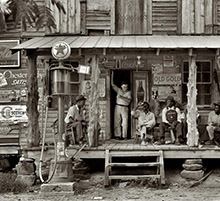

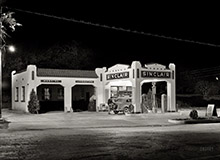




Triangle Service Station: 1925
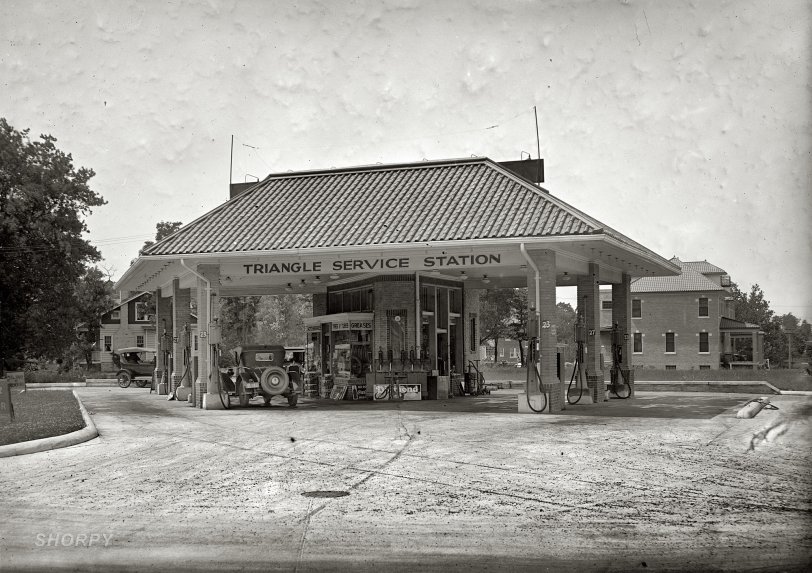
1925. The Triangle Service Station in Arlington, Virginia, at Mount Vernon Avenue and Military Road. View full size. National Photo Company Collection.
Gas Station
Rare Spanish Colonial Survives
http://www.curatorofshit.com/2010/05/03/gas-station-architecture-dies-he...

Roof tiles
I live about half a mile south of where this service station used to be, in the Del Ray neighborhood e*c mentions in his comment. If the indicated location is correct, none of the adjacent homes survived I'm afraid.
Very interesting architectural details though - take for instance the clay tile roofs on the station and the homes in the background - you won't find those anywhere anymore today. I'm also surprised to see that again both the service station as well as the homes already have K-style gutters mounted all around. I always thought that those were added decades later.
The home in background on the right has somewhat odd decorative keystones built-in around the windows. Can't say I've seen those before either. And did you notice all the open windows? No AC in 1925 and judging by the grass and foliage it's late spring or early summer...
Triangle Service
Mount Vernon Avenue and Glebe Road intersect here in Alexandria. There's a car wash on the corner now, but houses like the one in the photo are very common farther down Mount Vernon into the DelRay neighborhood.
Military & Mount Vernon
At present, Military Road and Mount Vernon Drive aren't even vaguely near each other. It is of course possible that road renaming has eliminated the intersection, but I haven't had any success in locating this one.
[Sections of Glebe Road were at one time also called the Military Road. Back before route markers and street signs became common, what a road was called often depended on who you asked or whose map you were using. - Dave]
Triangle Service Station
According to a 1931 display ad in the Washington Post, the Triangle Service Station (Esso) was in Arlington ("South Washington") at Mount Vernon Avenue and Military Road.
Service Station
It appears the road was recently re-asphalted what with dark pebbles on the entry apron. But the question for anyone who might have knowledge, what do the numbers 23 and 27 on the gas pump columns signify? Perhaps an earlier measure of octane, or simply the price at each pump? In any case, there does seem to be some sort of differentiation in the fuels.
[They mean 23 and 27 cents per gallon. - Dave]
Re: Antenna
In those days, even normal broadcast (medium wave) radios commonly used an outdoor random-wire antenna. Loop type antennas that were contained totally within the radio hadn't been invented yet.
23, 27
Why are there numbers 23 and 27 on the pumps? Were those early octane ratings, or prices for regular and premium (called high-test in those days)?
And, I think Triangle later merged with Cities Service, later Citgo.
Pumps?
Does anyone know what those gas-tank-looking things in the center behind the "Diamond" sign are?
[Lube carts -- mobile motor oil pumps that could be wheeled over to your car. - Dave]
 Shorpy.com is a vintage photography site featuring thousands of high-definition images. The site is named after Shorpy Higginbotham, a teenage coal miner who lived 100 years ago. Contact us | Privacy policy | Accessibility Statement | Site © 2024 Shorpy Inc.
On Shorpy:
Today’s Top 5