


Framed or unframed, desk size to sofa size, printed by us in Arizona and Alabama since 2007. Explore now.
Shorpy is funded by you. Patreon contributors get an ad-free experience.
Learn more.




- Details, Details
- What's that building to the left of the tower?
- Coal Barges
- Bromo-Seltzer
- Inner harbor
- The Basin
- What a headache!
- Giant stepladder?
- Baldwin 62303
- Baldwin VO-1000
- Cold
- No expense spared
- Tough Guys
- Lost in Toyland
- And without gloves
- If I were a blindfolded time traveler
- Smoke Consumer Also Cooks
- Oh that stove!
- Possibly still there?
- What?!?
- $100 Reward
- Freeze Frame
- Texas Flyer wanted
- Just a Year Too Soon
- WWII -- Replacing men with women at the railroad crossing.
- Yes, Icing
- You kids drive me nuts!
- NOT An Easy Job
- I wonder
- Just add window boxes

Photos submitted by Shorpy members!
Print Emporium






The Home of Low Prices: 1920
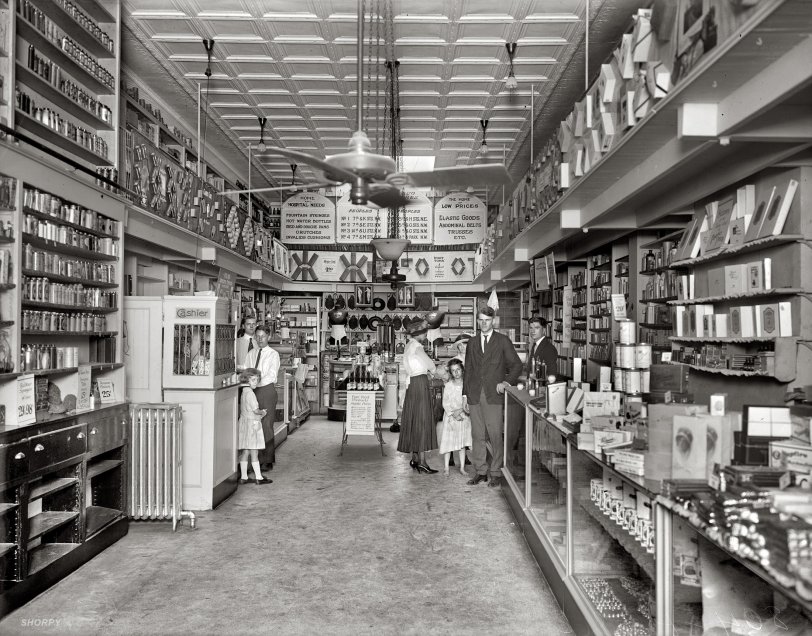
Washington, D.C., 1920 or 1921. "People's Drug Store, interior, 804 H Street N.E." View full size. National Photo Company Collection glass negative.
Those were the days!
I grew up in the D.C. area. When I was 7 we moved to Suitland, Maryland. There was the local People's Drug Store on the corner of Suitland Road and Huron Avenue. In the early '70s I'd sit at the food counter, order a burger and a shake and read the magazines. Everyone in the Suitland store knew my dad including the pharmacist. Everyone called the pharmacist "Doc." Back in those days I believe the pharmacist was actually the store manager. I'd go in and looking around and check out the new K-Tel albums. If I didn't have the money, I'd take it back to Doc and he'd say go ahead, take it home, he'd get the money from my dad later. Those were the good old days. It is amazing, I remember always wanting to grow up and get away, and now I am 47 and all I want is to go back to simpler times.

The standing woman
is so lovely and a picture of grace. I want that outfit right down to the hat!
Yes, Strychnine
While we primarily know strychnine as a poison, in small doses - such as you'd probably find in Hypo-Cod - it was both a stimulant and a laxative. In fact it was one of the first performance enhancing drugs in sports. I seem to recall reading that many runners in the 1896 Olympic Marathon drank water laced with strychnine to improve their performance over the distance.
WOW
What an awesome picture! I am fascinated by a foregone era...
[Let foregones be foregones, I always say. - Dave]
Radiators, tires and douchebags?
That radiator brings me back! My school had them all over the building. Just like the one in the pic, they were painted with silver metallic lead paint which dried and chipped.
Oh, and those "tractor tires" right next to the douchebags are hemorrhoid cushions. They are still sold to this day.
People's Drug
Back in the 80's (1980's), I used to work for this company in the advertising department. All the illustrations for the ads were done by hand. No scanners.
People's sold nearly everything. But the inner tubes are not what you think.
By the way, spilling perfume in a copier turns out to be a really bad thing.
Trusses and radiators
For the young whippersnappers on Shorpy, one does not hear about 'trusses' much these days because people have simple surgeries to correct their hernias. Previously, hernias were held in with tight, binding support belts or girdle-like wraps. As for that beautiful radiator, I just read in a home renovation magazine that after years of being thrown in the landfills, these radiators are highly sought-after and are bringing high prices to be freshly painted and used as architectural art to add interest to bland rooms. I grew up with radiators in every room, some were very elaborate, some rather plain. Some people thought they were eyesores and spoiled the decor and yet it seems they will be future art treasures. Who knew?
Flatfooted
The little barefoot girl looks like she could use some Foot-tona.
I love how they built the catwalks around the store for extra display and storage. But it's odd that the bottom shelves of the unit at the left are empty and quite dusty.
1, 2, 3 Douche Pans
I can't even imagine how they controlled their inventory at the end of a month/quarter. I used to work for a video store and once a month we'd have to scan everything in the store to see what might have been stolen. We'd have to start at midnight and finish up before the store opened the next morning. We had laser scanners and computers and everything was bar coded. In the time of this drugstore, the employees really had to know their product.
On a side note, I keep seeing the sign inthis photo as saying "Hypno Cod" instead of "Hypo Cod." Of course, neither makes much sense to me.
Hypo-Cod: now with strychnine!
Washington Post, Mar 16, 1919
The last carload of Hypo-Cod from Wheeling, the home of the nationally known Earle Chemical Company, arrived in Washington for People's Drug Stores just about a month ago, and to date over 15,000 bottles have been shipped to this firm alone. Another carload is ordered.
Doctors and thousands of users in Washington acknowledge that it is by far the finest tonic and builder after sickness. At one sweep it has taken the place of older and once famous remedies....
Earle's Hypo-Cod first of all, contains extractives from fresh cod livers freed of the fishy taste found in emulsions. It is pleasant to take, and everybody knows that cherry bark and cod liver oil are good for bronchial, catarrhal, pulmonary colds and coughs, chest soreness, weak lungs. In addition, Earle's Hypo-Cod contains malt extract, which is a fine building food. Extra select sherry wine is used.... Then into this remarkable preparation the chemists have put the compound syrup of hypophosphites, lime, potassium, manganese, iron, strychnine, quinine and sodium....
Lost it
This photo has actually generated drug store business today. I have to leave the site and go buy my first box of Depends after reading the lawn mower parts comment. I thought I'd seen the best/worst of them but this remark just made me "lose it". Thanks Dave, that laugh was the best I've had in years.
[Already I am envisioning a Shorpy-branded line of plastic chair protectors. - Dave]
Five of Eight
Is it reasonable to assume from the list in back that that we are in store #5? That #6 is near 5th and G NW? That #7 is 11th and G NW? That #8 is 14th and Park NW?
That the girl in shoes and socks is a lot happier to be here than the poor thing who's barefoot and disheveled? Maybe she's getting Hypo-Cod.
The packages spelling out "Foot" around the Foot-Tona were quite clever.
Barefoot ?
Does the little girl on the right side seem... off, like she just appeared out of nowhere -- barefoot in a downtown drugstore -- especially when you look at the other little girl, on the left side?
Fort Knox?
Why is the cashier behind bars? I would have thought that this style of cashier was more from today’s Stop and Go’s than from the 1920’s. When I was growing up the local corner store had lots of items in the back of the store and the one store owner went in the back while everyone was left alone in the front of the store. The siege mentality of store owners and shoplifting patrons did not seem to be an issue. You trusted each other and most people where trustworthy. As I grew up the crime rate went up and most people locked up everything when they were not home. Now I lock my doors while I am home and practically get an MRI while leaving the local store. Just goes to show that sometimes our memory of the simpler times of yesteryear may not have existed the way we remember.
Talcum Powder
Obviously, in those pre-airconditioning days, talcum powder was a huge deal. I spy a Whitman's Sampler on the lower right counter. Are they spelling out something with those Hershey's Kisses in the display underneath? I love this photo.
A Riding Mower, Maybe
No, these are for sitting on, then again I guess they could have a dual purpose if they had garden tractors back during this period.
Douche Pans!
Did that word mean the same thing back then as it does now?
["Pans"? - Dave]
Lawn mower parts in the drug store?
Center, rear. On the shelves at the back of the store. Inner tubes for the garden tractor?
[No gardening jobs for you! - Dave]
 Shorpy.com is a vintage photography site featuring thousands of high-definition images. The site is named after Shorpy Higginbotham, a teenage coal miner who lived 100 years ago. Contact us | Privacy policy | Accessibility Statement | Site © 2024 Shorpy Inc.
On Shorpy:
Today’s Top 5