


Framed or unframed, desk size to sofa size, printed by us in Arizona and Alabama since 2007. Explore now.
Shorpy is funded by you. Patreon contributors get an ad-free experience.
Learn more.



- Details, Details
- What's that building to the left of the tower?
- Coal Barges
- Bromo-Seltzer
- Inner harbor
- The Basin
- What a headache!
- Giant stepladder?
- Baldwin 62303
- Baldwin VO-1000
- Cold
- No expense spared
- Tough Guys
- Lost in Toyland
- And without gloves
- If I were a blindfolded time traveler
- Smoke Consumer Also Cooks
- Oh that stove!
- Possibly still there?
- What?!?
- $100 Reward
- Freeze Frame
- Texas Flyer wanted
- Just a Year Too Soon
- WWII -- Replacing men with women at the railroad crossing.
- Yes, Icing
- You kids drive me nuts!
- NOT An Easy Job
- I wonder
- Just add window boxes
Photos submitted by Shorpy members!
Print Emporium



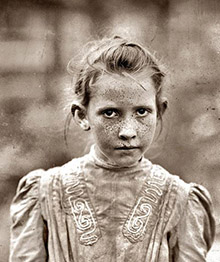
Cimarron: 1936
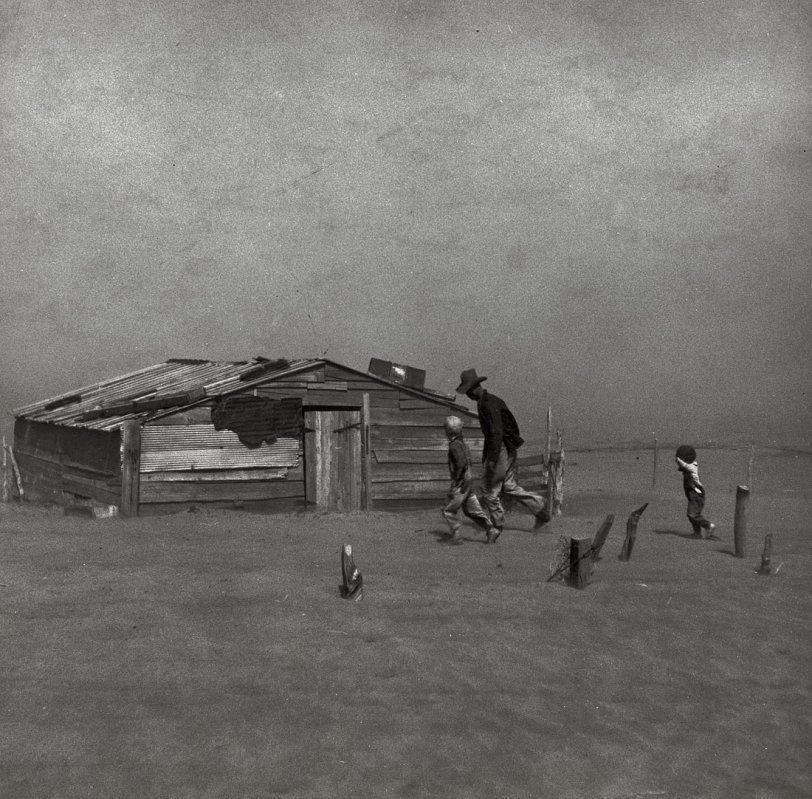
April 1936. "Farmer and sons walking in the face of a dust storm. Cimarron County, Oklahoma." Perhaps Arthur Rothstein's best known Dust Bowl image, and overall one of most memorable photographs to come out of the entire FSA/OWI program. Gelatin silver print by Arthur Rothstein. View full size.
Art in Hard Times
Funny that you think Democrats are whiners. Sis Cunningham, who wrote that great song, was about as lefty as you could get -- labor-organizer and founder of the agitprop Red Dust Players in Oklahoma, until she fled anti-Communist harassment and went to NYC to live with Seeger and Guthrie. Steinbeck was in the same boat (as were probably these photographers) and of course Springsteen, the great American blue-collar balladeer.
Hard to create great art unless you sympathize strongly with the human condition... but maybe you consider writing or singing about hard times to be whining.
Beautiful images. Very happy to find them.

1930s dust storms
The pictures take me back to the Texas panhandle in those days. I recall it vividly. Our school had no electric lights, no indoor plumbing. When the dust storms rolled in, they sent the kids home...walking in the dark. We tied a handkerchief over our noses. Dust seeped into the houses even though doors and windows were closed. Money was scarce and unemployment was very high. It was a hard time but it made us stronger. It helped prepare us for World War II.
Today, I am amused at the whiners (usually Democrats) who think times are bad. What wimps they are.
Comical
Nothing more laughable to me than Bruce Springsteen singing about Oklahoma hard times. Yeah, that's a good one alright.
My Oklahoma Home
Bruce Springsteen got to the heart of the Dust Bowl era with his version of "My Oklahoma Home (It Blowed Away)," written by Oklahoma-born political activist "Sis" Cunningham and her brother Bill.
Steinbeck's Prose
But it sounds like poetry (one short excerpt from "The Grapes of Wrath"
When the night came again, it was black night, for the stars could not pierce the dust to get down, and the window lights could not even spread beyond their own yards. Now the dust was evenly mixed with the air, an emulsion of dust and air. Houses were shut tight and cloth wedged around doors and windows, but the dust came in so thinly that it could not be seen in the air, and it settled like pollen on the chairs and tables, on the dishes. The people brushed it from their shoulders. Little lines of dust lay at the door sills.
Hard Times
Egan's "The Worst Hard Times" is a must read if you really want to understand the past and, more important, learn from their lessons what we should not be doing now. So glad to find a fellow reader. Thanks, Dave. It was your photos and the NYT review that prompted me to find out more.
Depression Reading
The best book I've come across dealing with the Dust Bowl and the incredibly durable Americans who stayed put through the Depression is called "The Worst Hard Time: The Untold Story of Those Who Survived the Great American Dust Bowl" by Timothy Egan. He discusses the causes of the Dust Bowl, going back to the 19th century, as well as descriptions of life in the Dust Bowl states. A truly compelling read. NY Times review.
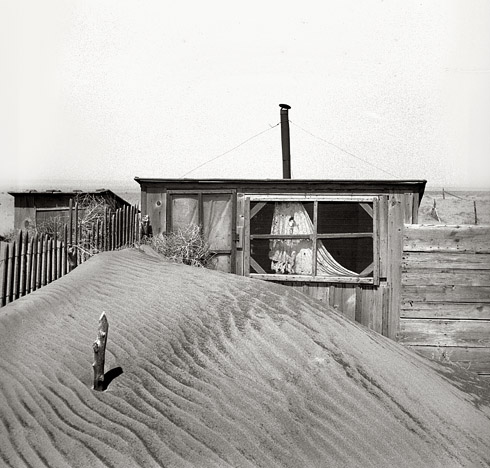
Sand dunes
Is the house that low, or is it actually buried in sand? Looking at what I assume are fence posts in front, I guess it is buried, but it's hard to believe that much sand can be blown.
[That's a shed, not a house. Below: Nearby dune, outhouse, farmhouses. - Dave]

Bad times
I'm probably stating the obvious, but how could the Dad leave that little guy tagging way behind?! 'Nuff said: That was a terrible time in the 20th century - ruined so many lives!
[It's not like they're running for their lives or anything. It's one of dozens of pics of these folks standing around and walking in the dust. The little boy is the one shown here. - Dave]
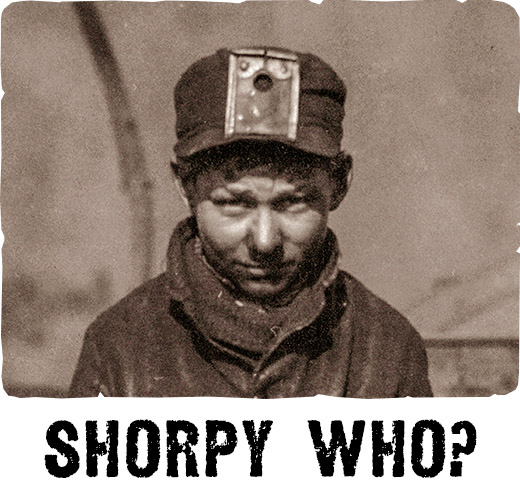
 Shorpy.com is a vintage photography site featuring thousands of high-definition images. The site is named after Shorpy Higginbotham, a teenage coal miner who lived 100 years ago. Contact us | Privacy policy | Accessibility Statement | Site © 2024 Shorpy Inc.

On Shorpy:
Today’s Top 5