


Framed or unframed, desk size to sofa size, printed by us in Arizona and Alabama since 2007. Explore now.
Shorpy is funded by you. Patreon contributors get an ad-free experience.
Learn more.



- What a headache!
- Baldwin 62303
- Baldwin VO-1000
- Cold
- No expense spared
- Tough Guys
- Lost in Toyland
- And without gloves
- If I were a blindfolded time traveler
- Smoke Consumer Also Cooks
- Oh that stove!
- Possibly still there?
- What?!?
- $100 Reward
- Freeze Frame
- Texas Flyer wanted
- Just a Year Too Soon
- WWII -- Replacing men with women at the railroad crossing.
- Yes, Icing
- You kids drive me nuts!
- NOT An Easy Job
- I wonder
- Just add window boxes
- Icing Platform?
- Indiana Harbor Belt abides
- Freezing haze
- Corrections (for those who care)
- C&NW at Nelson
- Fallen Flags
- A dangerous job made worse

Photos submitted by Shorpy members!
Print Emporium
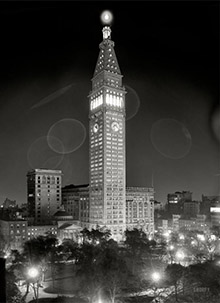
Night Train: 1943
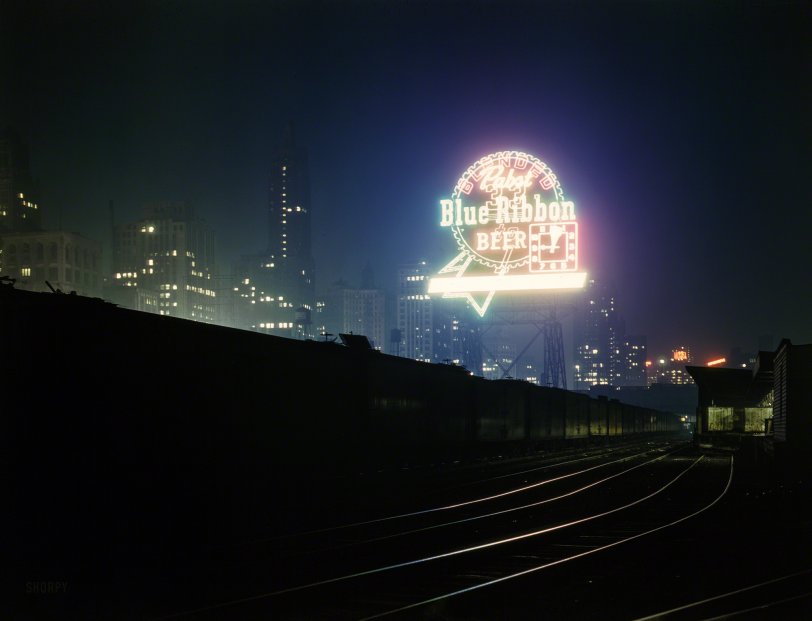
One of our first posts 10 years ago, enlarged and re-restored.
April 1943. "Illinois Central R.R. freight cars in South Water Street terminal, Chicago." Judging by the clock, this was a five-minute time exposure. Kodachrome transparency by Jack Delano for the Office of War Information. View full size.
Millennium Park
Today the yard is long gone and this area is now part of Grant Park, with this northwest corner specifically called Millennium Park. Most people have seen photos of the primary exhibit in this part of the park known as Cloud Gate. It is made up of very smooth rounded art shapes with a mirrored surface, and is quite popular not only with kids but also with photographers.

Bit late for the response but...
You very much can do long exposures with digital. I'm a photographer myself, and thats one of my favorite 'things' to do.
The reason you'd want a long exposure usually is because high ISO ratings introduce grain and generally degrade in quality. With newer cameras, this is becoming less and less of an issue. The brand I shoot with recently introduced a camera capable of ISO 819,200 which in layman's terms is 'pretty freakin' insane.'
Kodachrome
This is the original Kodachrome (the only one made in 4x5 and sheet film sizes) which would be ISO 10 although it was not labeled as such because they didn't have the ISO system then. Kodachrome II was ASA 25 and was released in 1961.
I love these images. I show them to people and when I say it's from 1942 their jaws drop. It just shows you how much we have regressed since then. The fact that no mass produced digital technology can come close to replicating a 79 year old technology is just sad. I'm going to try out 4x5 color printing and I honestly can't wait.
Silly Q
Can you do long exposures with digital? Is it necessary? Will you get better/higher definition like what we see here?
["Definition" doesn't have anything to do with exposure time. Resolution depends on the number of elements (pixels) in the image sensor. To shoot digital images with resolution comparable to the large-format Kodachromes and glass negatives seen here you could use a studio back like the Sinar 75H (33 megapixel sensor, image size 68 to 260 mb). Which, not coincidentally, is also the equipment used to image these very same Kodachromes and glass negatives. - Dave]
World's largest sign?
Wasn't this the world's largest neon sign at the time? I think my father said it was.
Being there
I have never seen so many beautiful photographs from the 1940s that are on your site, thank you. The clarity and colour of the images is remarkable it is just like you are standing there in person it's very surreal.
Jack Delano photos
This entire series of photos, including the non-rail, is one of the best things I've ever seen on the internet. Thankyou -all, for posting them!!
Kodachrome
Although standards for film speed varied [no ASA, no ISO but Kodak, Weston, etc] Kodachrome was what we'd think of as 8 to 10. By the sunny 16 rule that's 1/10 second at f16, so hold really still, and if it's not sunny, hold reeealllly still. It was available, as noted, in 4x5, truly awesome, up to 8x10, and in 35mm and 828. 828 was a paper-backed roll film that was 35mm wide but unperforated, so a larger picture area than a 35mm frame. Thus Kodachromes from the 40s are true treasures - it took lots of light and that meant big multiple flashes [bulbs] or long exposures. The permanence of Kodachrome is why we can see these images now, when other pre-E-6 process images have faded away. Now Kodachrome's time seems to be up, and too bad. When the CDs with digital pics have faded or no machines exist to translate them, Kodachrome images will be good enough to toss on the light table or hold up to the window and enjoy.
Pabst Sign
Pabst beer was the king on the East Coast back then, before Bud's big adverts.
Beautiful :^) A 5 minute
Beautiful :^)
A 5 minute exposure and this was taken in 1943. Maybe ISO 25 film or lower?
 Shorpy.com is a vintage photography site featuring thousands of high-definition images. The site is named after Shorpy Higginbotham, a teenage coal miner who lived 100 years ago. Contact us | Privacy policy | Accessibility Statement | Site © 2024 Shorpy Inc.
On Shorpy:
Today’s Top 5